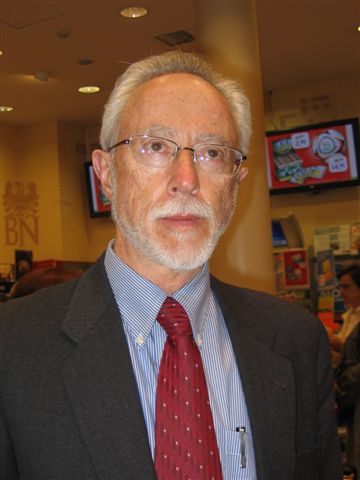
J. M. Coetzee was born in Cape Town in 1940. His father's line traced back to seventeenth-century Dutch settlers; his mother's was Dutch, German, and Polish. In his early twenties he worked as a programmer in England, then took a doctoral degree in English at the University of Texas at Austin. He taught at SUNY Buffalo from 1968 to 1971, returned to the University of Cape Town, and in 2002 settled in Adelaide, Australia. He is also a translator of Dutch and Afrikaans texts.
His novels are short, spare, and morally demanding. A single consciousness is placed in a position where no clean answer exists: a magistrate watching a colonial frontier in Waiting for the Barbarians, a gardener who withdraws from society in Life & Times of Michael K, a disgraced professor in Disgrace. The prose is plain, the sentences often short, and the narrative refuses to resolve the ethical knot it has tied. He has also written in non-fictional and memoir modes, including Boyhood and Youth.
Life & Times of Michael K took the Booker Prize in 1983. Disgrace won the same award in 1999, making him the first author to hold two Bookers. The Nobel Prize in Literature followed in 2003; the Swedish Academy's citation singled out his rendering of "the surprising involvement of the outsider."
For a first Coetzee, start with Disgrace. The premise is immediate: a university professor in post-apartheid South Africa goes to live on his daughter's farm after a scandal, and a violent attack on her resets the power between them. The sentences stay plain, the questions stay hard, and the novel ends without a verdict. It is the tightest of his books, and if it grips you, Life & Times of Michael K is a natural next read.