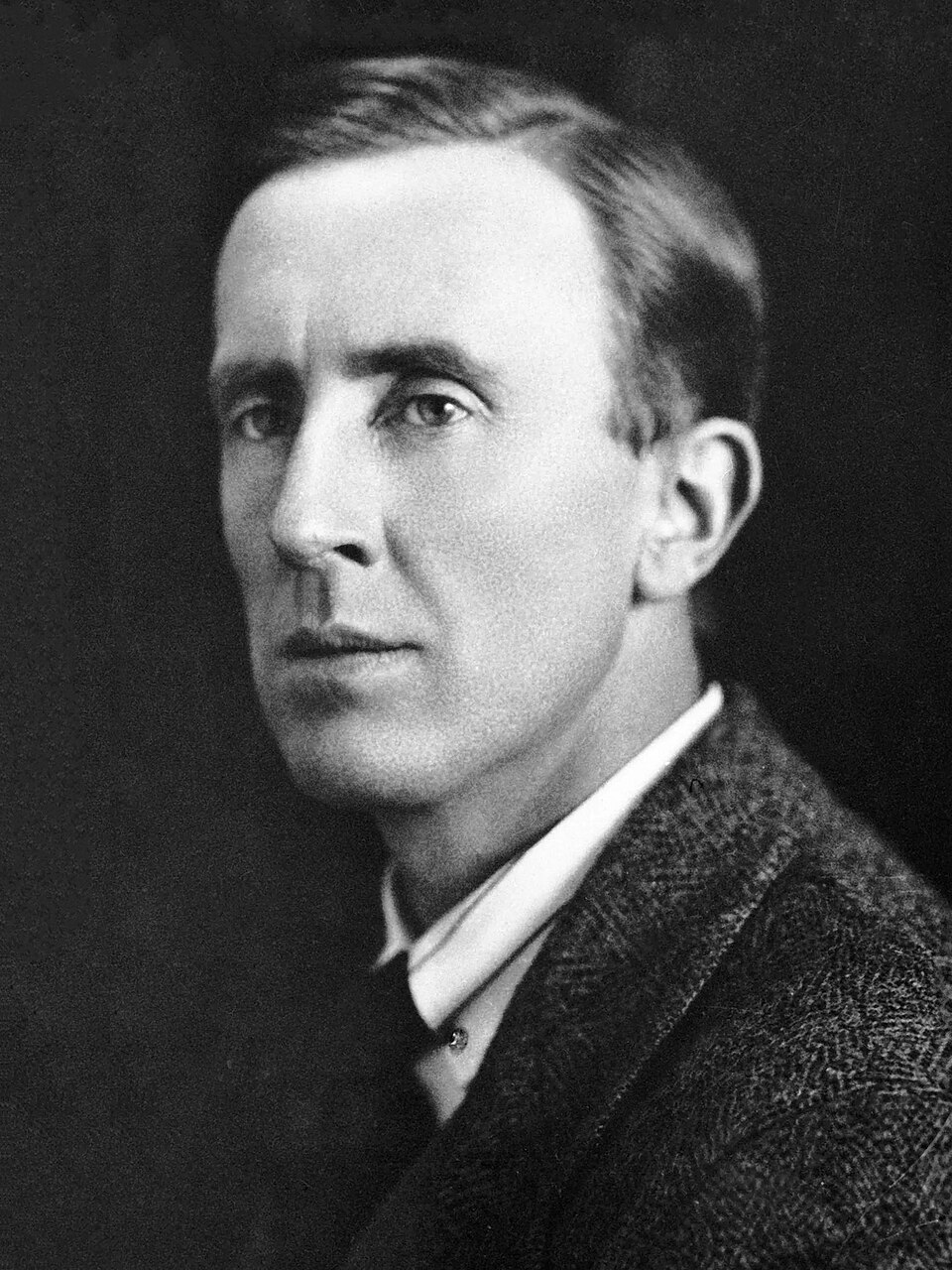
Photo of J.R.R. Tolkien
Photo: Wikimedia Commons contributor · Public domain · via source

Author profile

J.R.R. Tolkien

English writer and Oxford philologist (1892-1973) who created Middle-earth in The Hobbit and The Lord of the Rings. The Silmarillion, edited by his son Christopher, gathers his mythic tales of that invented world, published after his death.

1 published book 0 published articles

About J.R.R. Tolkien

John Ronald Reuel Tolkien was born in Bloemfontein, in present-day South Africa, on 3 January 1892 and died in Bournemouth on 2 September 1973. He worked at Oxford for decades: Rawlinson and Bosworth Professor of Anglo-Saxon from 1925 to 1945, then Merton Professor of English Language and Literature until 1959. His 1936 British Academy lecture on Beowulf, "The Monsters and the Critics," is still treated as a landmark in the study of that poem.

He wrote fantasy as a scholar of old languages and old stories would. Britannica calls his two best-known books richly inventive fantasy epics, and the genre label that fits The Silmarillion best is mythopoeia, the deliberate making of a mythology. The Silmarillion is not a novel. It is a set of legendary tales set in Arda, his invented world.

The Hobbit appeared in 1937 and The Lord of the Rings in 1954 and 1955. Peter Jackson's film versions of the second began in 2001 and ended in 2003. Tolkien never finished The Silmarillion in his lifetime. His son Christopher edited it, with help from Guy Gavriel Kay, who later became a fantasy novelist, and it was published on 15 September 1977.

A new reader should begin with The Hobbit, which is the shortest and most direct way into Middle-earth, and then go on to The Lord of the Rings. The Silmarillion is best saved for the point where you want more of the world's history and are happy to read a chronicle of myths. It rewards that patience.

Published books

Author

The Silmarillion

The Silmarillion is J.R.R. Tolkien's mythic history of the world that later holds Middle-earth. It runs from a cosmic act of creation, through the long wars of the First Age, to the drowning of Númenor and the forging of the Rings. Christopher Tolkien assembled and edited it after his father's death. It reads less like a novel than like a chronicle of divine powers, Elves, and mortal Men, driven by the fate of three radiant jewels and the ambition of one rebellious power. It is a foundation stone of modern epic fantasy. Readers looking for books like The Lord of the Rings will find the deep background to that story here, in a graver and more elevated voice. This profile describes the 1979 Ballantine paperback printing.

View book