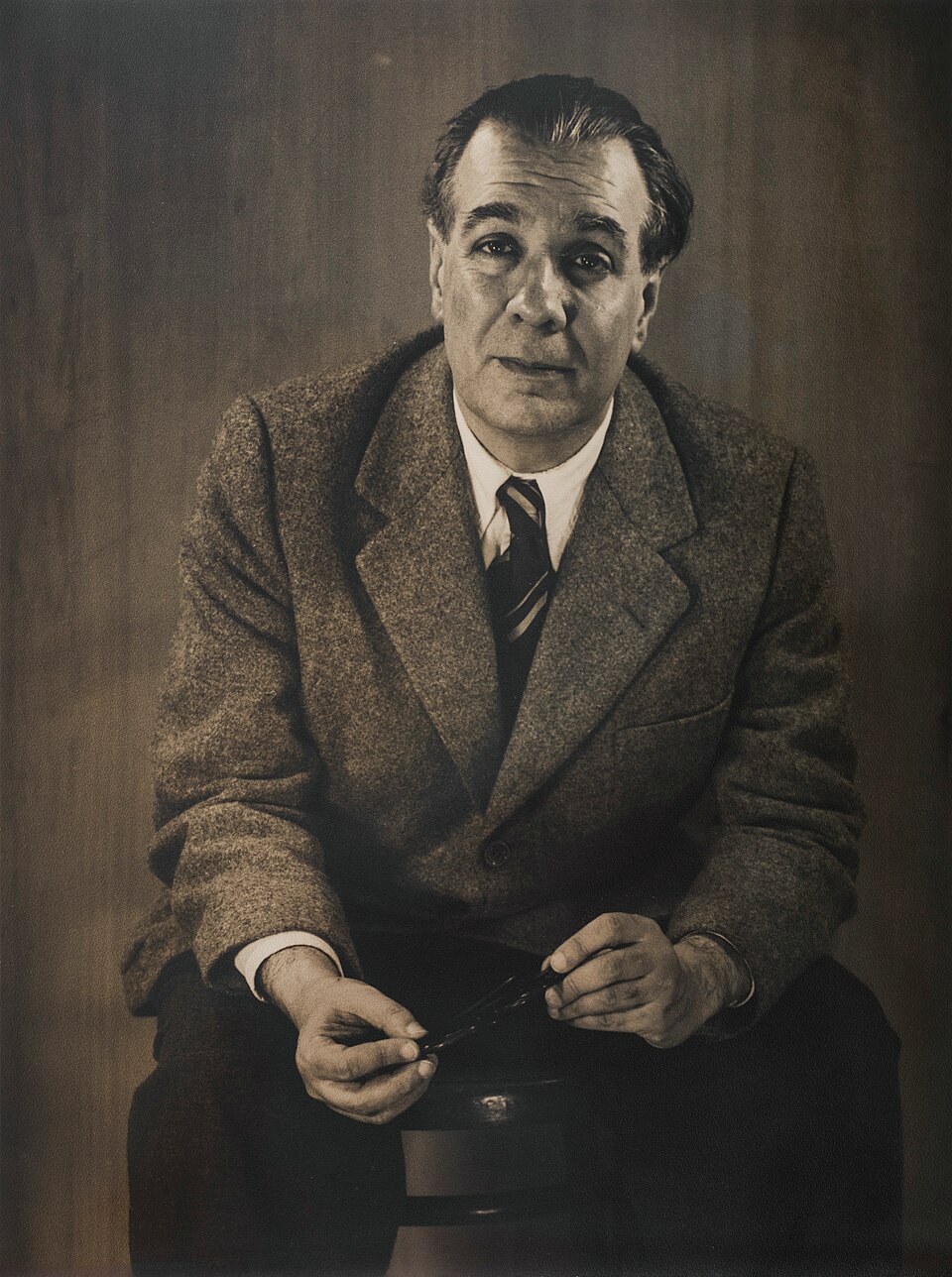
Photo of Jorge Luis Borges
Photo: Grete Stern · Public domain · via source

Author profile

Jorge Luis Borges

Argentine poet, essayist and short-story writer (1899–1986). His compact, fantastical stories, collected in Ficciones and The Aleph, made him one of the most influential Spanish-language authors of the twentieth century.

1 published book 0 published articles

About Jorge Luis Borges

Jorge Luis Borges was born in Buenos Aires in 1899 and schooled in Switzerland. He knew early that he would be a writer. A hereditary blindness crept up on him from the 1920s and was total by the middle of the 1950s, so he turned to dictation and gave up long texts. From 1955 he directed Argentina's National Library, a post he left in 1973 when Perón returned to power. He died in Geneva in 1986.

He wrote poems, essays and short stories, and the stories are what most readers come for. Much of his work is fantasy and metaphorical allegory, packed into a few pages rather than spread over a novel.

Ficciones (1944) won him an international following, and The Aleph followed in 1949. In 1961 he shared the first International Publishers' Prize, the Prix Formentor, with Samuel Beckett. The prize drew English-language readers to a writer who had barely been translated. Later he shared the Cervantes Prize with the poet Gerardo Diego. The Nobel Prize never came, a fact his admirers have often held against it.

Start with Ficciones. It joins The Garden of Forking Paths, a collection of eight stories from 1941, to a newer section titled Artificios, so one volume covers the period that made his name. The Grove edition on WebToTell carries Anthony Kerrigan's translation and an introduction by John Sturrock. If it hooks you, The Aleph is the natural next step.

Published books

Author

Ficciones

Ficciones is Jorge Luis Borges's best-known book, a compact set of tales that turned philosophical puzzles into fiction. A secret encyclopedia leaks an invented planet into the real world. A minor author sets out to rewrite a famous novel word for word. A universe is imagined as an endless library, and a detective chases a killer through a geometry of clues. Borges often writes as a scholar, critic or witness rather than a conventional storyteller, and that choice shapes the whole book. Among short story collections, few have had so much influence on later writers worldwide. This Everyman's Library hardcover adds an introduction by John Sturrock and presents the stories in English.

View book