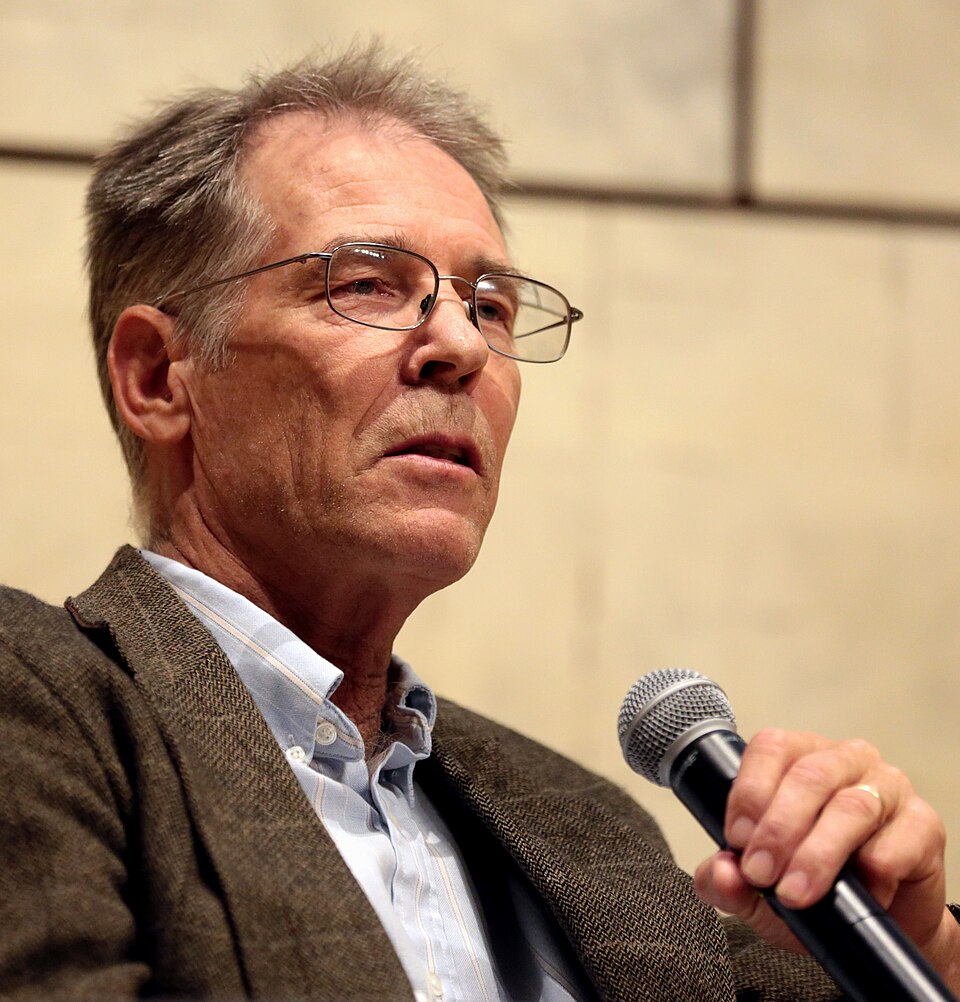
Photo of Kim Stanley Robinson
Photo: Gage Skidmore · CC BY-SA 3.0 · via source

Author profile

Kim Stanley Robinson

American science-fiction writer known for research-rich novels about climate, politics and humanity’s possible futures, including the Mars trilogy and The Ministry for the Future.

1 published book 0 published articles

About Kim Stanley Robinson

Kim Stanley Robinson is an American science-fiction writer whose career began in the 1980s. He is best known for the Mars trilogy, which follows the settlement and transformation of Mars across generations. His other major novels include The Years of Rice and Salt, 2312, Aurora and New York 2140.

Robinson writes speculative fiction grounded in scientific research, but technology is rarely his only concern. His books examine climate change, political institutions, economics and the practical work of building less destructive societies. He often treats the future as a contested process rather than a fixed utopia or dystopia, moving between individual lives and systems operating on a planetary scale.

His fiction has received the Hugo, Nebula and Locus awards. Red Mars won the Nebula Award for Best Novel, Green Mars won the Hugo Award for Best Novel, and 2312 won another Nebula. Beyond fiction, The High Sierra combines memoir, natural history and reflections on decades of travel through California’s Sierra Nevada.

For a first encounter, choose The Ministry for the Future. Its harrowing opening follows an aid worker through a lethal heat wave in India; from there, the novel expands into a many-voiced account of finance, activism, diplomacy and climate intervention. It offers a direct route into Robinson’s central question: how might institutions change quickly enough to make a livable future possible?

Published books

Author

The Ministry for the Future

Kim Stanley Robinson’s near-future novel examines climate change as a crisis of institutions, economics, technology, justice, and collective action rather than as a single disaster with a single solution. It opens with a lethal heat wave in India, experienced by aid worker Frank May, and follows the psychological and political consequences of that catastrophe. A second central thread concerns Mary Murphy, the head of an international body informally called the Ministry for the Future, whose mandate is to represent future generations and living beings that lack political power in the present. The book gradually expands beyond Frank and Mary into a global systems narrative. It moves among central bankers, climate scientists, activists, refugees, lawyers, agricultural communities, engineers, political officials, and covert organizations. Conventional scenes are interspersed with testimony, reports, meeting notes, explanatory passages, dialogues, and nonhuman or conceptual voices. This co…

View book