
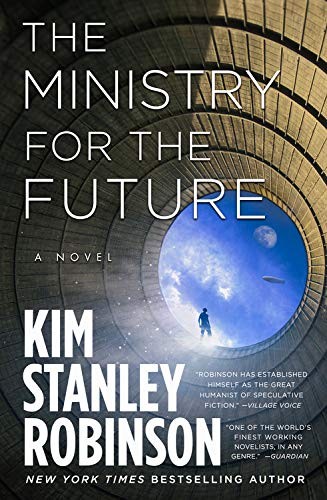
The Ministry for the Future
A Novel
Kim Stanley Robinson’s near-future novel examines climate change as a crisis of institutions, economics, technology, justice, and collective action rather than as a single disaster with a single solution. It opens with a lethal heat wave in India, experienced by aid worker Frank May, and follows the psychological and political consequences of that catastrophe. A second central thread concerns Mary Murphy, the head of an international body informally called the Ministry for the Future, whose mandate is to represent future generations and living beings that lack political power in the present. The book gradually expands beyond Frank and Mary into a global systems narrative. It moves among central bankers, climate scientists, activists, refugees, lawyers, agricultural communities, engineers, political officials, and covert organizations. Conventional scenes are interspersed with testimony, reports, meeting notes, explanatory passages, dialogues, and nonhuman or conceptual voices. This co…
Where to buy or borrow
Are you selling this book? Bookstores, publishers, authors and libraries can be listed here for free. Request a listing
About this book
The book gradually expands beyond Frank and Mary into a global systems narrative. It moves among central bankers, climate scientists, activists, refugees, lawyers, agricultural communities, engineers, political officials, and covert organizations. Conventional scenes are interspersed with testimony, reports, meeting notes, explanatory passages, dialogues, and nonhuman or conceptual voices. This collage-like construction allows Robinson to explore carbon pricing, monetary policy, geoengineering, land use, migration, infrastructure, cooperative ownership, ecological restoration, and political violence within one speculative history.
Rather than imagining that one invention or heroic leader rescues civilization, the novel presents change as an accumulation of imperfect measures pursued by institutions, movements, communities, and individuals with conflicting methods. Its central dramatic question is therefore not whether climate change exists, but whether societies can reorganize power and incentives quickly enough to preserve a habitable and more equitable world.
Deep Overview
The book gradually expands beyond Frank and Mary into a global systems narrative. It moves among central bankers, climate scientists, activists, refugees, lawyers, agricultural communities, engineers, political officials, and covert organizations. Conventional scenes are interspersed with testimony, reports, meeting notes, explanatory passages, dialogues, and nonhuman or conceptual voices. This collage-like construction allows Robinson to explore carbon pricing, monetary policy, geoengineering, land use, migration, infrastructure, cooperative ownership, ecological restoration, and political violence within one speculative history.
Rather than imagining that one invention or heroic leader rescues civilization, the novel presents change as an accumulation of imperfect measures pursued by institutions, movements, communities, and individuals with conflicting methods. Its central dramatic question is therefore not whether climate change exists, but whether societies can reorganize power and incentives quickly enough to preserve a habitable and more equitable world.
Key Themes
Money and governance are treated as technologies that can be redesigned. Central banking, carbon incentives, public investment, cooperative organization, and legal standing for future interests become as important to the speculative project as engineering. Robinson also explores the moral ambiguity of coercion and political violence: the transition he imagines is not peaceful, orderly, or attributable solely to official policy.
A further theme is practical hope. The book does not equate hope with confidence that everything will work out. Instead, hope emerges from sustained action under conditions of fear, grief, uncertainty, and incomplete knowledge.
Historical and Intellectual Context
Academic criticism has described the novel as polyphonic, politically postmodern, and a form of utopian realism. These descriptions reflect its unusual combination of recognizable contemporary institutions with speculative social transformation. Unlike distant-future science fiction, the narrative begins close to its publication period, creating immediacy but also making its early chronology vulnerable to being overtaken by real events.
The book also continues Robinson’s long-standing interest in climate, political economy, planetary engineering, and the possibility of constructing better social systems without presenting them as flawless utopias.
Intended Audience
Readers who enjoy systems thinking and extended discussions of how institutions function are likely to find more value here than readers seeking a tightly focused adventure or intimate character drama. The novel assumes that climate change requires urgent collective action; readers looking for a debate over that premise may find its political orientation didactic. The opening catastrophe, trauma, mass death, terrorism, kidnapping, and political violence may be distressing.
Reading Difficulty
No specialist training is required, because the novel frequently explains its concepts, but readers must be willing to move between narrative, argument, and speculative policy discussion. The opening heat-wave sequence is emotionally intense. Later portions can feel slower because institutional negotiations and conceptual explanations often take priority over suspense or character development.
Helpful Background Knowledge
Readers do not need to research all of these subjects beforehand. A productive approach is to treat the novel’s proposals as speculative interventions rather than settled predictions and to note which ideas deserve independent verification after reading.
Why Read This Book?
It is especially valuable as a generator of questions. The book encourages readers to think about who can represent the unborn, whether financial systems can be redirected toward ecological survival, how policy interacts with direct action, and whether an imperfect transition can still count as meaningful progress. Its combination of fiction and policy speculation can make abstract systems easier to discuss, even when readers disagree with Robinson’s proposed pathways.
Potential Reader Takeaways
The novel suggests that large transformations rarely have one cause. Official policy, scientific work, mass organizing, local experimentation, financial reform, cultural change, and morally troubling forms of pressure may operate simultaneously. Readers may also reconsider the difference between optimism and hope: optimism expects a favorable outcome, while the book’s version of hope depends on continuing to act without guarantees.
Strengths
The opening disaster gives bodily urgency to subjects that could otherwise remain abstract. The later institutional and technical material expands the novel beyond warning into an extended thought experiment about possible responses. Its refusal to rely on one miraculous technology is another strength: change results from overlapping measures, compromise, conflict, and persistence.
The novel is also highly suitable for discussion because its proposals are specific enough to question. Readers can distinguish between what they find plausible, desirable, ethically unacceptable, or insufficient.
Limitations and Cautions
Because the story begins in a future very close to its 2020 publication, parts of its imagined chronology have already diverged from actual history. The book should not be treated as a forecast, scientific reference, or validated policy program. Its technologies and economic mechanisms differ in technical maturity, political feasibility, risk, and evidentiary support.
Its account of global transformation may also appear too optimistic about coordination or too permissive toward coercive action, depending on the reader’s perspective. Although the story ranges internationally, its enormous scale necessarily compresses local political, cultural, and historical complexities.
Important Concepts
The novel also explores carbon pricing and a speculative carbon-linked monetary incentive; quantitative easing and the power of central banks; geoengineering, including interventions in atmospheric radiation and ice dynamics; regenerative agriculture; habitat restoration; cooperative ownership; refugee mobility; and legal representation for humans and nonhuman life lacking an effective political voice.
Polyphony is important to the book’s form: multiple speakers and textual modes prevent any one character from possessing complete narrative authority. Utopian realism is a useful critical term for its attempt to imagine major improvement emerging from recognizable institutions and material constraints rather than from an idealized society.
Questions the Book Explores
The novel also asks whether reform and revolution are genuinely separate paths, whether violence can accelerate necessary change without corrupting it, how trauma alters political judgment, and whether global cooperation can coexist with unequal power among nations. At its broadest, it asks what kind of realism is appropriate when preserving the existing order is itself increasingly unrealistic.
Reading Group Guide
Members can maintain a shared list of proposed interventions and classify each as technological, financial, legal, political, ecological, or cultural. At the final meeting, revisit the list and discuss which measures seem most plausible, which seem most desirable, and which carry unacceptable risks. Because the book blends fiction with real concepts, groups should clearly separate what the novel asserts from what independent evidence establishes.
Discussion Questions
2. What does Mary’s relationship with Frank reveal about the distance between institutional responsibility and lived catastrophe?
3. Does the Ministry effectively represent the future, or does the novel reveal the limits of representation itself?
4. Which proposed intervention seems most politically plausible, and which seems least plausible?
5. How does the book distinguish reform, direct action, sabotage, and terrorism? Are those distinctions convincing?
6. What is gained and lost when explanatory essays and documentary forms interrupt the central narrative?
7. Does the novel give adequate attention to the risks and unintended consequences of geoengineering?
8. Is its transformed future best described as utopian, realistic, hopeful, or coercive?
9. Which characters possess genuine agency, and which primarily embody ideas or institutional positions?
10. How does the novel connect climate repair with economic redistribution and changes in ownership?
11. Does the book’s global range broaden its perspective, or does it compress cultural and political differences too severely?
12. After finishing the novel, which assumption about climate action seems most worth reconsidering?
Sources and Verification
Comments
No published comments yet.
Available editions
Hardcover
First edition; U.S. hardcover
- Publisher
- Orbit
- ISBN-13
- 9780316300131
- Publication date
- Pages
- 576