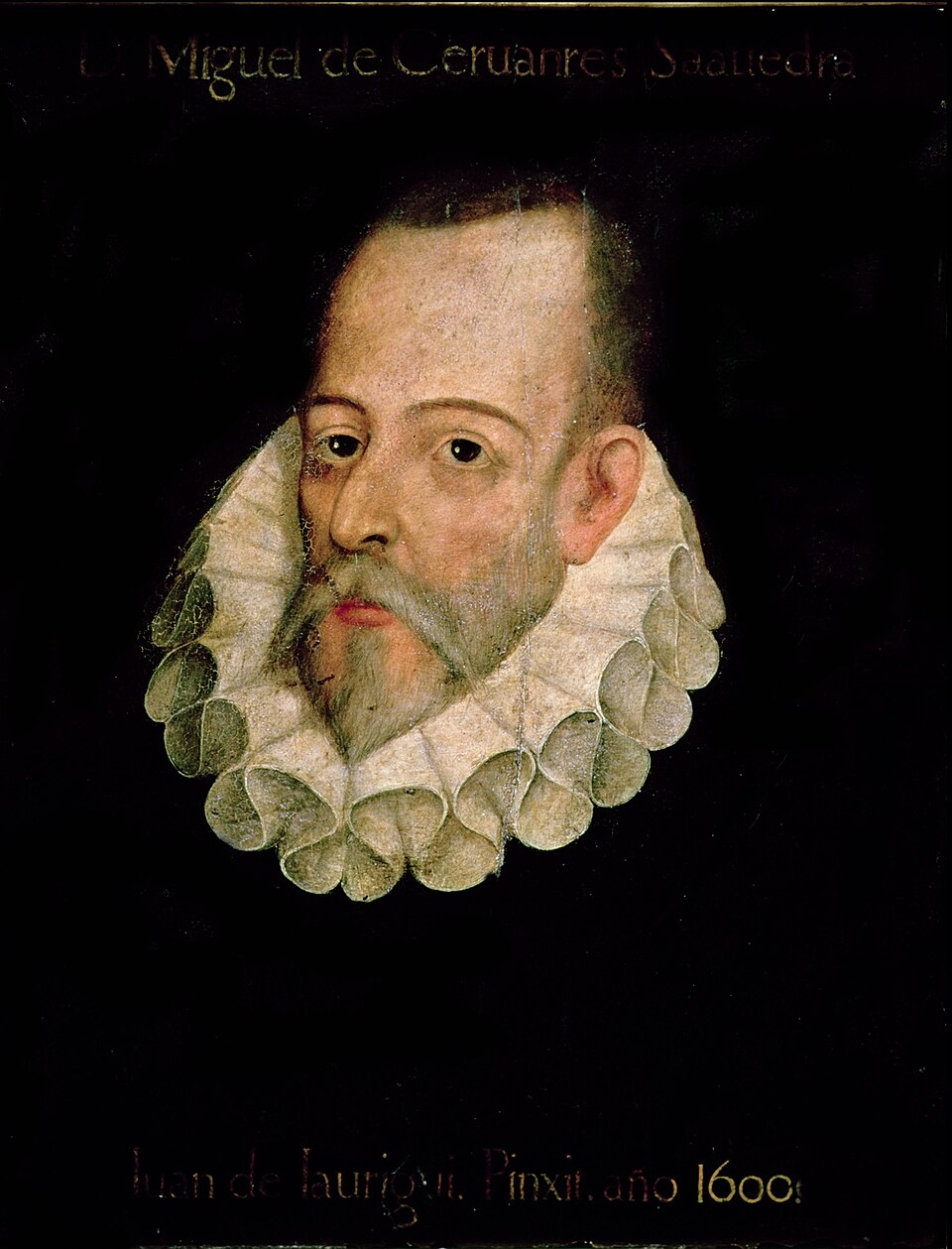
Miguel de Cervantes was born in Alcalá de Henares in 1547 and died in Madrid on 22 April 1616. He came to writing late and by a hard road. He fought the Turks at Lepanto in 1571, lost the use of his left hand there, and was then captured by pirates and held in Algiers until a ransom freed him in 1580. Later money troubles, and a spell in prison, followed him through years of tedious government work.
He tried nearly every form: the pastoral romance La Galatea (1585), plays, poems, the twelve stories of the Novelas ejemplares (1613), and the Byzantine romance Persiles y Sigismunda, published after his death in 1617. The constants are irony, comedy and a humane eye for ordinary people. His time in Algiers fed the Captive's Tale inside Don Quixote.
Don Quixote came out in two parts, in 1605 and 1615. A minor nobleman, Alonso Quixano, reads so many chivalric romances that he sets out as a knight-errant. In Part Two he finds that strangers have read about him, and Cervantes also uses it to attack an impostor's unauthorised imitation. Thomas Shelton's English version of Part One appeared in 1612. Critics have read the book as parody, as heroic idealism, and as a comment on Spanish imperial ambition. Spain's highest award for a Spanish-language writer, the Premio Miguel de Cervantes, bears his name.
Start with Don Quixote, in the Edith Grossman translation published by Ecco in 2003, with an introduction by Harold Bloom. It is long, but the early episodes are brisk and funny, and the book grows more complicated as it goes. If you want something quicker afterwards, try the Novelas ejemplares.