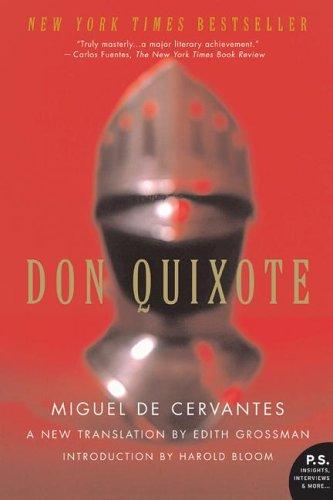
Deep Overview
The book begins with a man whose name is uncertain, a minor country nobleman in La Mancha who spends his days and income on tales of knights, giants and enchanters. He concludes that the world needs knight-errantry restored, renames himself Don Quixote of La Mancha, and invents an ideal lady, Dulcinea del Toboso, to serve. Everything he meets is processed through his reading. Inns become castles, windmills become giants, and puppets, flocks of sheep and funeral processions become enemies or marvels. The humour comes from the distance between what happens and what he thinks is happening. Cervantes adds the practical Sancho Panza, who is tempted by promises of an island to govern and who keeps trying to correct his master with common sense.
The first part is loose and picaresque in shape. The two travellers drift along roads and through inns, and they meet shepherds, priests, runaway lovers, galley slaves, barbers and muleteers. Cervantes keeps interrupting the main line with other stories and with long conversations about poetry, the theatre and what fiction should be. Characters in the book discuss other books, and the narrator discusses his own sources. He claims to have found the history in the writing of Cide Hamete Benengeli, which a translator then renders into Spanish. That frame makes the reader doubt who is really telling the story.
Part Two, published in 1615, turns this self-awareness into structure. Many people the pair meet have already read the first part, and some stage elaborate pranks to exploit Don Quixote's fantasy. The most developed case is the Duke and Duchess, who treat the knight as entertainment. Sancho's time as a governor tests his shrewdness and decency. As the story advances, the relationship between master and squire deepens. Sancho absorbs some of his master's idealism, while Quixote grows more conscious of how others see him. The ending moves from farce towards sorrow, and readers have argued about it ever since.
What makes the book more than a parody is the way Cervantes keeps complicating who is foolish. Quixote's judgment is faulty, yet he is often generous, brave and eloquent. The people who mock him are not always wiser or kinder. The novel asks whether imagination makes people better or only more vulnerable, and it has no single answer. Grossman's translation is useful here because the comedy depends on tone, such as formal speech meeting everyday speech, so a rendering that keeps the voice natural lets the humour and the sadness arrive together.
Key Themes
Illusion and reality sits at the centre. The book keeps testing how much of what we call reality depends on perception, habit and the stories we have absorbed. Closely related is the power and danger of reading: Quixote is shaped by books, and the novel is also a book about books. Idealism and its costs runs through the whole narrative, because noble aims produce injury and embarrassment as readily as they produce kindness. Friendship and mutual transformation develop in the pairing of Quixote and Sancho. Authorship and authority appear in the borrowed-manuscript device and in the second part's awareness of readers. Social class, justice and honour appear in the encounters with innkeepers, nobles, prisoners and peasants. Madness and sanity are treated as unstable categories rather than a clean divide.
Historical Context
Cervantes wrote in Habsburg Spain, during the period often called the Golden Age. It was a time of imperial prestige, religious orthodoxy, and uneven economic strain. His own life was rough. Reference sources recount that he fought against the Ottoman fleet at Lepanto in 1571, was left with a crippled left hand, spent years as a captive in North Africa after being taken by pirates, and returned to a life of modest and uncertain means. Those experiences give the book's treatment of captivity, soldiering and bureaucracy more weight than a simple farce would have.
The literary target was the chivalric romance, a hugely popular genre of improbable knightly adventures. Cervantes also drew on pastoral fiction, the picaresque tradition of rogue narratives, and the theatre. Part One was published in 1605, after Cervantes sold the rights to the bookseller Francisco de Robles, and it was quickly reprinted in several cities. Part Two followed in 1615, and Cervantes died in 1616. An early English translation by Thomas Shelton appeared in the following years, and the book has gone on to be translated into a great many languages. Modern commentators often describe it as a foundation of the European novel.
Intended Audience
The book suits adult readers and confident older students who want a major work of world literature that is genuinely entertaining. It will reward readers of satire, metafiction and comic novels, and anyone curious about the sources of modern fiction, from Laurence Sterne to later experimental writers. Students of Spanish, European or comparative literature will find it essential. It is also a good fit for people who enjoy long, digressive books they can dip into over several weeks.
It may be less suitable for readers who want a tightly plotted narrative with steady momentum, because the structure is episodic and sometimes repeats its basic joke. Readers who dislike digressions, long speeches or interpolated stories may find stretches of Part One slow. Those who want a scholarly edition with extensive notes should know that this translation is aimed at general readers.
Reading Difficulty
The English is readable and conversational by the standard of classics from the early seventeenth century, and the chapters are short. The main challenge is length: the printing here runs to 992 pages, so pacing matters. Readers can treat it as a sequence of episodes and read a few chapters at a time. Humour that depends on references to chivalric romances, proverbs and period customs can need a moment's thought, and some interpolated stories feel like detours from the main journey. Part Two is usually considered more cohesive, but it does assume you remember Part One. The paperback is dense and heavy, so an ebook or audiobook may be easier to carry, although format details of other editions should be checked separately.
Helpful Background Knowledge
No specialist training is needed. A little orientation helps: know that knight-errantry means a wandering knight who defends the weak and seeks adventures, and that romances about such knights were popular reading in Cervantes's time. A basic sense of early modern Spain, its Catholic monarchy and its social hierarchy, makes the jokes about status, honour and lineage easier to read. It is useful to know that the book appeared in two parts a decade apart. Reading Harold Bloom's introduction before or after the novel gives one prominent literary critic's view of its place in the canon, though he is one voice among many. Readers who want help with the original Spanish references can look at the supplementary material in the P.S. edition.
Why Read This Book?
Many classics survive on reputation. This one still performs as comedy, and it also hurts. A contemporary translation matters in that regard, because stiff English can turn a witty book into a museum piece. Grossman's version, which Carlos Fuentes praised on its first publication in The New York Times Book Review, is a sensible entry point for readers who want the humour intact. Reading it also lets you see where later novels got their tools: unreliable narrators, characters who know they are in a book, double-layered storytelling, and the pairing of an idealist with a realist. And the central pair are memorable. Sancho Panza in particular is one of fiction's great comic and moral creations, and his growth over the book is a reason to keep going.
Reader Takeaways
A careful reader may come away with a sharper sense of how fiction shapes expectations, including their own. You may notice how Cervantes plays with narration: who is telling the story, who has read it, and who decides what counts as true. You may reconsider the line between foolishness and integrity, because the book repeatedly makes mockery look cruel and idealism look both ridiculous and admirable. You may also understand more clearly why the adjective quixotic carries a mix of affection and criticism. Finally, readers often gain a clearer map of the history of the novel, from romance and satire to modern psychological and self-aware fiction.
Strengths
The book's chief strength is range. It moves between slapstick, philosophy, social observation and tenderness without losing its voice. Its characters grow, and the central friendship is convincingly drawn. The formal inventiveness, especially in Part Two, is still striking. This edition adds a readable modern translation, an introduction by a major critic, and extra reader-oriented material in the P.S. section. The short chapters make it manageable in small sessions despite the size.
Limitations and Cautions
The structure is episodic, and the repeated pattern of delusion, mishap and beating can wear on some readers. Interpolated stories in Part One are sometimes felt to interrupt the main narrative. The book reflects seventeenth-century attitudes, including portrayals of women, of Moors and Muslims, and of Spanish social rank, that modern readers may find uncomfortable and that scholars read in different ways. Any translation involves interpretive choices, and Grossman's approach favours naturalness over close literalism, so readers wanting a more scholarly or archaic rendering may prefer another version. This edition is not heavily annotated, so specialist readers may want a commentary alongside it.
Important Concepts, People, and Places
Miguel de Cervantes: the author, a soldier and writer whose own experiences of war, captivity and hardship inform the book's worldview.
Edith Grossman: the translator of this edition, an acclaimed translator from Spanish whose 2003 version made the book accessible to many English-language readers.
Harold Bloom: the critic who wrote the introduction, placing the novel in the Western literary canon.
Don Quixote (Alonso Quixano): the protagonist, a minor nobleman who renames himself and takes up knight-errantry.
Sancho Panza: the squire, whose proverbs and practical outlook balance Quixote's visions.
Dulcinea del Toboso: the idealised lady Quixote invents, who works as a symbol of devotion rather than a developed character.
Cide Hamete Benengeli: the fictional Arab historian whom the narrator credits as the source, a device that complicates ideas of authorship.
La Mancha: the region of Spain from which Quixote takes his title, and the setting for many early episodes.
Chivalric romance: the popular genre that Cervantes parodies and that drives Quixote's delusions.
Picaresque: the tradition of episodic narratives about wandering, low-born protagonists, which influences the book's form.
The Duke and Duchess: aristocratic characters in Part Two who stage pranks on Quixote and Sancho, and test the book's ethics of mockery.
Questions the Book Explores
Can imagination improve a life even when it misreads the world? Who is responsible when people exploit someone's delusion for entertainment? What does a story owe to truth, and how can a reader tell when a narrator can be trusted? Is practical wisdom enough without ideals, or ideals without practicality? How do class, language and reputation shape the way others treat us? What happens to a person when their own story is already known to everyone they meet, as happens to Quixote and Sancho in the second part?
Reading Group Guide
Because of the length, groups often do best by splitting the book into several meetings, for example Part One in two or three sessions and Part Two in the same number. Agree in advance whether to read every interpolated story or to discuss them as optional detours. Consider reading Harold Bloom's introduction at the start or saving it for the final session, as the group prefers. Bring a favourite episode to each meeting and compare how each of you reacted to it, since the comic scenes tend to divide readers. If members have read other translations, comparing a short passage across versions can be a lively exercise, and may help the group think about how translation shapes tone.
Discussion Questions
1. Which moments make Quixote seem most foolish, and which make him seem most admirable? What distinguishes them?
2. How does Sancho's relationship to his master change from the start of the journey to the end?
3. What is the effect of presenting the story as a translation of another writer's manuscript?
4. In Part Two, characters have read about Quixote. How does this change what we think of his adventures and of the people who mock him?
5. Are the pranks played on Quixote and Sancho funny, cruel, or both? Does your answer shift over the book?
6. What does the novel suggest about the benefits and dangers of reading?
7. How do the interpolated stories relate to the main plot, if at all?
8. How does the English of this translation shape your sense of the humour? Did any passages feel modern or archaic?
9. How do you read the final chapters? What do you think the book wants us to feel about Quixote's return to ordinary life?
10. Why do you think the word quixotic has endured, and is it a fair description of the character?
These book discussion questions can be used in any order, and groups may prefer to choose only a few.
Sources and Verification
This profile draws on the Library of Congress catalog record for the Grossman translation, the publisher's own listing for this paperback edition, and the Open Library catalogue for edition details. Historical and literary background comes from Encyclopaedia Britannica entries on Cervantes and on the character Don Quixote, a reference summary of the novel's publication, and a contemporary review by Carlos Fuentes of the translation. Bibliographic details such as the imprint vary between retailers and catalogues, with some listing Harper Perennial and others Ecco. This profile follows the publisher's listing. Page counts also differ between the hardcover and paperback printings. All analysis and wording is original.