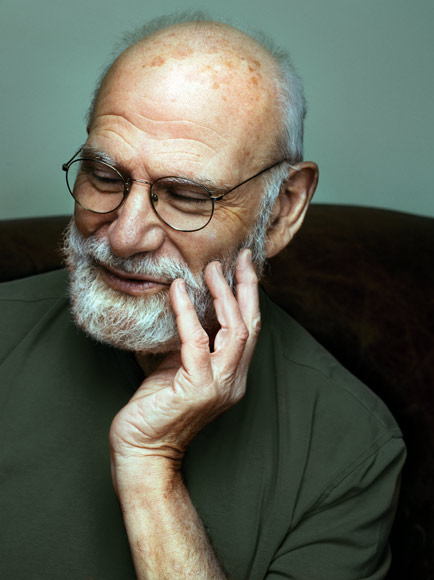
Photo of Oliver Sacks
Photo: Maria Popova · CC BY-SA 3.0 · via source

Author profile

Oliver Sacks

British neurologist and author whose humane case histories explore perception, memory, identity and the many ways people adapt to neurological conditions.

1 published book 0 published articles

Official website

About Oliver Sacks

Oliver Sacks (1933–2015) was a London-born neurologist and writer who spent most of his professional life in New York. Educated in medicine at Oxford, he worked with patients for more than five decades and taught neurology at institutions including NYU School of Medicine. He also contributed regularly to The New Yorker and The New York Review of Books.

Sacks wrote narrative nonfiction rooted in clinical observation. His case histories examine memory, perception, language, music and identity, but diagnosis is rarely the endpoint. He follows how people build lives around unusual neurological experiences, combining medical detail with biography and philosophical inquiry.

His books include Awakenings, An Anthropologist on Mars, Seeing Voices and Musicophilia. Awakenings, about patients who survived the encephalitis lethargica epidemic and were later treated with L-dopa, inspired the 1990 film starring Robin Williams and Robert De Niro. In 2001, Sacks received Rockefeller University’s Lewis Thomas Prize, which honors literary achievement in science.

The Man Who Mistook His Wife for a Hat is the best starting point. Its compact case histories introduce Sacks’s characteristic method through people living with disrupted recognition, memory and bodily awareness. The title case, concerning a musician who can see details but cannot reliably identify what he sees, quickly establishes the book’s central concern: how a person preserves a sense of self when perception no longer behaves as expected.

Published books

Author

The Man Who Mistook His Wife for a Hat

In this collection of twenty-four clinical narratives, neurologist Oliver Sacks examines people whose injuries, illnesses, and atypical neurological conditions have profoundly altered perception, memory, bodily awareness, language, impulse, or identity. The title case concerns Dr. P., a musician who can describe individual visual features yet cannot reliably recognize the objects and people before him. Other chapters consider severe amnesia, Tourette syndrome, loss of proprioception, phantom limbs, involuntary reminiscence, unusual artistic abilities, and distinctive forms of calculation and attention. Sacks is interested not only in locating an impairment but also in understanding the life constructed around it. Music, routine, imagination, faith, art, and personal relationships may become essential means of orientation. The result is an influential example of literary medical writing that presents neurology as a study of whole lives, while also raising enduring questions about patie…

View book