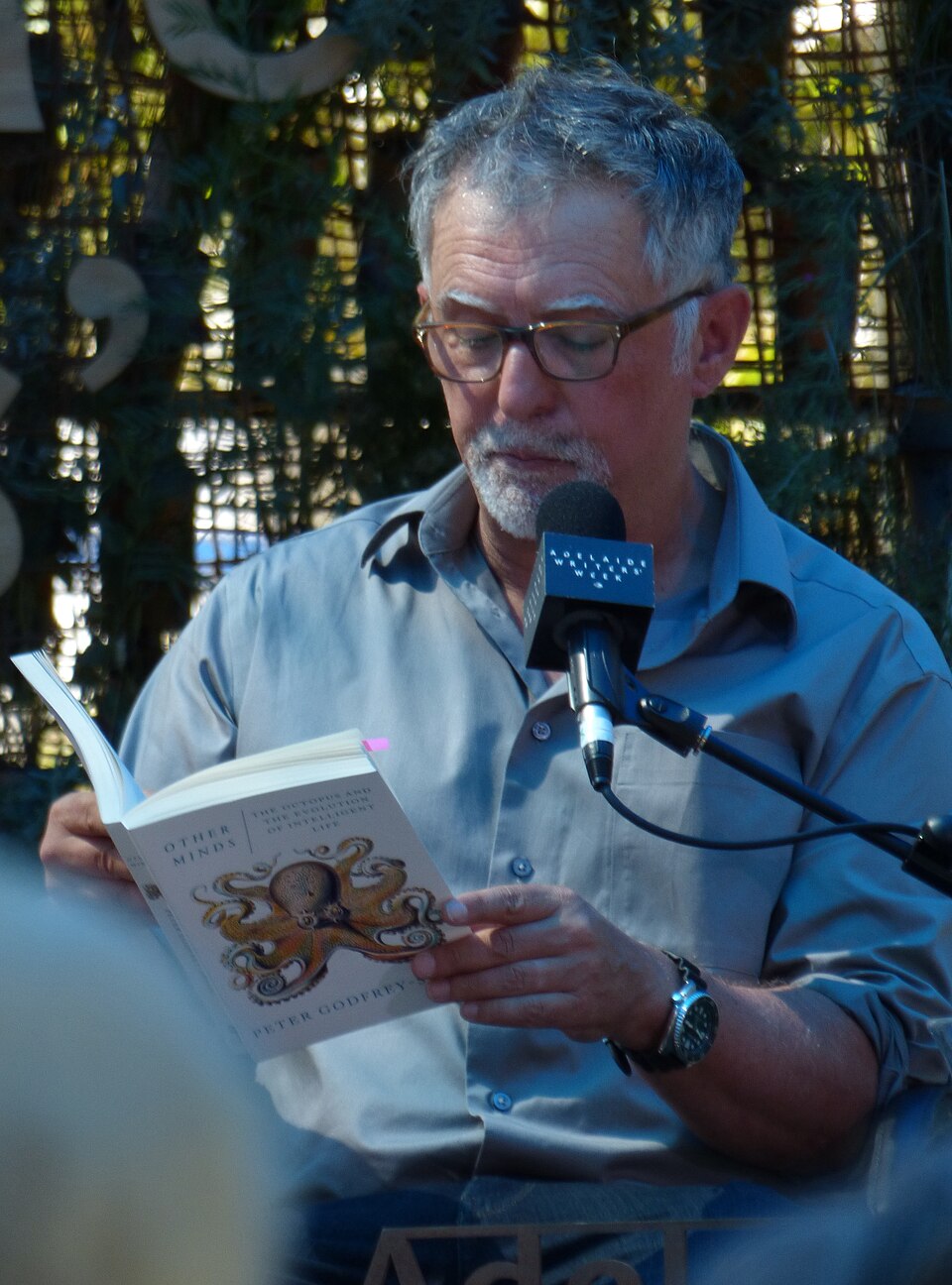
Photo of Peter Godfrey-Smith
Photo: Danimations · CC BY-SA 4.0 · via source

Author profile

Peter Godfrey-Smith

Australian philosopher of science and author who writes about evolution, animal minds and consciousness, often drawing on encounters with marine life.

1 published book 0 published articles

Official website

About Peter Godfrey-Smith

Peter Godfrey-Smith is an Australian philosopher of science and professor in the University of Sydney’s School of History and Philosophy of Science. Educated at the University of Sydney and UC San Diego, he has taught at Stanford, Harvard, the Australian National University and the CUNY Graduate Center. His research joins philosophy of biology with questions about mind and knowledge.

His books range from academic studies to accessible nonfiction. Across them, he asks how minds emerged within living systems and what evolutionary history can tell us about experience. In Other Minds, firsthand underwater observation meets biology and philosophy: octopuses, cuttlefish and squid become evidence for an evolutionary route to complex behavior far removed from that of vertebrates.

Other Minds was shortlisted for the 2017 Royal Society Science Book Prize. Godfrey-Smith extended its inquiry beyond cephalopods in Metazoa, then considered how organisms reshape their surroundings in Living on Earth. His more technical Darwinian Populations and Natural Selection won the 2010 Lakatos Award for work in the philosophy of science.

Start with Other Minds. Its meetings with octopuses off Australia give the larger argument a vivid center, while its account of nervous systems and independent evolutionary paths makes difficult questions about consciousness unusually approachable.

Published books

Author

Other Minds

Other Minds examines consciousness by approaching it through one of evolution’s most unusual achievements: the complex behavior and nervous systems of cephalopods, especially octopuses. Peter Godfrey-Smith combines evolutionary biology, philosophy of mind, natural history, and firsthand underwater observation to ask how subjective experience could have emerged from ordinary biological processes. The book follows animal life from early multicellular organization and basic sensing to neurons, coordinated action, memory, and sophisticated behavior. Cephalopods are central because their lineage diverged from the vertebrate line hundreds of millions of years ago, yet independently produced large nervous systems and flexible intelligence. Their existence therefore challenges any assumption that minds must resemble centralized, social, long-lived human minds. Moving between deep evolutionary time and encounters at Australian dive sites, Godfrey-Smith presents the octopus as evidence that int…

View book