
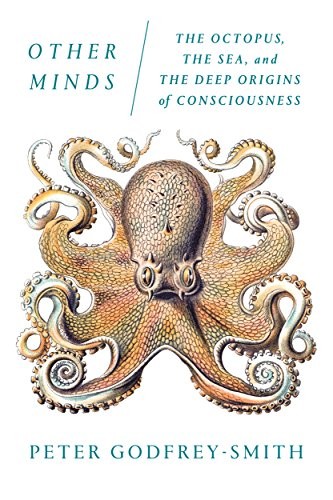
Other Minds
The Octopus, the Sea, and the Deep Origins of Consciousness
Other Minds examines consciousness by approaching it through one of evolution’s most unusual achievements: the complex behavior and nervous systems of cephalopods, especially octopuses. Peter Godfrey-Smith combines evolutionary biology, philosophy of mind, natural history, and firsthand underwater observation to ask how subjective experience could have emerged from ordinary biological processes. The book follows animal life from early multicellular organization and basic sensing to neurons, coordinated action, memory, and sophisticated behavior. Cephalopods are central because their lineage diverged from the vertebrate line hundreds of millions of years ago, yet independently produced large nervous systems and flexible intelligence. Their existence therefore challenges any assumption that minds must resemble centralized, social, long-lived human minds. Moving between deep evolutionary time and encounters at Australian dive sites, Godfrey-Smith presents the octopus as evidence that int…
Where to buy or borrow
Are you selling this book? Bookstores, publishers, authors and libraries can be listed here for free. Request a listing
About this book
Deep Overview
The inquiry starts before octopuses. Early organisms sensed conditions and acted in ways that maintained life. Multicellular animals then created new problems of coordination: different cells had to combine perception and movement across an entire body. Nervous systems helped solve these problems by linking sensory input, bodily control, and action. This long evolutionary account matters because it frames mind not as an isolated substance but as an outgrowth of increasingly elaborate ways of engaging with an environment.
The vertebrate and cephalopod lineages eventually followed profoundly different routes. Humans belong to a lineage in which centralized brains, durable bodies, prolonged development, and intense sociality became important. Cephalopods—octopuses, squid, and cuttlefish—descend from molluscan ancestors and independently evolved behavioral flexibility and large nervous systems. Their complexity is therefore not a near copy inherited from a recent intelligent common ancestor. It is a separate evolutionary outcome built from a different body plan.
That body plan complicates familiar assumptions about where a mind resides. An octopus has a central brain, but much of its nervous system extends through its arms. The arms possess extensive local sensory and motor capacities, while the soft body can bend, extend, squeeze, taste through its suckers, alter skin texture, and produce rapid visual displays. Control is consequently distributed rather than simply commanded by a brain directing passive limbs. Godfrey-Smith uses this organization to question whether the octopus has the same kind of unified perspective humans ordinarily assume for themselves.
The book also investigates the mismatch between cephalopod sophistication and cephalopod life history. Many species live briefly, and octopuses are often described as relatively solitary. These facts make their intelligence puzzling under theories that emphasize long childhoods, stable social groups, or cumulative culture. Godfrey-Smith considers ecological demands, active predation, exploration, manipulative arms, and the loss of a protective shell as pressures that may have favored flexible behavior.
Color and pattern form another major line of inquiry. Cuttlefish and squid can create intricate displays across their skin, raising questions about signaling, camouflage, and whether an animal’s outward appearance can function like a changing expressive surface. The book does not force these phenomena into a human model of language. Instead, it treats them as evidence that communication and bodily expression may take forms organized around very different senses and anatomies.
Encounters at Octopolis, an Australian site where octopuses gathered more densely than expected, give the book a recurring observational setting. These scenes keep the philosophical argument attached to living animals. The book ultimately offers no simple test that settles exactly what an octopus experiences. Its achievement is to show why cephalopods expand the range of plausible minds and why consciousness must be studied as both an evolutionary and a philosophical problem.
Key Themes
**Mind as embodied activity:** Perception and thought are inseparable from the kind of body doing the sensing and acting. The octopus’s flexible body, chemically sensitive suckers, changing skin, and semi-autonomous arms suggest a mental organization unlike the human brain-and-limbs model.
**Continuity without oversimplification:** The book searches for gradual transitions from basic biological sensitivity to conscious experience. It resists both a magical leap into consciousness and the claim that every responsive organism must therefore possess a rich inner life.
**The problem of other minds:** Behavior gives evidence of intelligence, preference, exploration, and learning, but another creature’s subjective experience remains indirect. Cephalopods make this familiar philosophical problem especially vivid.
**Sociality and intelligence:** Octopus cognition complicates accounts that make sustained social life the principal engine of intelligence. Ecological demands, predation, bodily control, and exploration may also generate behavioral complexity.
**Expression beyond language:** Cephalopod color and texture changes invite comparison with communication while warning against treating human speech as the universal standard for meaningful expression.
**Mortality and compressed lives:** The combination of sophisticated behavior and short lifespans raises questions about why evolution would build elaborate nervous systems that exist for such limited periods.
Historical and Intellectual Context
Cephalopods are particularly important within this shift because the vertebrate and molluscan lines separated deep in animal history. Their complex behavior therefore provides a comparative case for asking which features of nervous systems are broadly associated with cognition and which reflect a particular lineage. Laboratory work on learning and problem-solving, field observations of camouflage and signaling, and research into distributed neural control supply the scientific background.
Godfrey-Smith also draws on a longstanding philosophical question: how can anyone know whether another being has subjective experience? In human life, shared language and bodily similarity help bridge that gap. With an octopus, both supports are weakened. The book turns this uncertainty into a method, using evolutionary history and behavior to expand discussion without pretending that the evidence removes every mystery.
Intended Audience
No specialist training is required, and the underwater episodes give concrete form to abstract questions. Readers seeking a comprehensive zoological reference, a systematic survey of every cephalopod species, or a definitive theory of consciousness may find the scope more selective than expected. The book is exploratory and synthetic: it assembles a persuasive way of thinking rather than closing the scientific and philosophical debates it introduces.
Reading Difficulty
The structure ranges across immense timescales and several disciplines, so the argument can feel more associative than a textbook’s step-by-step progression. Some passages about early animal evolution, neural organization, and theories of consciousness merit slow reading. Illustrative episodes and photographs make the material easier to visualize, but they do not eliminate the book’s central uncertainties.
Helpful Background Knowledge
For the philosophical chapters, it helps to distinguish observable behavior from subjective experience: an organism may display learning or flexible action even when researchers cannot directly establish what that activity feels like from the inside. Prior knowledge of neuroscience is unnecessary, though a simple awareness that nervous systems can distribute processing outside a single central brain will help readers appreciate the octopus case.
Why Read This Book
The book also models a careful way to discuss animal consciousness. Godfrey-Smith takes unusual behavior seriously without treating every anecdote as proof of a humanlike mind. Readers are invited to hold evidence, wonder, and uncertainty together. That balance makes the book useful beyond cephalopods: it supplies a framework for thinking about any organism whose sensory world, body, and style of intelligence differ sharply from our own.
Reader Takeaways
The book also sharpens the distinction between recognizing sophisticated behavior and claiming complete access to another creature’s experience. Evidence can justify serious consideration of animal consciousness without revealing its precise form. Finally, readers may reconsider the body’s role in mentality: sensing, moving, manipulating, displaying, and responding are not peripheral outputs of mind but parts of the biological processes from which minds emerge.
Strengths
Godfrey-Smith also handles uncertainty well. He distinguishes plausible interpretation from settled demonstration and uses disagreement as an invitation to refine questions. The organization moves from the early history of animal life through nervous systems, cognition, display, consciousness, aging, and social encounters, giving the subject both breadth and a coherent intellectual arc.
Limitations and Cautions
Some of the most compelling material comes from individual encounters and reported animal behavior. Such cases are illuminating, but they cannot by themselves determine the general capacities of an entire species or lineage. The philosophical conclusions also remain deliberately provisional: behavior and neural complexity support hypotheses about experience but do not provide direct access to it.
Because the book appeared in 2016, subsequent work in cephalopod neuroscience and cognition is outside its scope. Its enduring value lies more in its comparative framework and central questions than in serving as a current survey of every relevant finding.
Important Concepts, Organisms, People, and Places
**Cephalopoda:** The molluscan class containing octopuses, squid, cuttlefish, and nautiluses. Cephalopods provide the book’s main example of complex nervous systems evolving far from the vertebrate line.
**Octopus:** The central comparative organism. Its exploratory behavior, flexible body, many arms, and distributed neural organization challenge familiar assumptions about centralized control and unified consciousness.
**Cuttlefish and squid:** These cephalopods are especially important to the discussion of rapid color change, patterning, camouflage, signaling, and the body as a dynamic expressive surface.
**Distributed nervous system:** A system in which substantial sensing and control occur outside a single central brain. In an octopus, extensive neural resources in the arms help coordinate local movement and interaction.
**Convergent evolution:** The independent emergence of similar capacities in separate evolutionary lineages. Vertebrate and cephalopod intelligence exemplify how complex behavior can arise through different biological histories.
**Subjective experience:** The felt, first-person aspect of mental life—the question of whether and how there is something it is like to be a particular animal.
**Octopolis:** A seafloor site near the east coast of Australia where octopuses were observed gathering and interacting at unexpectedly high density. It complicates a simple picture of octopuses as uniformly solitary.
**Common ancestry:** The branching relationship linking all animals. The enormous evolutionary distance between humans and cephalopods makes their comparison informative about both shared foundations and independent innovations.
**Chromatophores and bodily display:** Pigment-related structures and associated skin mechanisms allow many cephalopods to alter their appearance rapidly. The book considers these changes in relation to camouflage, expression, and communication.
**David Hume and Lev Vygotsky:** Philosophers and theorists invoked in the book’s discussion of human mentality, language, social interaction, and the construction of a unified self. They help frame the contrast between human minds and cephalopod organization.
Questions the Book Explores
What can independently evolved nervous systems reveal about the general requirements for intelligence?
Does an octopus experience itself as one unified agent, or does its distributed neural organization support a less centralized form of subjectivity?
Why did complex cognition evolve in animals that are often short-lived and comparatively solitary?
How much can flexible behavior, exploration, learning, and individual variation tell us about consciousness?
Can changing color and skin pattern count as communication, expression, or thought made externally visible?
Which features of human consciousness are ancient animal inheritances, and which depend on language, culture, and social development?
How should uncertainty about animal experience affect the way humans understand and treat other species?
Reading Group Guide
Compare the deep-time chapters with the underwater encounters. Discuss whether the observational passages merely illustrate the evolutionary argument or materially change its force. Pay particular attention to the sections on arm control, color display, brief lifespans, and Octopolis, since each disrupts a familiar theory about what intelligence requires.
A productive final discussion can focus on method. Consider whether Godfrey-Smith successfully avoids both anthropomorphism and excessive skepticism. Groups may also compare the octopus with familiar mammals or birds and identify which standards of intelligence are genuinely general and which are based on human anatomy, language, or social life.
Discussion Questions
2. Which feature of octopus anatomy most strongly challenges a human-centered model of consciousness?
3. Does the book make a convincing case for gradual continuity between basic biological sensitivity and conscious experience?
4. How should readers evaluate anecdotes about escape, play, recognition, irritation, or curiosity in individual octopuses?
5. What explanations for cephalopod intelligence remain plausible if long life and complex social organization are not necessary conditions?
6. Could a mind be intelligent without having the same degree or kind of unity that humans experience?
7. What do cephalopod color displays suggest about the relationships among body, communication, and thought?
8. How do the Octopolis observations complicate the description of octopuses as solitary animals?
9. Where does Godfrey-Smith draw the line between evidence and speculation, and is that line convincing?
10. Does uncertainty about an animal’s inner life weaken or strengthen the case for ethical caution?
11. Which parts of human mentality appear less inevitable after comparison with cephalopods?
12. How does the book change the meaning of the phrase “other minds”?
Sources and Verification
Comments
No published comments yet.
Available editions
Hardcover
First U.S. edition; hardcover
- Publisher
- Farrar, Straus and Giroux
- ISBN-13
- 9780374227760
- Publication date
- Pages
- 272