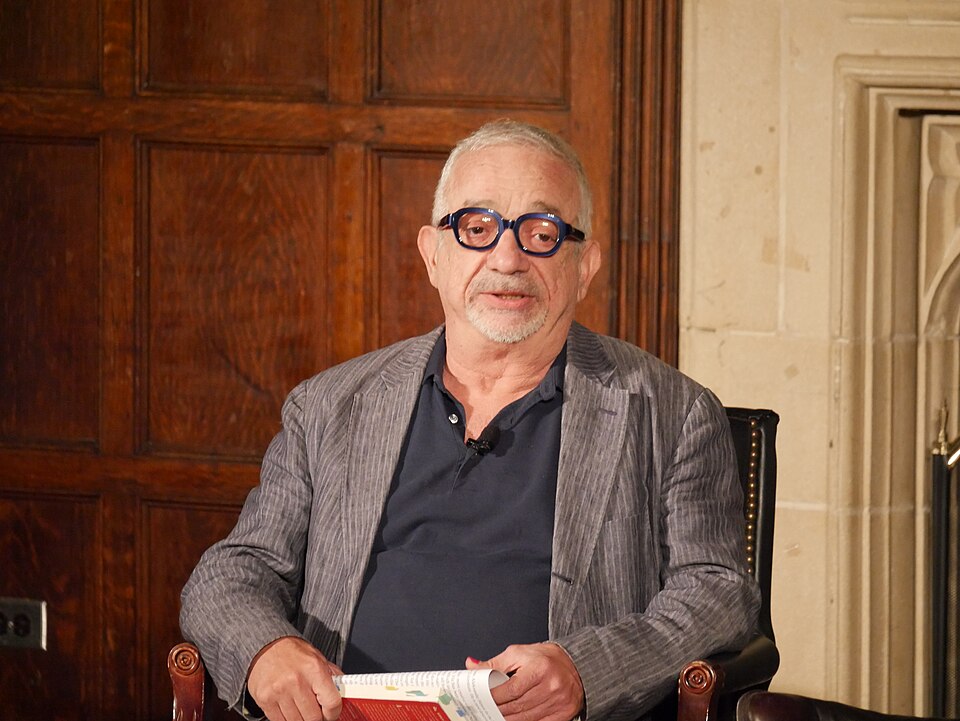
Born in Amman in 1959 to Lebanese Druze parents, Rabih Alameddine grew up split between Kuwait and Beirut before leaving at seventeen for England and then California. An engineer by training (UCLA) and later an MBA holder, he became a painter first and a novelist second, settling into a life shared between San Francisco and Beirut. He identifies as gay and as an atheist, and both shape the world of his fiction.
His novels are wide, digressive, and funny even when they deal with civil war, economic collapse, or the AIDS crisis. Koolaids (1998) set the pattern: a San Francisco narrative entangled with the Lebanese Civil War. The Hakawati (2008) stretches from the Koran to Scheherazade. An Unnecessary Woman (2014) follows a reclusive translator in a Beirut under siege. The Wrong End of the Telescope (2021) sends an Arab American trans woman into the refugee camps of Lesbos. The True True Story of Raja the Gullible (and His Mother) (2025) is a six-decade, non-linear family saga narrated by a sixty-three-year-old gay philosophy teacher in a tiny Beirut apartment, told with a comic voice that refuses to let grief calcify.
Recognition has accumulated over the years: a 2002 Guggenheim Fellowship, the 2019 Dos Passos Prize, the 2022 PEN/Faulkner Award, and in 2025 the National Book Award for Fiction. His books have been translated into more than twenty languages, and he holds the Lannan Foundation Visiting Chair at Georgetown University.
A new reader can start with The True True Story of Raja the Gullible (and His Mother). Its non-linear structure and Raja's irrepressible narrative voice make it the most accessible entry point, while the book's range across decades and continents rewards readers who go back for the earlier novels.