
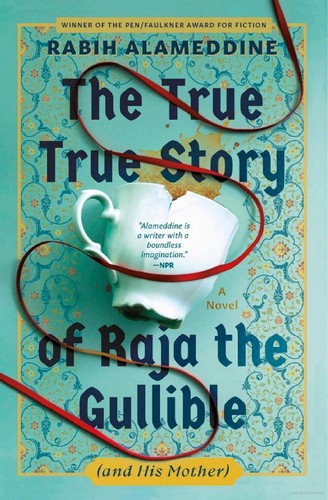
The True True Story of Raja the Gullible (and His Mother)
Rabih Alameddine's 2025 National Book Award–winning novel follows Raja, a 63-year-old gay philosophy teacher in Beirut, and his octogenarian mother Zalfa, as he navigates an invitation to a writing residency in America. Told in a non-linear, deeply comedic voice, the book spans six decades—from Raja's boyhood in 1960s Lebanon through the civil war, the 2019 banking crisis, the pandemic, and the 2020 Beirut port explosion. The narrative weaves together a harrowing captivity during the war, the tangled bond of a mother and son, and the absurdities of survival in a country defined by catastrophe. Alameddine's blend of savage humor, queer storytelling, and literary ambition makes this one of the most distinctive award winning books of the year.
Where to buy or borrow
Are you selling this book? Bookstores, publishers, authors and libraries can be listed here for free. Request a listing
About this book
Deep Overview
The emotional center is the cohabitation of Raja and Zalfa in a cramped Beirut apartment. Zalfa, octogenarian, politically furious, fond of edibles, and incapable of respecting privacy, is rendered with a tenderness that belies the exasperation Raja feels. Their dynamic is not a simple comedy of inconvenience; it is the novel's sustained argument that a mother's need to know everything about her child is both an affront and a form of love that has no adequate answer. Raja calls himself his mother's confidant, but concedes he is not the complete one she needs. This gap is where Madame Taweel, a neighborhood generator-mafia boss, enters: she and Zalfa become inseparable confidantes, bonding over makeup, low-budget films, and political rants, with Taweel's armed lieutenants standing guard outside.
The novel's most demanding and formally daring section returns to 1975, when fifteen-year-old Raja is kidnapped by a militiaman named Boodie during the Lebanese Civil War. Over two months, the captivity becomes a complex entanglement of violence, care, sexual coercion, and something Raja can only half-name as connection. The narrative stages this episode almost as a twisted domestic drama, refusing to resolve it into a simple trauma narrative or a simple act of forgiveness. Raja ultimately rejects the label of victimhood—not because the experience was harmless, but because he sees the true source of harm as the system that produced Boodie's choice to participate in a murderous war. He also refuses the closure of forgiveness, not from inability but from a deliberate decision.
The philosophical underpinning is Sartre's insistence that we are condemned to be free. Raja adopts this as a working principle: he cannot change what happened, but he can decide, to some degree, what it means. This gives the novel its exuberant, forward-looking energy even in its darkest passages. The 2019 banking crisis and the 2020 Beirut port explosion are played with a comic verve that might seem irreverent, but the humor functions as a survival mechanism, the same one Raja uses to keep sane in his mother's apartment. The pandemic becomes a farce of Zoom classes and excluded mothers; the banking collapse becomes a spectacle of Zalfa as protest celebrity. Through all of it, Raja's voice remains buoyant, self-mocking, and unapologetically camp—a voice that insists the pain of the past need not overwhelm the present, the identity, or the story being told.
Key Themes
Storytelling as survival and meaning-making runs through every section. Raja's digressive, non-linear narration is not a stylistic affectation but a philosophical stance: a true life cannot be told in a straight line, and the act of retelling is where memory, identity, and meaning are constructed. The 'True True' in the title is itself a comment on the impossibility and necessity of getting the story right.
Queerness in a conservative, war-torn society is woven into the narrative without being the sole subject. Raja's identity as a gay man shapes his captivity, his relationships, his professional life, and his self-mockery. The novel refuses to reduce his queerness to a single defining trait; it is one thread in the carpet, neither the dominant color nor an absent one.
National catastrophe and individual absurdity coexist without one cancelling the other. The Beirut port explosion, the banking collapse, the pandemic, and the civil war are all rendered with the same comic, human-scale attention as a mother's refusal to leave a son alone. This is not a dismissal of the politics; it is an insistence that the personal and the national are inseparable and that neither can be dignified into solemnity without losing truth.
Freedom, self-determination, and the refusal to be defined by what happened to you form the novel's philosophical backbone, drawing on Sartre's existentialism without turning it into a lecture. Raja's repeated self-labels—gullible, imbecile, neurotic clown—function as both defense and assertion: he chooses his own description rather than accepting one imposed by others.
Historical Context
Lebanon's 2019 banking and liquidity crisis, which led to widespread protests and economic collapse, forms part of the novel's mid-section. Zalfa's participation in anti-government demonstrations, including her brush with teargas and her rise to a kind of accidental celebrity among her son's students, grounds the novel in the political reality of a nation whose financial system has effectively frozen.
The August 2020 Beirut port explosion, in which over 200 people were killed and thousands more injured by a massive ammonium nitrate detonation, is one of the novel's set pieces. It is described in the book as the largest non-nuclear explosion in history. The explosion's aftermath, including its psychological and social impact on Beirut residents, shapes Raja's present-day despair and his longing for escape.
The COVID-19 pandemic, experienced in Beirut's specific conditions, provides a comic and poignant backdrop for the mother-son domestic scenes. Raja's Zoom philosophy classes, from which Zalfa is excluded, and her boredom and loneliness during lockdown anchor the pandemic in the intimate rather than the epidemiological.
Alameddine's own background—born in Amman, Jordan, to Lebanese Druze parents, raised in Kuwait and Lebanon, educated in the United States, and a self-described atheist—positions him as both an insider and an observer. His queer identity and his long residence in San Francisco and Beirut inform the novel's perspective without making it a straightforward autobiography.
Intended Audience
The novel was specifically named in the Los Angeles Times' list of 101 best book club picks for 2025, which signals its suitability as a book club books selection: the mother-son dynamic, the moral complexity of the captivity scene, and the blend of comedy and darkness all generate rich discussion. Readers who enjoy darkly comic literary fiction in the tradition of authors like David Sedaris or, in a more literary vein, the comedic elements of Philip Roth or John Irving will recognize the tonal territory, though Alameddine's Beirut setting and queer sensibility make the ground wholly his own.
The novel may be less suitable for readers who prefer tight, linear plots or who find extended digression and unreliable narration frustrating. The humor is specific and relies on a certain tolerance for camp and self-mockery; readers who prefer a consistently grave register in war fiction may find the comic treatment of serious events jarring rather than liberating.
Reading Difficulty
The vocabulary is accessible, though Raja's self-referential humor and occasional French or Arabic words (untranslated, as is common in Lebanese English) add a small layer of texture. The conceptual difficulty is low to moderate: the Sartrean philosophy is present but never lectured, and the political context, while complex, is rendered through character and incident rather than exposition.
The captivity scene, which spans two months of Raja's adolescence, is the most emotionally demanding passage. Its treatment of sexual coercion and violence is direct and unflinching, and readers should be prepared for that weight even within the novel's otherwise comedic frame. The pacing is uneven by design: fast and funny in the domestic sections, slower and more harrowing in the war sequences. This ebb and flow is part of the experience rather than a flaw.
Helpful Background Knowledge
Familiarity with Alameddine's earlier novels—particularly The Hakawati (2008), An Unnecessary Woman (2014), and The Wrong End of the Telescope (2021)—will deepen the reading but is not necessary. This is a standalone novel, and Raja is a distinct character, not a stand-in for protagonists in his other books. Readers who enjoy the work will likely want to explore his earlier fiction, but each novel stands on its own.
A basic awareness of Sartre's existentialist idea that humans are 'condemned to be free' will help the reader catch the novel's philosophical undercurrent, but Alameddine never requires the reader to be a philosophy student. The idea functions more as a refrain than an argument. Similarly, the novel's references to Lebanese political life, Druze identity, and the specific texture of Beirut neighborhood culture are rendered with enough warmth and specificity that they are accessible to outsiders.
Why Read This Book?
The mother-son relationship is rendered with a specificity and affection that will resonate with anyone who has ever felt both loved and suffocated by a parent. Zalfa is not a caricature of the 'difficult mother'; she is a fully realized, funny, politically engaged, and genuinely lonely woman whose need to be heard is as valid as her son's need for space. The novel does not resolve this tension, and that refusal is its greatest strength.
As one of the most significant award winning books of 2025, the novel earns its reputation through craft rather than spectacle. The National Book Award judges described it as an artistic exploration of the darkest aspects of existence that 'has no business being as funny as it is.' That tension—between the comic form and the dark content—is the book's engine, and it is a reason to choose it over more conventional literary fiction about similar subjects.
For book club readers, the novel's mix of humor, moral complexity, and emotional depth makes it a natural discussion catalyst. The captivity scene, the mother-son dynamic, and the novel's treatment of queerness in a conservative society all generate conversation that does not require a guide.
Reader Takeaways
The novel will likely reframe a reader's relationship to storytelling itself. Raja's insistence that a true tale has many heads and tails, that it branches like a river, challenges the assumption that a good story must be linear, resolved, and singular. The act of retelling, of choosing which thread to follow, is itself a form of meaning-making.
The mother-son dynamic may prompt readers to reconsider their own family relationships, particularly the ways in which a parent's need for closeness can feel like an invasion while simultaneously being the only proof that the parent sees you at all. The novel does not judge Zalfa; it does not judge Raja. It holds both in frame and lets the reader feel the full weight of their mutual need.
Readers may also notice, after finishing, how the novel's humor functioned as a form of consent. The jokes, the self-deprecation, the camp, the absurdity—these were not escapes from the pain but the conditions under which the pain could be approached at all. That insight, about the necessity of comedy in the face of genuine suffering, is the book's most transferable idea.
Strengths
The structure, which could easily have become scattershot, coheres because each digression is anchored to a recurring emotional question: How do I live with this? How do I tell this? How do I decide what it means? The non-linear form is not a gimmick but a philosophical commitment to the way memory and identity actually work.
Zalfa is one of the most vividly drawn supporting characters in recent literary fiction. Her political fury, her need for companionship, her refusal to be diminished by her son's boundaries, and her friendship with Madame Taweel all serve the novel's larger arguments while also standing as a fully realized comedic and emotional portrait.
Alameddine's handling of the captivity scene is both brave and restrained. The scene is the novel's emotional climax, and it earns its weight through specificity, tonal control, and the refusal to let Raja become a simple victim or a simple survivor. The scene's aftermath, including Raja's escape in a dress and the public humiliation that follows, is rendered with a compassion that extends to all parties without excusing the harm done.
The novel's scope is impressive: it moves from 1960s Beirut through the civil war, the banking crisis, the pandemic, and the port explosion without becoming a history textbook. Each historical event is filtered through the personal, the domestic, the absurd, and the funny, which is what makes the scale feel manageable and human.
Limitations and Cautions
The comedy, while integral to the novel's method, will not land for every reader. The self-mockery, the camp, the relentless sarcasm—these are specific tonal choices, and readers who prefer a more measured or elegiac approach to war and trauma may find the humor distracting or even offensive, particularly in the scenes involving the banking crisis and the port explosion. This is a limitation of audience fit rather than of craft, but it is worth noting.
The captivity scene is heavy and unflinching, and its treatment of sexual coercion and adolescent vulnerability may be difficult for some readers. The novel does not shy away from these elements, and the reader should be prepared for their directness.
The novel is set almost entirely in Beirut and in the narrow orbit of Raja's apartment, his school, and his immediate neighborhood. While this specificity is a strength, readers looking for a broader portrait of Lebanese society or a more expansive geographic scope will find the setting deliberately contained. The novel is about one family, one apartment, and one mother-son relationship, and it does not pretend to be a national epic in the traditional sense.
Alameddine's philosophical references, particularly to Sartre, are light and playful rather than rigorous. Readers looking for a sustained philosophical argument will find that the novel treats philosophy as a tool for living rather than a discipline to be mastered. This is appropriate to the novel's tone but may feel thin to those expecting more depth in the intellectual register.
Important Concepts, People, and Places
Zalfa: Raja's octogenarian mother, the novel's emotional counterweight and comic engine. Her political fury, her need for companionship, and her friendship with Madame Taweel are central to the novel's argument about intimacy, aging, and the right to be loud.
Madame Taweel: A neighborhood generator-mafia boss who becomes Zalfa's closest friend and confidante. Her character embodies the novel's theme that intimacy and survival in a crisis can take forms that defy conventional categories. She is funny, dangerous, and deeply loyal.
Boodie: The militiaman who kidnaps fifteen-year-old Raja during the civil war. Their two-month captivity is the novel's most demanding and morally complex scene. Boodie is rendered with a complexity that resists simple villainy without excusing his participation in a violent system.
The Beirut Port Explosion (August 2020): A massive ammonium nitrate detonation that killed over 200 people and injured thousands more. In the novel, it is one of the disasters that shapes Raja's present-day despair and his longing for escape. It is described as the largest non-nuclear explosion in history.
The Lebanese Civil War (1975–1990): The conflict that frames Raja's adolescence and defines the novel's historical past. The war is the source of Raja's captivity and the broader social upheaval that shapes his identity.
Lebanon's 2019 Banking Crisis: The liquidity crisis that froze deposits and triggered mass protests. Zalfa's participation in the anti-government demonstrations is a key comic and political episode in the novel.
The American Excellence Foundation: A Virginia-based organization that invites Raja to a writing residency. The invitation is the novel's inciting event and is treated with a skepticism that mirrors the title's double 'True.'
Jean-Paul Sartre: The philosopher whose existentialist idea—that humans are 'condemned to be free'—functions as Raja's working principle. The reference is light and playful rather than academic, but it underpins the novel's argument about agency and self-determination.
Rabih Alameddine: The author, born in Amman, Jordan, to Lebanese Druze parents, educated in the United States, and a self-described atheist and gay man. His earlier novels, including Koolaids: The Art of War, The Hakawati, An Unnecessary Woman, and The Wrong End of the Telescope, establish his recurring engagement with Lebanon, queerness, and the comic treatment of dark material. His 2022 PEN/Faulkner Award win and 2025 National Book Award for Fiction cement his position in the contemporary literary canon.
Questions the Book Explores
What does a mother owe her child, and what does a child owe a mother, when love and suffocation are the same gesture? The novel does not answer this; it stages the question in every domestic scene and leaves it unresolved.
Is humor a form of dishonesty when applied to genuine suffering, or is it the only honest way to approach it? The novel's tonal strategy—comic in the face of war, economic collapse, and personal trauma—is itself an argument about the ethics of storytelling.
What does it mean to be free in a country that has no electricity, no functioning banks, and no reliable government? Raja's philosophical commitment to self-determination is tested by the material conditions of Lebanese life, and the novel asks whether freedom is a philosophical abstraction or a daily, unglamorous practice.
How does queerness shape a person's relationship to their community, their family, and their country? Raja's identity as a gay man in Beirut is not the novel's sole subject, but it informs his relationships, his self-mockery, his professional life, and his understanding of what it means to be seen and not seen.
Can a story be true if it is not linear, not consistent, and not fully known? The novel's structure and Raja's unreliable narration pose this question formally, making the reader a participant in the act of determining what is true and what is memory.
Reading Group Guide
A practical starting point is to have each reader identify one scene that made them laugh and one that made them uncomfortable, and to share both. The novel's tonal shifts are deliberate, and comparing where the group felt the humor land and where it felt forced can generate productive discussion about the ethics of comedy in the face of suffering.
The mother-son dynamic is the easiest entry point for most readers. Ask the group: Have you ever felt both loved and invaded by a parent's need to know everything? Is Zalfa's behavior an affront, a form of love, or both? Does Raja's self-deprecating narration protect him, or does it keep him from fully acknowledging his own needs?
The captivity scene is the most challenging to discuss in a group, and facilitators should be prepared to move past it if the conversation becomes too intense. If the group does engage with it, the key question is not 'Was Raja a victim?' but 'What does Raja's refusal to call it simple trauma tell us about how we process harm?'
The novel's structure can also be a discussion point. Raja's digressions and his insistence on non-linear storytelling are not just a stylistic choice; they are an argument about how memory works. Ask the group: Do you find the structure confusing, engaging, or both? Does Raja's narration feel trustworthy? Where, if anywhere, do you suspect he is telling the story in a way that favors himself?
Finally, the novel's political content—the banking crisis, the protests, the port explosion—can be a starting point for discussing the relationship between the personal and the national. Is it fair to treat a national disaster as comic material? Does humor diminish the suffering of those affected, or does it honor their resilience?
Discussion Questions
Zalfa's need to know every detail of Raja's life is framed as both an affront and a form of love. Is there a way to honor both truths simultaneously, or must one always win? Where does a parent's right to know end and a child's right to privacy begin?
The novel's title includes 'True True,' a deliberate doubling. What does the repetition suggest about the relationship between truth, memory, and storytelling? Can a story be true if it is told by someone who is unreliable, self-interested, and funny?
Raja's captivity by Boodie is the novel's most morally complex scene. He describes it as both 'horrific' and 'exhilarating.' Is that duality credible, or does it risk making the reader uncomfortable in a way that serves the narrator's comfort more than the reader's? What does Raja's refusal to forgive, framed as a choice rather than an inability, suggest about the nature of forgiveness?
Madame Taweel and Zalfa's friendship is one of the novel's warmest and funniest relationships. What does their bond suggest about the kinds of intimacy that become available later in life, and about the ways that community forms in the absence of reliable institutions?
The novel treats the banking crisis, the pandemic, and the port explosion with a comic verve that some readers may find irreverent. Is humor an appropriate response to national catastrophe, or does it require a certain emotional distance that the novel does not actually have? How does Alameddine's treatment compare to your expectations for how these events should be rendered in fiction?
Raja receives an invitation to a writing residency in America, and the invitation feels too generous. What does the novel suggest about the relationship between opportunity and debt, between being invited and being obligated? Is the American Excellence Foundation a source of salvation or another layer of gullibility?
The novel ends in 2025, in a present that is still unfolding. Does Raja's voice change by the end, or does it remain the same? If it changes, in what ways? If it does not, what does that tell us about the relationship between time, memory, and identity?
Sources and Verification
Comments
No published comments yet.
Available editions
Other format
- Publisher
- Grove Press
- ISBN-13
- 9780802166470
- Publication date