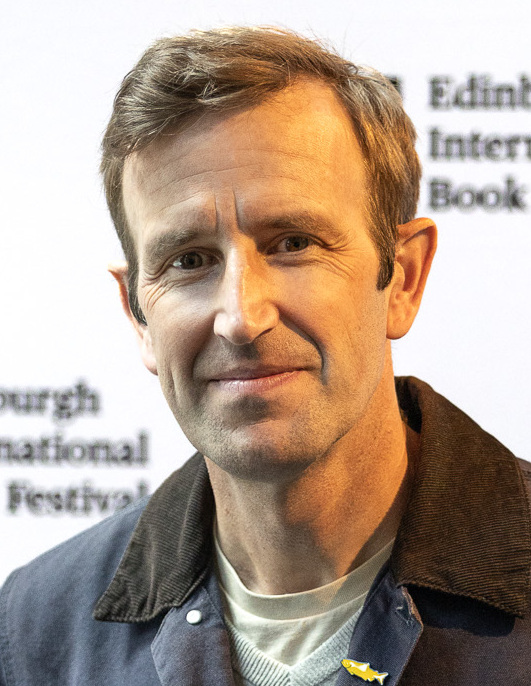
Photo of Robert Macfarlane
Photo: Amy Martin Photography · CC BY-SA 4.0 · via source

Author profile

Robert Macfarlane

British writer and Cambridge professor known for lyrical nonfiction about landscape, nature, language and the bonds between people and place.

1 published book 0 published articles

About Robert Macfarlane

Robert Macfarlane is a British writer and Professor of Literature and the Environmental Humanities at the University of Cambridge. He studied at Pembroke College, Cambridge, and Magdalen College, Oxford, later joining Emmanuel College as a Fellow. His work also extends into film, theatre and music.

Macfarlane writes literary nonfiction shaped by walking, close observation and research. Paths, mountains, underground spaces and rivers become ways of thinking about memory, language and environmental change. His prose moves between physical journeys and cultural history, drawing together fields such as geology, archaeology and natural history.

His books include Mountains of the Mind, The Wild Places, Landmarks, Underland and Is a River Alive? With artist Jackie Morris, he created The Lost Words and The Lost Spells. Mountains of the Mind won the Guardian First Book Award and Somerset Maugham Award; The Old Ways was shortlisted for the 2012 Samuel Johnson Prize. He received the E. M. Forster Prize for Literature in 2017, while Underland won the 2019 Wainwright Prize.

Begin with The Old Ways. Macfarlane follows footpaths, holloways, pilgrimage routes and sea roads, asking how movement through a place changes both traveller and landscape. It is an ideal introduction to his characteristic blend of journey writing, scholarship and attentive description.

Published books

Author

The Old Ways

In The Old Ways, Robert Macfarlane travels along ancient routes to investigate how paths connect landscape, history, imagination, and memory. His journeys encompass chalk tracks, holloways, pilgrimage roads, dangerous tidal crossings, mountain routes, and sea paths in Britain and beyond. Rather than treating a path as a line between destinations, Macfarlane reads it as a record made through repeated movement—a place where geology, ecology, language, custom, and personal experience converge. The poet and walker Edward Thomas serves as an important guiding presence, linking physical travel to literary remembrance. Macfarlane also walks with contemporary artists, writers, sailors, and local guides whose knowledge reveals different ways of inhabiting terrain. Blending travel narrative, nature writing, cultural history, biography, and meditation, the book argues that people shape paths while paths, in turn, shape perception, memory, and identity.

View book