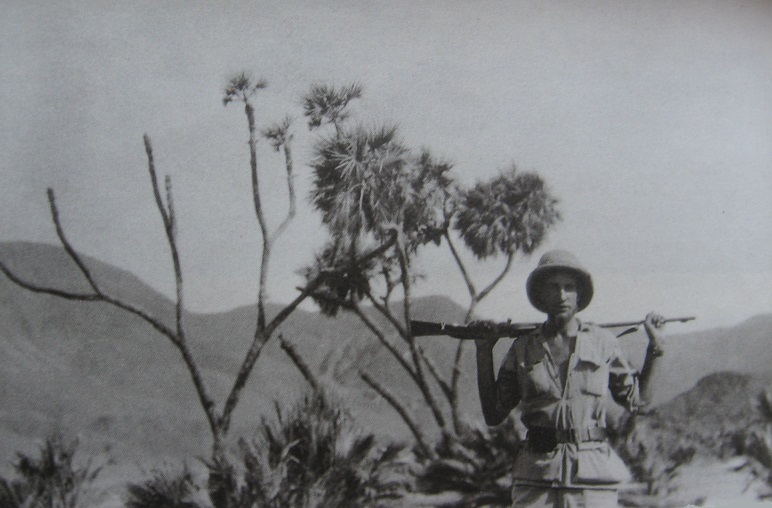
Photo of Wilfred Thesiger
Photo: Probably Umar, Wilfred Thesiger's Somali guide and interpreter, 1934 · Public domain · via source

Author profile

Wilfred Thesiger

British explorer, photographer and travel writer best known for Arabian Sands and The Marsh Arabs, books shaped by long journeys through Arabia and Iraq.

1 published book 0 published articles

About Wilfred Thesiger

Wilfred Thesiger was a British explorer, photographer and travel writer born in Addis Ababa in 1910. Educated at Eton and Magdalen College, Oxford, he served in the Sudan Political Service and in military roles during the Second World War. From 1945 to 1950 he travelled through southern Arabia, twice crossing the Empty Quarter by camel.

His travel writing grew from sustained journeys and close observation. Arabian Sands recounts his Arabian years and the hardships shared with his Bedu companions. The prose is direct and attentive to practical realities: wells, hunger, tribal boundaries and the exacting pace of camel travel. His photographs, now held by Oxford’s Pitt Rivers Museum, form another substantial record of the people and places he encountered.

The Marsh Arabs, published in 1964, draws on the years he spent among the Ma‘dan of southern Iraq. His later books include the autobiography The Life of My Choice, My Kenya Days and The Danakil Diary. The Royal Geographical Society awarded him its Founder’s Medal, and he was appointed CBE in 1968.

Begin with Arabian Sands. It is Thesiger’s defining account, built around two crossings of the Rub’ al Khali and sharpened by his awareness that motor travel and the oil economy were changing the world he described. Readers drawn to its combination of journey narrative and social observation should continue with The Marsh Arabs.

Published books

Author

Arabian Sands

Arabian Sands is Wilfred Thesiger’s account of his journeys through southern Arabia between 1945 and 1950, including two camel crossings of the Rubʿ al Khali, or Empty Quarter. Although the crossings supply the book’s physical drama, its deeper subject is the life Thesiger shared with his Bedouin companions: dependence on wells and camels, endurance of hunger and thirst, tribal obligations, hospitality, loyalty, raiding, and the constant judgment required for survival. Written after oil development and motor transport had begun transforming the region, the narrative also serves as an elegy for a social world Thesiger believed was disappearing. The book combines expedition narrative, portraiture, landscape description, and cultural observation. Its lasting interest lies in the tension between its unusually close record of mid-twentieth-century desert life and the unmistakably personal—and sometimes romanticizing—perspective through which that life is presented.

View book