
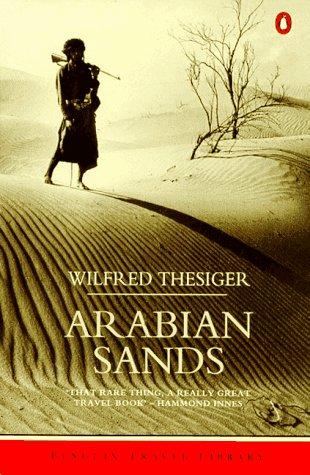
Arabian Sands
Arabian Sands is Wilfred Thesiger’s account of his journeys through southern Arabia between 1945 and 1950, including two camel crossings of the Rubʿ al Khali, or Empty Quarter. Although the crossings supply the book’s physical drama, its deeper subject is the life Thesiger shared with his Bedouin companions: dependence on wells and camels, endurance of hunger and thirst, tribal obligations, hospitality, loyalty, raiding, and the constant judgment required for survival. Written after oil development and motor transport had begun transforming the region, the narrative also serves as an elegy for a social world Thesiger believed was disappearing. The book combines expedition narrative, portraiture, landscape description, and cultural observation. Its lasting interest lies in the tension between its unusually close record of mid-twentieth-century desert life and the unmistakably personal—and sometimes romanticizing—perspective through which that life is presented.
Where to buy or borrow
Are you selling this book? Bookstores, publishers, authors and libraries can be listed here for free. Request a listing
About this book
Deep Overview
The book’s central journeys are two crossings of the Rubʿ al Khali. On the first, undertaken in 1946–1947, Thesiger and his companions moved from the southern edge of the desert across its eastern sands. The second crossing, in 1947–1948, took a western route from Yemen toward the interior and onward to Abu Dhabi. These journeys required close calculations of water, grazing, distance, camel condition, political boundaries, and tribal relations. Their danger came not only from heat and thirst but also from entering territory without secure permission, encountering hostile groups, and depending on uncertain wells.
Thesiger repeatedly makes clear that the crossings were collective achievements. Men including Salim bin Kabina and Salim bin Ghabaisha become central presences, not background guides. Their knowledge makes travel possible, while their constancy shapes Thesiger’s emotional understanding of companionship. Shared deprivation creates the book’s moral framework: courage is measured less by dramatic gestures than by patience, generosity, humor, and reliability when food and water are scarce.
The desert itself is presented as both material environment and ethical test. Its dunes, gravel plains, mountains, wells, and oases determine every decision. Yet Thesiger also turns the landscape into a standard against which settled, comfortable life appears diminished. This preference gives the prose much of its force, but it also produces one of the book’s central tensions. Hardship is real and sometimes deadly for the communities described; Thesiger, however, can regard it as a source of freedom and nobility partly because he has chosen it.
Beyond the crossings, the narrative ranges through Dhofar, the Hadhramaut, Oman, the Trucial Coast, Abu Dhabi, and parts of what is now Saudi Arabia. It records markets, rulers, tribal affiliations, hospitality, hunting, raiding, blood obligations, religious practice, and changing political authority. Thesiger’s meetings with Sheikh Zayed bin Sultan Al Nahyan also connect the book’s desert world to the later formation of the United Arab Emirates.
The closing significance of Arabian Sands lies in historical transition. Roads, engines, wage labor, expanding state power, and oil wealth were beginning to alter mobility and social relations across Arabia. Thesiger interpreted these changes chiefly as loss. Readers need not accept that judgment wholesale to recognize the value of his detailed record—or the power of a book that makes friendship, dependence, and cultural change as important as exploration itself.
Key Themes
**Friendship across cultural boundaries:** Thesiger’s strongest attachments are formed through travel with Bedouin companions. Mutual loyalty becomes his principal measure of human worth, though differences in privilege and mobility remain.
**Modernization and loss:** Motor vehicles, oil development, borders, and centralized government represent practical transformation. Thesiger treats them as forces dissolving a social order based on pastoral movement, tribal obligation, and desert expertise.
**The ethics of hospitality:** In conditions of scarcity, the duty to feed and protect a guest carries exceptional moral weight. Hospitality appears not as decorative custom but as a social institution essential to desert life.
**Landscape as a moral ideal:** Thesiger values the desert’s austerity because it strips life to necessities. His descriptions often turn geography into an implicit criticism of industrial society.
**Observation and romanticization:** The narrative offers precise firsthand detail while also idealizing selected forms of hardship, masculinity, and tradition. Productive reading requires holding those qualities together rather than choosing between admiration and dismissal.
Historical Context
At the same time, oil exploration and production were beginning to accelerate economic and infrastructural change. Roads, trucks, aircraft, wage employment, and stronger government administration would transform movement and settlement. The Trucial States encountered by Thesiger later became part of the United Arab Emirates in 1971, with Sheikh Zayed bin Sultan Al Nahyan as the federation’s founding president.
The book also belongs to a British tradition of Arabian exploration writing associated with figures such as T. E. Lawrence, Harry St John Philby, and Bertram Thomas. Arabian Sands inherits that tradition’s fascination with geographical difficulty and cross-cultural immersion, but it should also be read against the unequal power relations and assumptions of the late imperial era.
Intended Audience
It may be less suitable for anyone seeking a contemporary guide to Bedouin communities or a balanced social history of the Arabian Peninsula. Thesiger provides one traveler’s retrospective account, not a comprehensive regional study, and local people rarely receive the opportunity to frame their experiences independently of his narration. Readers uncomfortable with hunting, animal hardship, descriptions of violence, or period language should expect such material. The book rewards an audience willing to appreciate its literary and documentary qualities while critically examining its colonial-era viewpoint.
Reading Difficulty
Arabic names may appear in transliterations that differ from contemporary spellings, and the political geography does not always correspond neatly to current national boundaries. The narrative is episodic because it compresses several years of travel. Readers accustomed to modern memoirs may also find Thesiger emotionally restrained: affection and fear often emerge through actions and remembered details rather than explicit introspection.
Helpful Background Knowledge
Readers may also benefit from knowing that “Bedu” is Thesiger’s usual term for nomadic Bedouin communities and that tribal identity in the book affects protection, hospitality, access, and danger. Awareness of Britain’s political presence around the Gulf and southern Arabia helps explain Thesiger’s access and freedom of movement. Finally, familiarity with the beginnings of the Arabian oil era makes the book’s persistent sense of impending change more intelligible.
Why Read Arabian Sands?
The book is also valuable as a record of particular routes, individuals, practices, and landscapes during a period of rapid transformation. Its portraits preserve the personalities of named companions rather than reducing every encounter to scenery. Just as importantly, the book invites critical questions about who gets to describe a culture, why outsiders idealize difficult ways of life, and how nostalgia can preserve historical detail while simplifying change.
Reader Takeaways
Readers may also come away more alert to the ambiguity of modernization. New infrastructure can reduce hunger, isolation, and danger while weakening skills, relationships, and forms of independence built around an older environment. Finally, Arabian Sands provides a useful lesson in reading historical travel writing critically. An account can be observant, moving, and culturally significant while still carrying romantic assumptions, unequal perspectives, and judgments that deserve examination.
Strengths
The narrative’s extended time span is another advantage. Repeated journeys allow relationships and regional knowledge to deepen rather than producing a sequence of brief encounters. Maps and photographs strengthen the connection between literary narrative and historical documentation. The book also possesses a clear governing tension—the author’s admiration for austere nomadic life against the arrival of technological and economic change—which gives coherence to material gathered across several expeditions.
Limitations and Cautions
Women appear only marginally, leaving family life and gendered experience seriously underrepresented. The book also reflects the language and assumptions of a British traveler formed in an imperial age. Although Thesiger depended on and admired his companions, he retained privileges unavailable to them, including the ability eventually to leave the hardships he celebrated. Arabian Sands should therefore not be used alone as an ethnography or general history of Arabia. Its greatest value emerges when its detailed testimony is read alongside accounts by regional historians and Arab writers.
Important Concepts, People, and Places
**Rubʿ al Khali (Empty Quarter):** The immense sand desert spanning much of southern Arabia. Two camel crossings form the narrative and symbolic center of the book.
**The Bedu:** Nomadic Bedouin groups whose desert knowledge, tribal relationships, and hospitality make Thesiger’s journeys possible. The term encompasses distinct communities rather than a single uniform society.
**Salim bin Kabina and Salim bin Ghabaisha:** Rashid Bedouin companions who become two of the book’s most important figures. Their endurance, humor, and loyalty embody Thesiger’s ideal of desert companionship.
**The Rashid:** The Bedouin group from which several of Thesiger’s closest traveling companions came. Their expertise is essential to the Empty Quarter crossings.
**Dhofar and Salalah:** The southern Omani region and its principal city provided a base for early journeys toward the desert. Thesiger initially came to the area through anti-locust work.
**Hadhramaut:** A historical region largely in present-day Yemen. Its settlements, tribes, and routes form an important part of Thesiger’s southern Arabian travels.
**Liwa Oasis:** An oasis region on the northern edge of the Empty Quarter and an important destination or staging point in the crossings.
**Sheikh Zayed bin Sultan Al Nahyan:** Then the ruler’s representative in Al Ain and later the founding president of the United Arab Emirates. He supported Thesiger’s later regional travels with hospitality, guides, and camels.
**British Middle East Anti-Locust Unit:** The organization whose fieldwork gave Thesiger an official reason to enter southern Arabia, linking the beginnings of his travels to regional efforts to understand locust breeding.
**Camel pastoralism:** The ecological and social system underlying much of the narrative. Camels provide transport and sustenance, while access to water and pasture determines mobility.
**Hospitality and tribal protection:** Institutions that regulate encounters, safety, and obligation. They are practical mechanisms of survival as well as moral values in the book.
Questions the Book Explores
Can an outsider enter deeply into another society without turning it into an image of his own desires?
What is gained—and what may be lost—when roads, engines, wage labor, and centralized government replace older forms of mobility?
Why does Thesiger treat voluntary hardship as a form of freedom, and how does that judgment differ from the experience of those who cannot leave?
How do geography and scarcity shape hospitality, courage, leadership, and social obligation?
To whom does the achievement of an expedition belong: the person who records it, the companions who enable it, or the community whose knowledge makes the route possible?
How should later readers distinguish valuable observation from nostalgia and cultural idealization?
Reading Group Guide
Track moments when Thesiger’s companions make decisive contributions. Consider how the book would change if Salim bin Kabina, Salim bin Ghabaisha, or another companion narrated the same crossing. Compare the practical dependence visible in events with the authority Thesiger retains as author.
Notice how descriptions of the landscape shift between precise geography and moral symbolism. Ask when the desert is simply an environment and when it becomes an argument against modern life. A second productive thread is the treatment of change: list the benefits of modernization that Thesiger minimizes, then list the forms of knowledge or community that he fears will disappear.
Groups may also compare the photographs with the prose. Do the images individualize the people represented, support Thesiger’s elegiac vision, or create additional questions about observation and ownership?
Discussion Questions
2. Which companion emerges most clearly as an individual, and what narrative choices produce that effect?
3. Does the book distinguish convincingly between simplicity and deprivation?
4. How does voluntary hardship affect Thesiger’s interpretation of hardship experienced by others?
5. Where does admiration deepen his understanding of Bedouin life, and where might it distort that understanding?
6. How do wells, camels, and grazing function as social forces rather than mere expedition details?
7. What does hospitality mean in an environment where food and water are scarce?
8. How does the near absence of women limit the book’s picture of society?
9. Is Thesiger’s resistance to modernization persuasive, selective, or contradictory?
10. How should readers evaluate a work that is both a valuable record and a product of colonial-era travel culture?
11. What ethical obligations does a travel writer have toward companions who become subjects in a published narrative?
12. Would Arabian Sands have the same power if it lacked Thesiger’s nostalgia for a disappearing world?
Sources and Verification
Comments
No published comments yet.
Available editions
Paperback
paperback
- Publisher
- Penguin Classics
- ISBN-13
- 9780141442075
- Publication date