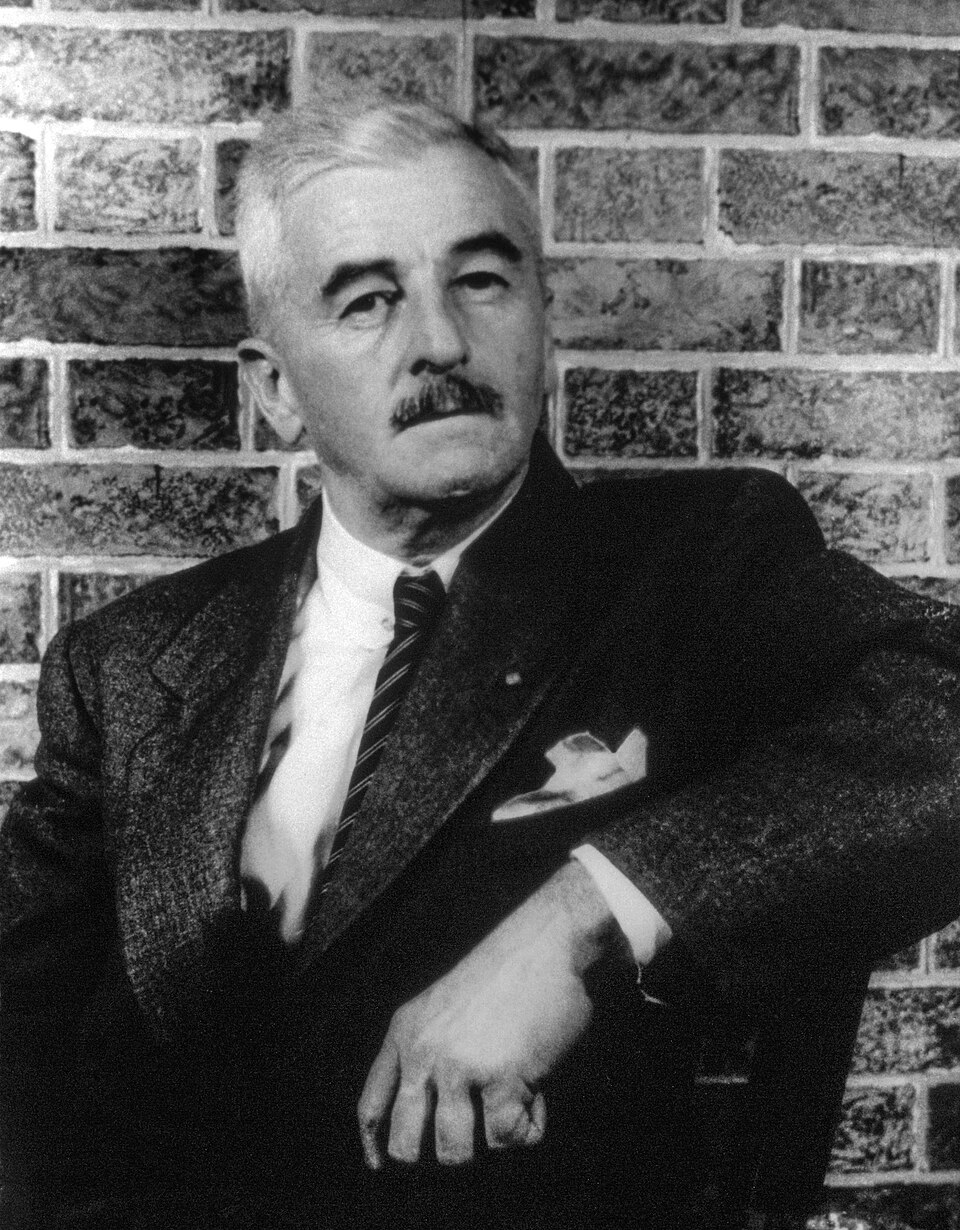
William Faulkner was born in New Albany, Mississippi, in 1897, and the family moved to Oxford, the small college town where he spent most of his adult life. He left high school early, then in the summer of 1918 enlisted in the Royal Air Force (Canada) in Toronto. The war ended before he finished training. Back in Oxford he worked as a postmaster for the University of Mississippi, eventually resigned the job, and earned his degree from the same school in 1920.
Nearly all of his novels and stories are set in Yoknapatawpha County, an invented Mississippi community where the same bloodlines and small-town figures resurface across decades of fiction. The subjects cluster around race, the collapse of the agrarian South, and the way families carry inherited damage into the next generation. His prose is dense, often unreliable in narrator, with timelines that braid back on themselves.
Faulkner received the 1949 Nobel Prize in Literature, the Swedish Academy citing a "powerful and artistically unique contribution to the modern American novel." He also won Pulitzer Prizes for Fiction for A Fable (1954) and The Reivers (1962). By the mid-1940s much of his output was out of print, and Malcolm Cowley's Portable Faulkner (1946) helped bring new readers back to the work.
The Sound and the Fury is the natural first book. Four separate voices tell the story of the Compson family's decline: Benjy, Quentin, Jason, and a third-person narrator. Benjy's opening section moves through a lifetime in a single present moment and is genuinely difficult, but the later perspectives untangle what the first one leaves knotted. If that wins you over, the shorter As I Lay Dying, about the Bundren family hauling their mother's coffin across the countryside, is a strong next step.