Deep Overview
The novel opens in a decaying, hungry, over-watched London, now the chief city of Airstrip One in the superstate Oceania. Society is split into the privileged Inner Party, the subordinate Outer Party to which Winston Smith belongs, and the largely unregarded proles. Winston works in the Ministry of Truth, where he rewrites past newspaper items so that they match whatever the Party currently claims. His labour shows the book's first major idea: whoever controls the record of the past can control what the present is allowed to mean.
Winston's rebellion begins as something small and almost involuntary, a private diary, a stray memory, a suspicion that the figures he handles are lies. Orwell keeps the story close to his protagonist's perception, so the reader feels the pressure of telescreens, informers, rationing and the constant propaganda of Big Brother as daily texture rather than abstract politics. The Thought Police do not need to catch every offender. They only need everyone to behave as if they might.
The middle of the novel is a fragile affair with Julia, a fellow Party worker. Their relationship matters because it is a rare area of sincerity and physical life in a world built to turn private feeling into public loyalty. Orwell also introduces O'Brien, an Inner Party figure whom Winston wants to trust. Through him, the novel moves from social observation to a theory of power. In the closing movement the Party's methods are explained in plain terms: it does not seek obedience as a means to some other end. It treats domination as its purpose.
Two embedded texts widen the book's argument. One is an in-world analysis of Oceania's permanent war and class structure, attributed to the regime's enemy Emmanuel Goldstein. The other is the appendix on Newspeak, a language designed to narrow the range of possible thought. Together they show Orwell testing how institutions, vocabulary and fear could interlock.
The book is not simply a prediction about 1984. Orwell's argument concerns mechanisms: the manipulation of facts, the shrinking of language, the use of endless war to justify control, and the psychological breaking of individuals. Readers who come to it only through its famous phrases often find it stranger, more intimate and more painful than its cultural reputation suggests. The sections of the book that deal with captivity are likely to unsettle even well-prepared readers.
Key Themes
Truth and the control of the past: the Party's authority rests on rewriting records, so that nothing outside its version can be proved. Language and thought: Newspeak is presented as a project to make dissent unthinkable by removing the words needed to express it. Surveillance and self-policing: the telescreen matters less as technology than as a reason for people to monitor themselves. Power for its own sake: the novel rejects the idea that tyranny is a tool for some higher goal. Individual consciousness versus collective belief: Winston's struggle is to trust his own senses and memory. Love, loyalty and betrayal: private attachments are treated as political threats. Perpetual war: the conflict among Oceania and its rival blocs works as a method of social management rather than a conventional struggle for territory.
Historical Context
Orwell wrote the novel in the aftermath of the Second World War, when the memory of Nazi Germany was fresh and the Soviet Union under Stalin had become a major world power. The Orwell Foundation notes that the book was written while he was seriously ill with tuberculosis, and describes it as a satire on totalitarianism. Orwell's earlier fable Animal Farm, also hostile to Stalinism, had already established his public voice on the subject, and his reportage and fiction of the 1930s had shown his concern with poverty and oppression.
The book appeared at the start of the Cold War, and it was quickly absorbed into political arguments of that era. Its themes also have wartime roots: censorship, propaganda, rationing, bomb damage and the manipulation of official information were all part of British life in the 1940s. Later writers, including those who experienced Soviet repression, have been read alongside it. The critic Ben Pimlott argued in an introduction published by the Orwell Foundation that the novel shaped how others, including survivors of such systems, would describe totalitarianism. Pimlott also contended that some of its literal warnings had not come true on the schedule Orwell implied.
Intended Audience
The book suits readers who want to understand where terms such as Big Brother, thoughtcrime and doublethink come from. It also suits students of political fiction, history or media, and anyone who wants a foundational example of the dystopian genre. It is accessible to confident teenage and adult readers. Readers who prefer plot-driven thrillers may find the long expository passages slower than expected. Those sensitive to depictions of torture, psychological coercion and bleak endings should approach the final third with care. Readers who want a hopeful or reassuring treatment of politics will not find one here.
Reading Difficulty
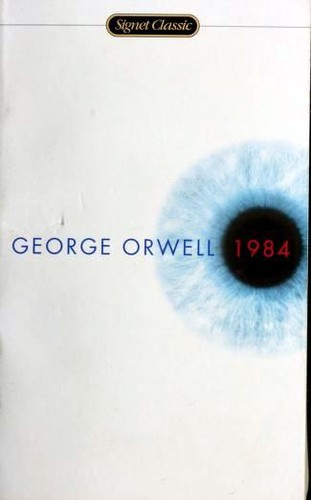
Orwell's prose is plain and direct, and the sentences are rarely complicated. The challenge is emotional and conceptual rather than linguistic. The pacing varies: the opening chapters build atmosphere carefully, the middle accelerates around the central relationship, and the late chapters contain dense dialogue about power and reality. The two embedded texts, the political treatise and the Newspeak appendix, are expository and may slow the pace. This edition is a small mass market paperback of roughly 352 pages, so print is compact; readers who prefer larger type may want to compare formats. No specialist knowledge is needed, though some familiarity with twentieth-century politics deepens the reading.
Helpful Background Knowledge
A basic grasp of the Second World War, the rise of fascist and communist regimes, and the early Cold War is the most useful preparation. Some familiarity with propaganda and censorship, and with Orwell's own essays on politics and language, adds depth. It also helps to know that the novel is set in an imagined future from the viewpoint of 1948 to 1949, so it should be read as a warning built from contemporary tendencies rather than a literal forecast. Readers who have encountered the book's phrases only in popular culture should expect the novel to complicate their sense of what those phrases mean. Reading the new introduction and afterword in this edition after the novel, rather than before, avoids unintended spoilers.
Why Read This Book?
Few novels have supplied as much of the modern political vocabulary. Reading the original shows how those terms work inside a story, which is quite different from encountering them as slogans. The book is also unusually good at showing how oppression is experienced by an ordinary, flawed, frightened person rather than a heroic one. Its concerns, including official falsehood, language manipulation and constant monitoring, give readers a framework for discussing contemporary media and politics without needing the novel to be a literal prophecy. This anniversary edition is also useful for readers curious about how a new generation of writers responds to Orwell: the afterword comes from the author of a novel that retells the story from Julia's perspective. For a first encounter with classic dystopian fiction, it is among the clearest starting points.
Reader Takeaways
A careful reader may come away better able to separate surveillance as a technology from surveillance as a social habit of fear. They may notice how control of vocabulary and records shapes what a society can argue about. They may reconsider the idea that a regime needs ideology or economic goals to justify itself, since Orwell portrays power as self-justifying. They may also notice how the book places private relationships, memory and bodily experience at the centre of political resistance. Finally, readers can practise distinguishing the novel's actual arguments from the many slogans and misuses attached to it in public debate.
Strengths
The novel's central system is coherent: records, language, surveillance, war and psychological methods reinforce one another. Orwell's plain style keeps a sophisticated argument accessible. The close focus on Winston gives the politics human stakes. The embedded treatise and appendix give the world documentary depth that few later dystopias match. The book also has remarkable staying power as a shared reference point for discussing propaganda and authoritarian control, which makes it highly useful in classrooms and reading groups. This edition adds contemporary contributions that place the book in a current conversation.
Limitations and Cautions
The novel reflects its mid-twentieth-century moment, and some of its specific imagery, such as telescreens and rationed goods, belongs to the 1940s. Critics including Ben Pimlott have noted that the book's literal timetable did not come true and that its literary weaknesses are easier to see with distance. Some readers find the expository passages heavy, and the female characters have often been discussed critically; the Julia retelling referenced in this edition is one response to that criticism. The book has also been claimed by very different political camps, so readers should be cautious about interpretations that treat it as support for one party or doctrine. The torture sequences and the bleak ending are distressing. Note too that the same ISBN has been attached to several printings with different supplementary essays and page counts, so the edition in hand may differ from descriptions of older ones.
Important Concepts, People, and Places
Winston Smith: the protagonist, an Outer Party worker whose private doubts drive the plot. Julia: the woman with whom Winston begins a secret relationship, and the subject of Sandra Newman's later retelling. O'Brien: an Inner Party member who embodies the regime's intellectual and psychological methods. Big Brother: the Party's symbolic leader, presented as an object of devotion whose literal existence is uncertain. Emmanuel Goldstein: the regime's official enemy, to whom an in-world political treatise is attributed. Oceania, Eurasia and Eastasia: the three superstates locked in permanent war. Airstrip One: the name for Britain within Oceania. Ministry of Truth: the institution where Winston rewrites records; the Orwell Foundation notes that its inspiration was Senate House in London. Thought Police and thoughtcrime: the machinery and category by which inner dissent is punished. Newspeak: the engineered language designed to restrict thought. Doublethink: the capacity to hold contradictory beliefs and accept both. Room 101: the place associated with the novel's final coercion. Inner Party, Outer Party and proles: the three social tiers of Oceania. Animal Farm: Orwell's earlier political fable, a useful companion text.
Questions the Book Explores
What happens to a society when the past can be changed at will and no independent record survives? Can language be shaped to limit what people are able to think? Is there a core of private judgement that no authority can remove, or can minds be remade? Why might a ruling group pursue power as an end in itself? How does permanent war serve those who govern? What role do love, loyalty and betrayal play when personal feelings are treated as political acts? And how reliable is any individual's memory or perception when everyone around them insists on a different account?
Reading Group Guide
The novel works well over two or three sessions. A natural split is the opening exposition and Winston's first acts of dissent, then the relationship with Julia and the visit to O'Brien, then the later chapters and the appendix. Groups may want to agree in advance whether to read the introduction and afterword before or after the novel, since both may shape expectations. It helps to start by asking members which phrases from the book they already knew, and whether the novel matched those associations. Because the closing chapters are harrowing, a group may wish to check in about pacing and content before reaching them. The book discussion questions below are intended as starting points rather than a fixed agenda, and members are encouraged to bring passages they found surprising. A comparison session with Animal Farm or with Sandra Newman's Julia can extend the conversation.
Discussion Questions
1. Winston's job is to rewrite records. How does that work make him both a participant in and a critic of the regime?
2. Why does Orwell show the Party's power through everyday detail such as food, housing and slogans rather than only through large events?
3. Newspeak aims to narrow thought. Which parts of that idea seem persuasive, and which seem exaggerated?
4. What does the relationship between Winston and Julia suggest about the possibilities and limits of private resistance?
5. How do the three superstates and their continuous war function in the story?
6. Why do you think Orwell includes long explanatory passages from a text within the novel? Do they strengthen or interrupt the narrative?
7. How does the ending affect your view of Winston's earlier choices?
8. Which present-day debates about information, privacy or language does the novel illuminate, and where does the comparison break down?
9. How might the book read differently with a new introduction and afterword by contemporary authors?
10. Which character's perspective do you find least developed, and what would be gained by hearing more from them?
Sources and Verification
This profile draws on the publisher's own catalogue information for the Signet edition, an open library catalogue record for the ISBN, a reference-work entry on the novel's first publication, and material from the Orwell Foundation including an introduction by the critic Ben Pimlott. A general reference encyclopedia and a research-guide summary were used for author background and plot confirmation. Descriptions and analysis are the editors' own. Bibliographic details for this ISBN vary across printings: the page count shown follows the publisher's current listing, and an exact publication date for this printing could not be confirmed, so none is given. The original 1949 publication details refer to the first British edition, not to this paperback.