Category

Comparative Religion

4 published books 0 published articles

Books in this category

Primary category

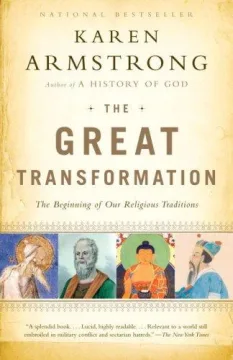
The Great Transformation

The Beginning of Our Religious Traditions

By Karen Armstrong

Karen Armstrong examines the formative centuries commonly called the Axial Age, when major religious and philosophical traditions developed across China, India, Israel, and Greece. Moving among Confucianism, Daoism, Hindu traditions, Buddhism, Israelite monotheism, and Greek rational inquiry, she asks why comparable ethical and spiritual innovations appeared in societies with no single shared history. Armstrong connects these developments to political upheaval, warfare, urbanization, and changing social structures. Her central emphasis is not doctrinal agreement but a recurring turn away from ritual performed for its own sake and toward inward discipline, compassion, self-criticism, and responsibility for others. Figures including Confucius, the Buddha, Socrates, and the prophet Jeremiah become part of a comparative account of humanity’s attempts to answer violence without reproducing it. The result is an ambitious history of ideas that also challenges modern readers to reconsider wha…

View book

Primary category

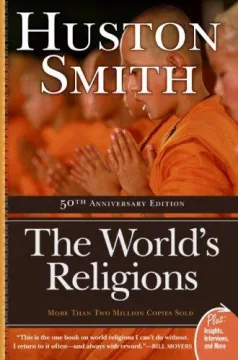
The World's Religions

By Huston Smith

Huston Smith introduces several of the world’s most influential religious traditions by asking what makes each one compelling to its adherents. Separate chapters consider Hinduism, Buddhism, Confucianism, Taoism, Islam, Judaism, Christianity, and traditions Smith groups under the historically common but now contested label “primal religions.” Rather than attempting an exhaustive institutional history, he concentrates on formative teachings, spiritual ideals, conceptions of reality, and paths of human transformation. The result is a sympathetic work of comparative religion that treats faiths as living responses to enduring questions about suffering, purpose, morality, community, and transcendence. Smith’s approach helped make the book an enduring introduction to religious diversity, but it also reflects the assumptions of an earlier generation of religious studies: it favors coherent spiritual essences over internal disputes, political conditions, and everyday variations. Readers can t…

View book

Primary category

The Case for God

By Karen Armstrong

Karen Armstrong presents a wide-ranging intellectual history of how human beings have approached God, sacred reality, and religious knowledge. Moving from Paleolithic ritual through ancient philosophy, Judaism, Christianity, Islam, medieval theology, the scientific revolution, the Enlightenment, modern atheism, and fundamentalism, she argues that religion was traditionally understood less as assent to factual propositions than as a disciplined way of life. Ritual, ethical conduct, contemplation, myth, and compassion were practices through which people sought transformation and transcendence. Central to her account is the apophatic tradition: the recognition that ultimate reality exceeds literal description and conceptual mastery. Armstrong contends that modern believers and critics often share an overly rationalized picture of God, treating religious language as if it were scientific explanation. The book therefore makes its “case” not by proving a supernatural being, but by recoverin…

View book

Primary category

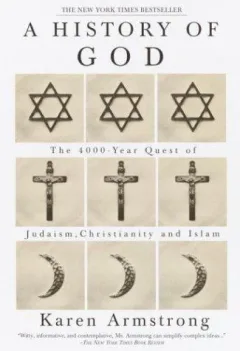
A History of God

The 4,000-Year Quest of Judaism, Christianity and Islam

By Karen Armstrong

Karen Armstrong traces changing ideas and experiences of God across Judaism, Christianity, and Islam, beginning in the ancient Near East and continuing through classical philosophy, medieval mysticism, the Reformation, the Enlightenment, modern atheism, and twentieth-century theology. Rather than attempting to prove or disprove God’s existence, the book examines how communities repeatedly reformulated the divine in response to intellectual, political, and spiritual change.

View book

Articles in this category

No published articles are currently connected to this category in this language.