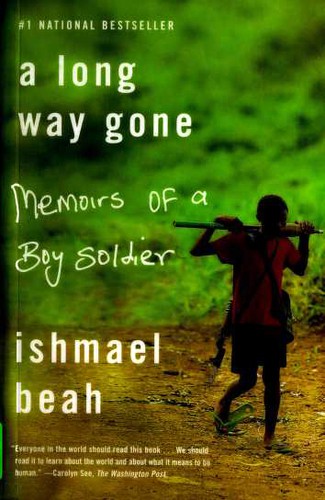
Deep Overview
The book's outline is chronological, but its emotional shape is a descent followed by a partial, uncertain return. It begins when the war still seems far away to a boy who loves hip-hop, dancing and storytelling. Beah and his older brother Junior travel with friends to a talent show in another town. While they are away, rebels attack the region, and home can no longer be reached.
The long middle stretch is a story of flight. Small groups of boys move through forest and ruined settlements. They are hunted by rebels and distrusted by villagers who fear that any boys on the road might be insurgents. They lose companions one by one, and with them any sense of a future. Hunger, sleeplessness and the constant replaying of what they have seen wear down the narrator's ordinary childhood habits.
The turning point is his recruitment by the government army. Beah presents it as a bargain between survival and complicity: the unit offers food, shelter, belonging and a target for grief and rage. He describes how commanders used drugs, war films and rehearsed revenge to turn frightened boys into efficient fighters. He recounts his own acts of killing in a restrained, almost flat voice that avoids both self-justification and spectacle. The moral interest of this section lies in the difficulty of seeing a child as fully responsible and fully innocent at once.
The final third moves to Freetown. After he is taken out of the army and brought to a rehabilitation centre run by humanitarian workers, he arrives hostile and physically unwell. Withdrawal, headaches and violent nightmares come with the anger. A nurse named Esther becomes central to the slow thaw. The book treats recovery as repetitive, relational work: small gestures of patience, a return to music and the first fragile experiences of trust. He is later taken in by a relative. When the conflict reaches the capital, he has to flee again. The book ends with his departure for the United States, where new acquaintances ask about his past and he answers sparingly.
Beah seems to be demonstrating three things. First, child soldiers are made through identifiable processes, and the fact that they are made implies they can be unmade. Second, rehabilitation depends on relationships more than slogans. Third, memory is both testimony and burden. The book's flashes of lyrical, sensory detail sit beside accounts of horror, and the narrator's present-day voice carries an awareness of how hard it is to be believed.
Key Themes
Lost childhood runs through the book: school, music and play are replaced by hunger, vigilance and violence. A second theme is moral ambiguity, since a boy is both coerced and an agent of harm. Beah also examines how armies manufacture obedience through drugs, propaganda, repeated exposure to violence and group loyalty. Another theme is the role of art and memory in survival, especially hip-hop, storytelling and the fragments of his family's life that he keeps hold of. Recovery appears as a long, non-linear process that depends on patient adults. Finally, the book considers what it costs to tell such a story to outsiders who may doubt it or fail to comprehend it.
Historical Context
The memoir is set against the Sierra Leone civil war, which began in 1991 when the Revolutionary United Front launched an insurgency from the Liberian border and which lasted until 2002. Over that decade the conflict involved the national army, rebel forces, militias and, at times, regional and international intervention. Both sides recruited children. The memoir covers only a slice of this period, as seen by a boy moving between provincial towns, the countryside and the capital. In the period when the book appeared, international attention to child soldiers had grown through UN agencies, human rights groups and humanitarian organisations, and Beah later became an advocate in this field. The Sierra Leone setting also overlaps with a broader literary tradition of African war testimony and with Western debates about how first-person suffering narratives are marketed and verified.
Intended Audience
The book suits general readers who want a human-scale account of modern warfare, students of African studies, human rights, development or social work, and teachers looking for a text that prompts discussion of conflict and recovery. It is also useful for readers interested in how trauma is narrated. Readers who need a political or military history of the Sierra Leone war will find the book too narrow for that purpose. People sensitive to depictions of killing, drug use and the abuse of children should approach it with care.
Reading Difficulty
The prose is direct, with short sentences, uncomplicated vocabulary and a clear chronological order. The paperback runs to about 230 pages and divides into brief chapters that are easy to read in sessions. The difficulty is emotional rather than linguistic. Scenes of violence, drug dependency and loss are described plainly but at length, and the narrator's account of his own actions can be disturbing. Place names, local terms and military ranks are introduced mostly through context, and the book includes a map. Readers who prefer explanatory background may want to read a short overview of the war alongside it.
Helpful Background Knowledge
No specialist knowledge is required. A short outline of the Sierra Leone civil war, including the rebel movement, the role of the national army and the 1990s coups, will help readers place the narrator's movements. It also helps to know a little about Sierra Leone's geography, with the mining and farming provinces in the south and the capital, Freetown, on the coast. Some familiarity with the debate on memoir and verification will add context for the controversy that followed publication. Readers should also keep in mind that the narrator is recalling events as a young adult, years after they happened.
Why Read This Book?
Among memoirs to read about war, this one is unusual in offering a child's-eye account of both perpetration and recovery rather than only victimhood. Its restrained style lets the events speak without heavy commentary, which many readers find more affecting than lengthy reflection. The book also gives a rare picture of the practical work of rehabilitation: what it asks of survivors and of the adults who care for them. Finally, it is a useful case for discussing how readers weigh emotional truth against factual precision in life writing.
Reader Takeaways
A careful reader may come away with a clearer sense of how recruitment, drugs, propaganda and grief combine to turn children into fighters, and why simple labels of victim or perpetrator fall short. They may also notice how the narrator depicts recovery as slow and dependent on trust, and how music and storytelling work as anchors for identity. The book also encourages readers to think about the ethics of reading suffering accounts, including how to respond to the debate over their factual details.
Strengths
The memoir's central strength is its voice: spare, controlled and unsentimental, with concrete sensory detail that makes events feel immediate. Its structure moves clearly from home to war to rehabilitation, so the reader understands not only what happened but how a person changes. It treats the aftermath of violence seriously, giving rehabilitation as much attention as combat. The short chapters make a heavy subject manageable without softening it. It has also been a useful starting point for classroom and community conversations about child soldiers and human rights.
Limitations and Cautions
The book is a personal account, not a history, and it offers little on the political causes, factions or wider course of the Sierra Leone war. Its factual details have been disputed. In early 2008 an Australian newspaper published a series of articles arguing that key dates in the memoir were inaccurate and that Beah's time as a soldier was shorter than the book suggests. Beah, his editor and his agent denied the allegations and defended the account, and Beah pointed to Sierra Leonean sources who supported his chronology. The dispute was never settled to everyone's satisfaction, and readers should treat the book as a survivor's recollection whose exact timeline remains contested. The detailed recollection of dialogue and scenes from years earlier also invites reasonable questions about memory and reconstruction. Graphic content makes the book unsuitable for some readers without preparation.
Important Concepts, People, and Places
Ishmael Beah is the author and narrator, born in 1980 in Sierra Leone, who later became a UNICEF Goodwill Ambassador and a human rights advocate. Junior is his older brother, whose separation from him marks the start of his displacement. Sierra Leone civil war is the conflict that frames the narrative. Mattru Jong and Yele are among the towns and villages in the account, tied to the narrator's departure from home and his lost family. The Sierra Leone Army is the government force that recruits him, and the rebel forces are the enemy that drives him from his home. UNICEF is the agency associated with the rehabilitation centre that takes him in. The Benin Home in Freetown is the centre where he begins to recover, and the nurse Esther is a key figure in that process. Freetown is the capital where recovery and renewed danger overlap. Laura Simms, the storyteller and writer who helped him in the United States and later with the book, appears in the debate over the memoir's accuracy. The Australian newspaper that questioned the memoir's chronology belongs to the book's publication history.
Questions the Book Explores
How does a child move from fleeing violence to committing it, and who bears responsibility? What do armies and communities do to make that transition possible? What conditions allow someone to recover after prolonged brutality, and how long does that take? What does it mean to be believed when telling a story that is hard to imagine? How do music, memory and storytelling help a person hold onto identity? And how should readers balance empathy for a narrator with scrutiny of his account?
Reading Group Guide
For book club books with heavy subject matter, begin by acknowledging the content and agreeing on pacing. Groups may want to read the book in three parts: the flight from home, the army, and rehabilitation. Each part raises different questions, about survival, responsibility and recovery. Bring a short note on the Sierra Leone war so that members share the same basic facts. A second session could look at the 2008 dispute over the book's chronology and discuss how readers should treat memoir. It may help to separate two questions: what the book shows about the process of making and unmaking child soldiers, and how confident we can be in its precise dates. Check in with members about how they are responding, since the material can be upsetting.
Discussion Questions
1. Why do you think Beah opens with scenes of ordinary adolescent life before the war reaches him? How does that choice shape your reading of what follows?
2. How does the book handle the question of responsibility for acts committed as a child under coercion?
3. What roles do music, storytelling and memory play in the narrator's survival and recovery?
4. How does the narrator describe the way commanders shaped the boys' behaviour, and what does that suggest about how groups produce violence?
5. What do the rehabilitation chapters suggest about the difference between physical safety and real recovery?
6. How did the plain, restrained style affect you, and what might a more reflective or analytical style have changed?
7. Given the public dispute about the memoir's timeline, how should readers weigh factual precision against the account's broader testimony?
8. What does the ending suggest about whether it is possible to leave a past like this behind?
Sources and Verification
This profile draws on library catalogue records and the Library of Congress record to identify the book and its first paperback edition, on the publisher's page and retailer listings for edition details, and on an open bibliographic database and an encyclopedia entry for author background. Coverage of the 2008 dispute over the memoir's accuracy comes from reporting in an industry magazine, a cultural magazine and a book news site. Page counts differ between library records and retailers, and an exact paperback publication date could not be confirmed from a first-party or library source, so none is given. Broader historical context on the Sierra Leone civil war is general background and has not been tied to a specific cited source. Readers are encouraged to consult the book itself and independent histories for further detail.