
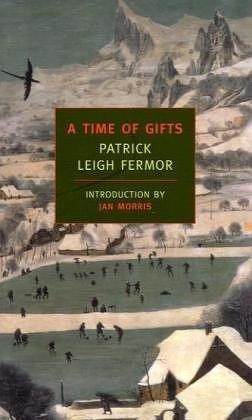
A Time of Gifts
On Foot to Constantinople: From the Hook of Holland to the Middle Danube
In December 1933, eighteen-year-old Patrick Leigh Fermor began walking from the Hook of Holland toward Constantinople. A Time of Gifts follows the first portion of that journey through the Low Countries, Germany, Austria, Czechoslovakia, and toward Hungary. He moves between barns, inns, monasteries, workers’ homes, and aristocratic houses, observing landscapes and social worlds that would soon be transformed by dictatorship and war. Written more than four decades after the walk, the book combines youthful immediacy with an older writer’s historical knowledge. Rivers, buildings, songs, languages, legends, religious traditions, and chance encounters become routes into Europe’s layered past. The result is at once a travel narrative, a coming-of-age memoir, and an elegy for the cultural variety of interwar Central Europe. Its central achievement lies less in reaching a destination than in showing how attentive movement through unfamiliar places can turn geography into lived history.
Where to buy or borrow
Are you selling this book? Bookstores, publishers, authors and libraries can be listed here for free. Request a listing
About this book
Deep Overview
The route supplies the book’s structure, yet Leigh Fermor seldom treats travel as simple forward progress. Walking slows the continent down. Weather, distances, river crossings, village streets, church interiors, ruined fortifications, dialects, and local customs acquire narrative importance because he encounters them bodily and without much insulation. His limited means lead to nights in humble lodgings and encounters with laborers, innkeepers, students, priests, and rural families. Letters of introduction and chance hospitality also open aristocratic households to him. These shifts expose him to contrasting social strata, though his access remains that of an adventurous young Englishman moving through cultures not his own.
The Rhine and Danube function as more than landmarks. They become historical corridors carrying Roman frontiers, medieval legend, ecclesiastical power, Habsburg memory, trade, warfare, music, and migration. Leigh Fermor repeatedly reads visible landscapes through inherited stories. Castles call up dynasties and sieges; monasteries connect architecture with religious life; place-names lead into linguistic speculation; songs and clothing suggest overlapping regional identities. His Europe is not a neat collection of nation-states but a dense palimpsest of Germanic, Latin, Slav, Magyar, Jewish, and other influences.
Political danger appears intermittently rather than governing every scene. Adolf Hitler had become German chancellor in January 1933, and the traveler crosses Germany as National Socialism is consolidating power. Uniforms, symbols, conversations, and public behavior indicate the changing climate, but the young walker does not possess the hindsight of the author. That gap creates one of the book’s most important tensions. Readers know that the communities, borders, and assumptions presented here stand close to catastrophe; the traveler usually does not.
The book is therefore shaped by two consciousnesses. One belongs to the sociable eighteen-year-old, receptive to beauty, novelty, friendship, and risk. The other belongs to the mature writer reconstructing the journey after war had remade Europe. Their perspectives overlap without fully merging. Youth gives the narrative energy and openness; retrospection supplies historical depth and elegiac force. What emerges is not a transparent diary but a crafted meditation on memory, historical loss, and the education made possible by sustained attention to place.
Key Themes
**Youth and retrospective knowledge:** The young traveler’s confidence is continually shadowed by the older author’s awareness of what happened after 1933. This double vision gives ordinary scenes historical poignancy.
**Hospitality across social boundaries:** Shelter and companionship come from people in cottages, inns, monasteries, bourgeois homes, and castles. These encounters reveal generosity while also exposing the traveler’s unusual freedom and social mobility.
**Europe as accumulated history:** Roman remains, Christian institutions, medieval legend, imperial politics, and modern nationalism coexist in the same places. The book resists treating landscape as empty scenery.
**Language and cultural identity:** Words, accents, songs, names, and etymologies repeatedly become clues to migration and cultural mixture.
**Impending political rupture:** National Socialism is present as an advancing force, although the narrative does not convert every encounter into an omen. The tension comes from knowing how much the traveler cannot yet foresee.
**Memory and reconstruction:** Because the account was written decades later, it asks readers to consider how remembered experience is reorganized through research, style, and subsequent history.
Historical Context
Central Europe still bore the imprint of the Austro-Hungarian Empire, dissolved after the First World War. New or enlarged states, including Czechoslovakia, existed beside older regional, religious, linguistic, and aristocratic affiliations. Vienna remained filled with imperial memory even though it was now the capital of a much smaller Austrian republic. The book’s castles and noble households likewise belonged to a social order whose security had already been weakened and would be further disrupted by war and postwar political change.
The work also emerged from a later historical moment. Published in 1977, it was written with knowledge of the Second World War, the Holocaust, Soviet influence in Eastern and Central Europe, and altered borders. Its depiction of 1933–34 is therefore inseparable from mourning for communities and cultural continuities that later violence destroyed or dispersed.
Intended Audience
It may be less suitable for anyone seeking a concise itinerary, a practical travel guide, or a consistently fast adventure narrative. Political history is important but episodic rather than systematic. Readers who prefer plain, minimalist prose may also find Leigh Fermor’s extended sentences and abundant cultural references demanding.
Reading Difficulty
The pace varies accordingly. Encounters and episodes can move quickly, while discussions of buildings, dynasties, legends, or linguistic connections invite slower reading. A map helps readers track the changing place-names and prewar borders. No specialist training is required, but patience with digression—and willingness to look up unfamiliar references—greatly improves the experience.
Helpful Background Knowledge
Readers may also benefit from recognizing that place-names and national boundaries have changed since the journey. Constantinople was already officially named Istanbul in the Turkish Republic, although the older English name remained common in Leigh Fermor’s milieu and frames his youthful destination. Some locations appear through German, Hungarian, Czech, Slovak, or historical forms.
It is equally helpful to approach the book as a later literary reconstruction rather than a daily journal reproduced without alteration. The mature author’s research and historical understanding are integral to the narrative voice.
Why Read This Book
The book is also valuable as a portrait of Europe at a historical threshold. Its people do not exist simply as representatives of a doomed age; they appear as hosts, companions, conversationalists, believers, workers, and eccentrics living in an uncertain present. Finally, the distance between the journey and its composition creates a sophisticated study of memory: exuberant youth is preserved, but it is surrounded by an older consciousness of loss.
Reader Takeaways
Readers may reconsider memoir as a genre. Recollection here is not merely retrieval; it is selection and interpretation shaped by everything the writer later learned. The work encourages attention to the difference between what a person experienced at the time and what that experience came to mean afterward.
It also complicates nostalgia. Leigh Fermor’s affection for vanished customs and social forms is powerful, but the same landscape contains class privilege, nationalism, authoritarianism, and approaching persecution. Admiration and historical scrutiny must therefore remain in conversation.
Strengths
Its narrative voice preserves youthful curiosity without pretending that the account was written by the young traveler on the spot. The resulting double perspective produces humor, wonder, and foreboding at once. The geographical progression provides cohesion even when the author digresses widely.
The social range of the journey is another strength. Movement between modest shelters and elite households creates a varied portrait of hospitality and custom. The elaborate prose is not incidental ornament; at its best, its rhythms and associations reproduce the abundance with which the traveler perceives Europe.
Limitations and Cautions
Leigh Fermor’s freedom of movement was shaped by his nationality, gender, social connections, and letters of introduction. Although he meets people across class lines, his strongest sustained access is often to male and socially privileged worlds. Women, Jewish communities, and other populations facing particular dangers in 1930s Europe are not represented with equal depth.
The book’s affection for aristocratic hospitality and vanished traditions can encourage nostalgia. Its historical digressions are learned but personal rather than systematic, and some linguistic or cultural generalizations reflect the assumptions of the author’s period. The ornate style will be a pleasure for some readers and an obstacle for others.
Important Concepts, People, and Places
**Xan Fielding:** The friend and wartime colleague addressed in the book’s introductory letter. This framing presents the narrative as recollection shared with someone connected to Leigh Fermor’s later life.
**The Hook of Holland:** The continental starting point of the walk and the gateway into the wintry Low Countries.
**The Rhine:** Both a travel route and a cultural archive associated with trade, castles, political frontiers, romantic legend, and German history.
**The Danube:** The book’s major organizing river. It carries the traveler toward Austria, Czechoslovakia, and Hungary while linking regions once joined within larger imperial systems.
**Vienna:** The former Habsburg imperial capital, encountered as a modern city still saturated with the architecture and memory of empire.
**Prague and Czechoslovakia:** Prague provides one of the journey’s major urban interludes, while Czechoslovakia represents the newer political map created after the First World War.
**The Habsburg monarchy:** Though dissolved before the journey, its institutions, aristocratic networks, buildings, and cultural mixtures remain visible throughout the Danube lands.
**National Socialism:** The authoritarian movement taking control of Germany during the journey. Its public symbols and social pressures form a disturbing countercurrent to the traveler’s encounters.
**Mitteleuropa:** A cultural and historical idea of Central Europe that crosses modern national boundaries. The book presents it through overlapping Germanic, Slav, Magyar, Jewish, Catholic, Protestant, and imperial inheritances.
**Hospitality:** More than a recurring convenience, hospitality is the social mechanism that gives the traveler access to otherwise separated communities and classes.
**Retrospective narration:** The mature author writes with knowledge unavailable to his younger self, allowing the book to hold innocence and historical foreknowledge in productive tension.
Questions the Book Explores
Can an older writer recover youthful perception without replacing it with hindsight?
What survives when empires disappear but their languages, buildings, customs, and social networks remain?
How do rivers connect cultures while also serving as political and symbolic boundaries?
What can hospitality reveal about class, identity, and the privileges carried by a traveler?
How should readers respond to beauty and conviviality in a society moving toward dictatorship and war?
Where is the boundary between remembered experience, researched history, and literary reconstruction?
Can nostalgia preserve cultural variety without concealing injustice or political danger?
Reading Group Guide
Compare scenes in barns, inns, family homes, monasteries, and castles. Consider what the traveler learns in each setting, what remains inaccessible to him, and how letters of introduction alter the apparent spontaneity of the journey.
Identify moments when the youthful viewpoint dominates and others when the mature author’s historical awareness becomes unmistakable. Groups may find it useful to ask whether these two perspectives reinforce or undermine each other.
Pay attention to passages involving Nazi symbols, political conversations, or collective behavior. Rather than treating every detail as prophecy, examine how the narrative balances ordinary life with signs of approaching rupture.
Finally, select one extended description or historical digression and consider its function. Does it deepen place, delay the journey, display learning, imitate memory, or accomplish several of these at once?
Discussion Questions
2. How does the long interval between journey and publication affect your trust in the narrative?
3. Where do you most clearly hear the youthful traveler, and where do you hear the mature writer?
4. How does the book use the Rhine and Danube differently—as routes, symbols, and historical archives?
5. What forms of privilege enable Leigh Fermor’s journey, and how openly does the book acknowledge them?
6. How do encounters with working people compare with visits to aristocratic households?
7. Does the book romanticize the prewar European order, or does its awareness of political danger sufficiently complicate that nostalgia?
8. How are National Socialism and authoritarian behavior registered in everyday scenes?
9. Which digressions most enrich the journey, and which interrupt it for you?
10. What responsibilities does a memoirist have when reconstructing dialogue and detail after many years?
11. How does the book portray cultural identity as layered rather than nationally uniform?
12. In what sense is this journey an education, and what kind of education does it fail to provide?
Sources and Verification
Comments
No published comments yet.
Available editions
Hardcover
First UK edition
- Publisher
- John Murray
- ISBN-13
- 9780719533488