
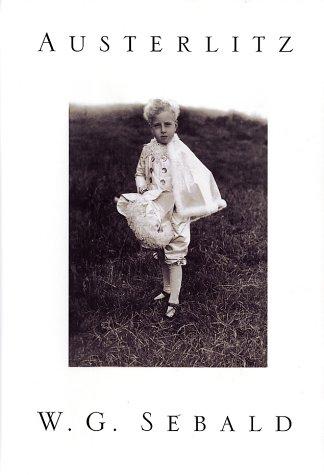
Austerlitz
In Austerlitz, an unnamed narrator recounts his intermittent encounters with Jacques Austerlitz, an architectural historian whose composed intellectual life conceals a childhood he cannot remember. Sent from Prague to Britain on a Kindertransport in 1939, Austerlitz was raised by a Welsh minister and his wife under a different name and without knowledge of his Jewish family. Decades later, fragments of memory lead him through railway stations, libraries, archives, photographs, Prague, Terezín, and Paris as he attempts to reconstruct what was taken from him. Sebald turns this search into a meditation on historical catastrophe, exile, personal identity, and the uncertain authority of images and documents. Buildings and transport networks become repositories of suppressed history, while the novel’s long sentences and embedded photographs blur fiction, testimony, essay, and archival investigation. The result is both an intimate account of belated remembrance and a wider examination of how…
Where to buy or borrow
Are you selling this book? Bookstores, publishers, authors and libraries can be listed here for free. Request a listing
About this book
Deep Overview
For years, Austerlitz’s scholarship functions as a defense against his own history. He remembers growing up in Bala, Wales, in the household of the austere Methodist preacher Emyr Elias and his wife. His original name and origins were hidden from him. Only later does he learn that he arrived in Britain as a refugee child. Even then, he resists pursuing the implications. His disciplined accumulation of architectural knowledge contrasts with his inability to organize or confront his personal past.
The recovery begins indirectly. Sounds, rooms, faces, languages, and railway spaces provoke sensations that precede conscious understanding. Austerlitz eventually travels to Prague, where Vera, who cared for him when he was small, helps restore parts of his early life. He learns about his mother, Agáta, a Jewish actress, and his father, Maximilian Aychenwald. Nazi persecution separated the family: Austerlitz escaped to Britain, his mother was deported to the Theresienstadt ghetto, and his father fled toward France.
Austerlitz then seeks evidence in archives, addresses, photographs, records, and surviving film. These materials do not yield an intact history. A photograph may produce recognition but cannot explain itself; an archive may contain immense quantities of information while leaving the fate of one person uncertain. His study of Theresienstadt exposes the conflict between documentation and deception, particularly through the Nazis’ staged representation of the ghetto for outside observers. The machinery intended to falsify reality becomes part of the historical record through which later generations must search.
Sebald connects this personal investigation to a geography of European catastrophe. Antwerp Central Station, London’s Liverpool Street Station, the fortress of Breendonk, the new Bibliothèque nationale de France, Prague, Terezín, and Paris form a network of sites where different eras seem to coexist. Movement through space becomes movement through buried time. Yet the search does not produce conventional resolution. Austerlitz can recover names, places, and possibilities, but not the lost continuity of childhood or complete knowledge of his parents’ lives.
The novel therefore treats remembrance as necessary but incomplete. It opposes oblivion without suggesting that historical research can reverse destruction. Its layered narration also keeps testimony at a distance: the reader receives Austerlitz’s account through another speaker, just as Austerlitz receives his past through witnesses and records. That structure makes transmission itself one of the book’s central subjects.
Key Themes
Displacement shapes both identity and perception. Austerlitz’s rescue from Nazi-occupied Europe saves his life but separates him from family, language, name, and cultural inheritance. Sebald refuses to reduce this experience to either deliverance or victimhood; survival carries its own forms of absence.
Architecture serves as materialized history. Buildings outlast their makers and users, bearing visible and invisible traces of political authority, collective ambition, confinement, and neglect. Railway stations are especially significant because they combine departure, arrival, separation, and uncertain return.
The novel repeatedly tests the reliability of evidence. Photographs, films, archives, maps, and witness accounts may preserve indispensable traces, yet none provides transparent access to the past. Images can disclose, mislead, or acquire meanings their makers never intended.
A further theme is the conflict between systems and individual lives. Monumental institutions classify, transport, store, and control, while personal experience remains irregular and difficult to retrieve. Sebald’s digressive form resists the simplifying order imposed by official histories.
Historical Context
The occupation of the Czech lands and the persecution of Prague’s Jewish population provide the immediate context for the fictional Austerlitz family’s destruction. Theresienstadt, also known by its Czech name Terezín, was simultaneously a ghetto, transit camp, site of deprivation, and instrument of Nazi propaganda. Before a Red Cross visit in June 1944, Nazi authorities altered parts of the ghetto to create a deceptive appearance of tolerable conditions. A propaganda film made there extended this fabrication.
The novel also belongs to postwar literature concerned with the difficulty of representing the Holocaust without turning suffering into spectacle. Published more than five decades after the war, it focuses on delayed knowledge, inherited responsibility, archival absence, and the persistence of catastrophe within apparently ordinary European landscapes.
Intended Audience
The novel rewards patience with long sentences, digressions, uncertain transitions between speakers, and a plot driven by inquiry rather than suspense in the conventional sense. Readers seeking rapid action, clearly divided chapters, or complete closure may find it less immediately accessible. Those willing to follow associations among places, images, historical events, and states of mind are more likely to appreciate its cumulative power.
Reading Difficulty
The pacing is contemplative. Architectural discussions that initially appear tangential gradually establish the novel’s intellectual structure, so reading only for biographical revelations can make important connections easy to miss. The photographs interrupt the prose but rarely explain themselves; readers must consider how each image changes, confirms, or complicates the surrounding account. Anthea Bell’s English translation retains the deliberate movement and density of Sebald’s style.
Helpful Background Knowledge
Readers may benefit from noticing the difference between memory, testimony, and archival evidence. The novel does not treat these as interchangeable. Some awareness of how railway networks, libraries, fortifications, and monumental civic buildings organize human movement and information can further illuminate Austerlitz’s architectural reflections. No formal knowledge of architectural history is required.
Why Read Austerlitz?
The novel also offers a powerful way of thinking about places. Stations, libraries, forts, waiting rooms, and city streets become active participants in historical memory rather than inert settings. Its treatment of photographs is equally distinctive: images appear as evidence while exposing how little evidence can explain on its own.
Above all, the book examines historical responsibility without offering easy consolation. It demonstrates why the search for traces matters even when no search can restore everything that has been lost.
Reader Takeaways
The book also encourages skepticism toward the apparent completeness of archives and images. A record may survive while its human meaning remains inaccessible; conversely, a minor object or fragment may become crucial when connected to testimony.
Austerlitz complicates simple accounts of rescue and survival. Physical safety does not erase forced separation, linguistic displacement, or the loss of an earlier identity. Finally, the novel presents listening as an ethical act. The unnamed narrator cannot repair Austerlitz’s past, but he can receive and transmit a story that might otherwise disappear.
Strengths
Sebald also uses architecture with unusual precision. His buildings operate simultaneously as physical environments, products of political power, storage places for memory, and metaphors for intellectual systems. The embedded photographs deepen the book’s documentary atmosphere while preventing that atmosphere from becoming unquestioned realism.
The restrained handling of extreme suffering is another strength. Rather than dramatizing catastrophe through scenes of conventional spectacle, the novel concentrates on aftermath, absence, belated recognition, and the difficulty of knowing. Anthea Bell’s translation makes the long, carefully balanced prose available in English without making it feel ordinary or hurried.
Limitations and Considerations
Its aesthetic distance can also be contested. The elegant prose, enigmatic photographs, and elaborate architectural correspondences may appear to some readers to risk turning trauma into a highly controlled artistic pattern. Others may regard that indirection as essential to the book’s refusal of spectacle.
The absence of conventional chapters and the density of the sentences can make orientation difficult. Several narrative layers separate the reader from the events, and the unresolved fate of important people is emotionally and intellectually deliberate rather than a missing conclusion.
Important Concepts, People, and Places
The unnamed narrator listens to Austerlitz over several decades and transmits his account. His presence emphasizes that testimony reaches later audiences through relationships, selection, memory, and retelling.
Agáta Austerlitzová is Jacques’s mother, a Jewish actress in Prague whose persecution and deportation become central to his investigation. Maximilian Aychenwald, his father, is associated with political resistance to Nazism and with a separate trail leading toward France. Vera, Jacques’s former nurse and caregiver, reconnects the adult Austerlitz with his childhood language, home, and parents.
Emyr Elias and his wife raise the refugee child in Bala, Wales, under a changed name. Their household represents both shelter and the suppression of identity.
The Kindertransport was the rescue movement through which thousands of mainly Jewish children reached Britain before and during the opening months of the Second World War. In the novel, it is the mechanism of Austerlitz’s survival and his separation from family.
Theresienstadt, or Terezín, is the ghetto to which Agáta is deported. Its manipulated appearance and propaganda film make it a central example of how documentary forms can be used to conceal persecution.
Liverpool Street Station in London is bound to Austerlitz’s arrival in Britain and the later return of buried memory. Antwerp Central Station helps establish the novel’s association between monumental railway architecture, movement, and historical time. The fortress of Breendonk links architectural design to incarceration and state violence.
The Bibliothèque nationale de France in Paris represents the promise and failure of institutional memory. Its vast systems of collection coexist with barriers that make personal histories difficult to recover.
Photography and archives are crucial methods of preservation, but the novel treats both as ambiguous. They retain traces of absent lives while requiring interpretation and sometimes reproducing the distortions of the institutions that created them.
Questions the Book Explores
Can suppressed memory truly disappear, or does it persist through bodily sensation, place, and involuntary recognition?
What can photographs and archives establish, and what remains beyond their reach?
How do buildings preserve the intentions and violence of the societies that created them?
What are the long-term psychological costs of rescue when rescue requires permanent separation?
How can fiction approach the Holocaust without claiming complete access to experiences that cannot be restored?
What responsibilities belong to the person who listens to and passes on another person’s testimony?
Does historical research create coherence, or can the accumulation of evidence make absence more visible?
Reading Group Guide
Examine the changing function of photographs. Some seem to authenticate the narrative, while others increase uncertainty or invite emotional recognition without explanation. A group might select several images and compare what can be observed directly with what the prose asks readers to infer.
It is also productive to discuss the layers of narration. Austerlitz’s experiences are reported by a listener who remembers conversations held across decades. Consider how this distance affects trust, intimacy, and ethical responsibility.
Finally, compare the book’s beginning and ending. Notice whether the search has transformed Austerlitz’s relationship to the past, even though it has not supplied a complete family history. Groups may disagree about whether the final movement suggests continuation, exhaustion, transmission, or some combination of all three.
Discussion Questions
2. How does the novel distinguish between factual knowledge and personal recognition?
3. Which building or public space most clearly expresses the book’s understanding of power?
4. Do the photographs make the narrative feel more trustworthy, or do they expose the limits of documentary evidence?
5. How should readers interpret the actions of Emyr Elias and his wife in concealing Austerlitz’s identity?
6. What does Vera provide that official records cannot?
7. How does the Kindertransport appear differently when considered as both rescue and rupture?
8. Why is Theresienstadt’s propaganda history especially important to the novel’s treatment of images?
9. What is gained by receiving Austerlitz’s story through an unnamed narrator rather than directly?
10. Does the book’s digressive structure bring readers closer to the workings of memory, or create further distance from Austerlitz?
11. What forms of recovery become possible by the end, and what losses remain irreversible?
12. What obligations, if any, does the novel place upon its readers as recipients of this transmitted history?
Sources and Verification
Comments
No published comments yet.
Available editions
Paperback
Modern Library paperback edition; translated by Anthea Bell, with an introduction by James Wood
- Publisher
- Modern Library
- ISBN-13
- 9780812982619
- Publication date
- Pages
- 320