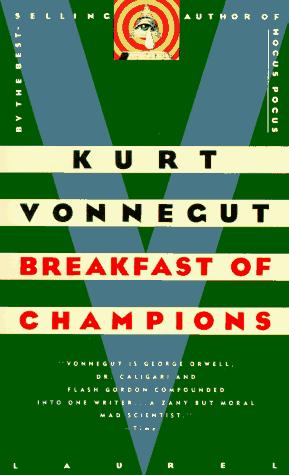
Cover for Breakfast of Champions

Humor & Satirical Fiction

Breakfast of Champions by Kurt Vonnegut

Breakfast of Champions is Kurt Vonnegut's 1973 satirical novel about two lonely older men heading for a collision in the fictional town of Midland City, Ohio. Kilgore Trout is an obscure science fiction writer. Dwayne Hoover is a wealthy Pontiac dealer whose mind is coming apart. Vonnegut appears in his own story as its creator. He uses plain language, his own marker-style drawings and abrupt asides to treat American myths about progress, race, money and violence as stories that people absorb and then act out. The book is short, strange, funny and at times disturbing. It is one of the books that make you think hardest about free will, mental illness and the narratives that shape behavior. This profile covers the Dell mass-market paperback edition.

Where to buy or borrow

Are you selling this book? Bookstores, publishers, authors and libraries can be listed here for free. Request a listing

About this book

Breakfast of Champions, or Goodbye Blue Monday is Vonnegut's seventh novel. It is usually classed as satire and metafiction, with strong threads of science fiction. It followed Slaughterhouse-Five (1969), the book that made him famous, and it reads like a deliberate act of housecleaning. In the preface he presents it as a gift to himself on turning fifty. He says he wants to clear out the accumulated clutter of his head and to question the national myths he had been taught. He also gives the narration a mock-naive voice, sometimes signed with the name of his invented alter ego Philboyd Studge.

The structure is a run of very short chapters. Plot, essay and commentary mix freely, and the author's own drawings illustrate the text. These drawings include cartoons of everyday objects. The narrator describes American life as if for a visitor from another planet, so that flags, money, highways and cars look strange. What sets the book apart from most of Vonnegut's other work is that the author becomes a character. He sits in a cocktail lounge watching the people he has invented. The fiction is openly aware of itself as fiction.

This edition is the 1991 Dell mass-market paperback. It reprints the 1973 text, which was first issued by Delacorte Press/Seymour Lawrence. Readers looking for book discussion questions will find the novel a rewarding subject. Its ideas are easy to state and hard to settle.

Deep Overview

The novel runs on two tracks that are built to collide. The first follows Kilgore Trout, an aging science fiction writer in Cohoes, New York. He has written more than a hundred novels and thousands of stories, and almost nobody has noticed them. Most of his work has been printed as filler in cheap pornographic magazines, and he supports himself by installing aluminum storm windows. Then Eliot Rosewater, a rich and erratic admirer, arranges for him to be invited to an arts festival in Midland City, Ohio. Trout decides to go mostly out of spite. He means to show the festival's patrons what a failed artist looks like. He sets off west by hitchhiking, but first he detours through New York City, where he is robbed. On the way he talks with truck drivers about a country that seems to be poisoning itself. The trip works as a slow tour of American roadside life, seen by a man who has stopped expecting anything from it.

The second track stays in Midland City with Dwayne Hoover. He owns the town's Pontiac dealership and shares in many other local businesses. His wife killed herself by swallowing drain cleaner. His son, Bunny, plays piano in a hotel cocktail lounge, and Dwayne cannot accept him. Dwayne starts repeating other people's words and seeing things that are not there. The narrator explains this calmly as a chemical problem: Dwayne's body is producing substances that disturb his mind. By framing it this way, Vonnegut takes away the usual moral language around madness and asks how much of anyone's behavior is truly chosen.

The structure keeps building suspense even while it gives the ending away. Early on, the narrator says that the two men will meet and that the meeting will be disastrous. The tension comes from watching the pieces move into place, not from wondering what will happen. Short scenes cut between Trout on the road and Dwayne's worsening days. Meanwhile, Wayne Hoobler, a young Black man just out of prison, lingers at the edge of the dealership lot hoping for a job, with nowhere else to go. In most novels he would be a minor figure. Here, the constant switching between him and Dwayne makes it clear how unequally Midland City hands out comfort and attention.

The climax takes place in the hotel cocktail lounge. Dwayne asks Trout for a message, and Trout's novel gives him one. The book is addressed to a single reader. It tells that reader he is the only creature in the universe with free will, and that everyone else is a robot. Dwayne takes it as a description of reality and attacks the people nearest him, hurting his son, his lover Francine Pefko, Trout and others. The scene shows the book's central fear in action. A careless fantasy, given to the wrong mind, turns into permission to hurt people.

Just before this, the painter Rabo Karabekian defends his canvas, a single vertical stripe on a flat field, against the mockery of the locals. He says the stripe stands for the living awareness at the center of every person, the one part that is not mechanical. The narrator, who is sitting in the lounge watching his characters, says this speech renews him. It works as the novel's counterweight. It offers a reason to value people even if the rest of them can be explained as machinery.

In the final pages, Vonnegut confronts Trout directly. He tells Trout that he is his creator and that he is setting him free. Trout does not answer with gratitude. He calls out to Vonnegut, asking to be made young again. The book ends on this unanswered request, which moves its questions about control and responsibility onto the author himself.

Key Themes

Free will and mechanism is the most visible theme. Vonnegut repeatedly describes people as machines and then asks whether anything in them is more than machinery. Fiction as a hazard is a second theme. The book shows how stories shape behavior, including cheap stories, national myths and the plots people borrow for their own lives. Mental illness is treated as a physical misfortune that can be made worse by circumstance, not as a character flaw.

Race, class and exclusion form another strand, shown through the way different people are treated in Midland City. The book also takes aim at commercialism and consumer culture, including the way brand names and money make up an identity. Environmental damage is a recurring background concern. Finally, authorship and responsibility run through the whole novel, as the writer is shown to be a god of his small world who may not be fit for the job.

Historical Context

The novel appeared in 1973, only a few years after Slaughterhouse-Five had turned Vonnegut from a cult writer into a celebrity. The United States was in the late stage of the Vietnam War era, and public trust in institutions was low. The book reflects that mood. Vonnegut had also read excerpts from it publicly before it was published. A recording of a 1971 lecture at the Library of Congress documents this.

Critical reaction at the time was mixed, and many reviewers saw it as a looser and less disciplined follow-up to his best-known work. Later readers have often treated it as a key to his preoccupations. It belongs to the American postmodern tradition of self-conscious fiction, in which the author, the text and the reader's expectations become part of the subject. It also draws on the Midwestern setting Vonnegut knew from Indiana, and it uses the mass-market science fiction culture that he had belonged to earlier in his career.

Intended Audience

The book suits readers who enjoy satire, experimental structure and short, quick chapters. It is a good entry for someone who has already read Slaughterhouse-Five or Cat's Cradle and wants to see Vonnegut in a looser, more personal mood. Students of American literature, postmodern fiction or satire will find a lot to analyze. It also works for readers who like unusual book club choices.

It may be less suitable for readers who want a conventional plot with sympathetic characters and a tidy resolution. Some will find the digressions and drawings frustrating. The novel also includes sexual content, racist attitudes depicted in the voices of its characters, suicidal thoughts and a violent episode, so readers sensitive to those subjects should be prepared.

Reading Difficulty

The sentences are plain and the vocabulary is simple. The difficulty lies elsewhere. The book is made up of fragments, shifts between past and present, and changes of tone from comic to bleak. A reader has to keep several threads in mind and decide which digressions matter. The chapters are very short, so the pace is quick, but the book rewards slower reading.

No specialist knowledge is required. The mass-market paperback has small print and the illustrations are reproduced at a modest size, which can matter for readers who like to study the drawings. Page counts differ between printings, so check your copy if you are coordinating a group reading.

Helpful Background Knowledge

Some knowledge of Vonnegut's earlier work helps. Kilgore Trout and Eliot Rosewater appear in other Vonnegut novels, and Slaughterhouse-Five is the book most often linked to this one. It also helps to know the basic outline of American history that the narrator is mocking, including the arrival of Europeans and the history of slavery. A reader who knows the 1970s setting, with its heavy car culture, its suburban commercial strips and its faith in brand names, will catch more of the jokes. The title is itself a brand slogan, and Vonnegut's preface acknowledges that it is a registered trademark.

Why Read This Book?

This is the most openly self-examining of Vonnegut's novels, and it is a good place to see how he thinks. It does not hide its theory. It shows a writer asking whether fiction is a harmless pastime or a force that moves people to act. It is short enough to finish quickly and strange enough to stay in the mind. It also stands out for its mixture of word and picture, which gives the book a notebook-like feel. A reader who wants a book that can be argued about for an evening will find plenty here. It remains a useful example of how satire can combine tenderness and anger.

Reader Takeaways

A careful reader may come away with a sharper sense of how stories and slogans shape behavior. You may notice how often the narrator refuses to let a familiar object or custom pass without comment, and you may try the same habit. You may also reconsider how a novel can be built from fragments and still hold together. The treatment of Dwayne Hoover's illness may prompt reflection on how society talks about mental health, and the contrast between Hoover and Wayne Hoobler may sharpen your attention to who gets sympathy and who does not.

Strengths

The book has a clear voice, a very distinctive form and an unusual willingness to let the author appear on the page. Its short chapters keep it moving, and its drawings add humor and strangeness. The central argument about stories and behavior is delivered through concrete scenes. It also gives readers a compact introduction to Vonnegut's habits as a writer: moral anger, dry jokes, simple language and compassion for ordinary people.

Limitations and Cautions

The book is uneven. Some digressions feel slight, and its reception at the time was divided, with some critics seeing it as scattered. Its social satire is the author's view and is delivered from a particular position, so some of its jokes about race, sex and other groups may strike modern readers as dated or uncomfortable. The depiction of mental illness is symbolic and partly comic, and it should not be read as a clinical account. The violent episode is brief but disturbing. Readers who want a developed plot or fully rounded characters may be disappointed, since many figures are deliberately sketched as types.

Important Concepts, People, and Places

Kilgore Trout: obscure science fiction writer and recurring Vonnegut figure. His fiction sets off the book's central crisis.

Dwayne Hoover: Pontiac dealer in Midland City whose mental breakdown drives the plot.

Midland City, Ohio: fictional town that stands in for ordinary American commercial life.

Kurt Vonnegut as narrator: the author who appears in the story and meets his own creation.

Eliot Rosewater: wealthy admirer of Trout who arranges his invitation to the arts festival.

Wayne Hoobler: young Black ex-convict whose experience contrasts with Hoover's privilege.

Rabo Karabekian: painter whose speech about his minimalist work states the book's idea of human awareness.

Bunny Hoover: Dwayne's son, a lounge pianist whose fate is part of the violence.

Francine Pefko: Hoover's employee and the object of his affections.

Free will: the philosophical question that the book repeatedly raises.

Philoyd Studge: the pseudonym Vonnegut uses to describe the book's voice. In the preface he treats this persona as the author he becomes when writing.

Questions the Book Explores

Can a person be responsible for actions that come from a damaged brain? Do stories, myths and slogans simply reflect a culture or help produce its behavior? What separates a human being from a machine, if anything? How does a society's wealth and racial hierarchy decide who is heard and who is ignored? What does an author owe to the characters he creates, and what happens when the author refuses to pretend he is not in control? Can awareness itself be a kind of dignity?

Reading Group Guide

Start by asking each member to name one passage or drawing that worked for them and one that did not. This will bring out the difference between readers who enjoy the fragmentary style and those who do not. Consider reading the preface aloud, since it sets the book's tone and reveals the author's intentions. Then divide the group into two halves, one defending the book as moral satire and the other criticizing it as scattered, and swap sides midway. Compare this novel with other Vonnegut books if members have read them. Because the book touches on suicide, mental illness, racism and violence, it helps to agree beforehand how the group will handle sensitive conversation. Finish by asking what each person would say to a friend who was deciding whether to read it. Groups looking for book discussion questions will find the next section useful.

Discussion Questions

1. Why might Vonnegut choose to appear as a character in his own novel? How does that choice change what the reader trusts?

2. How does the novel treat Dwayne Hoover's illness? Does the book ask for pity, understanding, or something else?

3. What is the effect of the author's drawings? Do they clarify, mock, or distract?

4. Why do Hoover and Wayne Hoobler appear in such close contrast, and what does the contrast suggest about opportunity?

5. How seriously should we take the claim that people behave according to stories they have absorbed?

6. What do you make of the ending, in which the author releases Kilgore Trout?

7. Which parts of the book's portrait of America feel dated, and which feel current?

8. How does the book's humor shape the way you react to its darker events?

9. What role does Rabo Karabekian's explanation of his painting play in the book's moral vision?

Sources and Verification

This profile draws on a bookseller listing for the ISBN, a reference-work entry on the novel, a study guide and plot summaries, an academic thesis, a reading group's notes, a digital text of the book's opening pages, and a Library of Congress record of a 1971 lecture. The identity of the work and author is well established. Details of this particular paperback are less certain: sources disagree on whether the publisher is Dell or Bantam, on the page count, and on the exact date. Those details are therefore not stated. Plot details were checked against more than one summary, and interpretive points are the editors' own reading.

Comments

No published comments yet.

Sign in to add a comment.

Available editions