
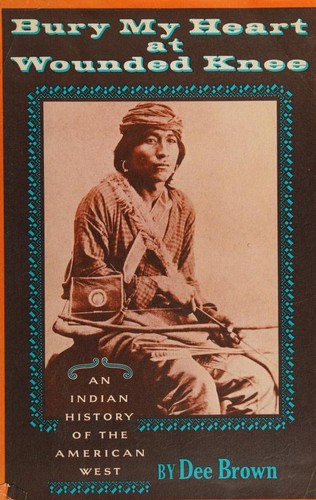
Bury My Heart at Wounded Knee
An Indian History of the American West
Dee Brown’s Bury My Heart at Wounded Knee recounts the conquest of the American West largely through the experiences and recorded words of Native peoples. Concentrating on the period from 1860 to 1890, it follows a succession of treaty negotiations, removals, wars, surrenders, killings, and reservation policies involving nations across the Plains, Southwest, Great Basin, and Northwest. Leaders including Little Crow, Red Cloud, Black Kettle, Sitting Bull, Crazy Horse, Chief Joseph, Captain Jack, and Big Foot emerge not as marginal figures in someone else’s frontier story but as political and military actors confronting invasion and dispossession. Brown ends with the killing at Wounded Knee, making it the culmination of a repeated pattern: federal promises yield to settler pressure, military force, and administrative control. Published in 1970, the book decisively challenged celebratory popular accounts of western expansion. It remains powerful and influential, though it is best read al…
Where to buy or borrow
Are you selling this book? Bookstores, publishers, authors and libraries can be listed here for free. Request a listing
About this book
Deep Overview
A recurring political pattern gives the book its structure. United States officials negotiate agreements that define boundaries or promise provisions and protection. Migration, mining, railroad construction, or local political demands then make those promises inconvenient. Federal representatives seek new concessions, while delayed supplies and corrupt or coercive administration weaken reservation communities. Resistance is treated as rebellion against United States authority even when Native leaders understand themselves to be defending recognized homelands or enforcing earlier agreements. Military defeat is followed by confinement, forced travel, imprisonment, exile, or another reduced reservation.
Brown places particular weight on leadership under impossible conditions. Red Cloud uses warfare and negotiation to defend Lakota control of the Bozeman Trail region. Black Kettle repeatedly seeks accommodation, yet Cheyenne communities associated with him suffer attacks at Sand Creek and the Washita. Kintpuash, widely called Captain Jack, becomes trapped between Modoc efforts to return home and government demands for removal. Chief Joseph becomes the best-known spokesman of the Nez Perce flight, though the movement’s decisions and military leadership were collective. Sitting Bull and Crazy Horse represent different forms of Lakota resistance before exile, surrender, and death close around them. These figures are connected less by a single strategy than by the shrinking range of choices available to them.
The book’s final movement concerns the destruction of the buffalo economy, reservation hunger, the Ghost Dance, the killing of Sitting Bull, and the encounter between the Seventh Cavalry and Big Foot’s Miniconjou Lakota band at Wounded Knee Creek on December 29, 1890. Brown presents Wounded Knee not as an isolated accident but as the symbolic endpoint of the preceding campaigns and policies.
This cumulative design is central to the book’s impact. Broken promises cease to look exceptional because similar mechanisms recur across distant territories. Yet the same design creates an important limitation: very different Native nations can appear joined primarily by shared victimization, and the ending risks turning an era of catastrophic loss into the apparent end of Indigenous history itself. The book is therefore both a landmark correction to older conquest narratives and a starting point that requires supplementation.
Key Themes
• **Homeland and forced movement:** Land is not treated merely as property. Removal disrupts subsistence, political authority, sacred relationships, kinship networks, and collective identity.
• **Language as power:** Councils depend on translation, official transcription, and competing legal assumptions. The book repeatedly shows how promises can be misunderstood, altered, selectively remembered, or ignored.
• **Expansion as policy rather than inevitability:** Brown rejects the idea that the conquest of the West simply happened through impersonal progress. Decisions by officials, military officers, agents, settlers, and commercial interests drive events.
• **Leadership under constraint:** Native leaders face choices in which negotiation, flight, accommodation, and armed resistance can all lead to loss. The book resists easy judgments about which response was correct.
• **Memory and national mythology:** By reversing the familiar viewpoint of the western, Brown asks who is allowed to define violence, civilization, heroism, and legitimate ownership.
Historical Context
The book appeared in 1970, during a broad reassessment of American institutions and national myths. The civil-rights movement, opposition to the Vietnam War, and growing public attention to the American Indian Movement and other Indigenous campaigns made Brown’s reversal of the frontier viewpoint especially consequential. In 1973, activists occupied Wounded Knee on the Pine Ridge Reservation, further joining the historical place to contemporary struggles over sovereignty, treaty rights, and federal power.
Modern readers should also recognize that terminology and scholarship have changed. Specific national names—such as Lakota, Diné, Cheyenne, or Nez Perce—are usually more precise than a single collective label, and contemporary Native histories place greater emphasis on sovereignty, survival, community continuity, and Indigenous intellectual traditions.
Intended Audience
It may be less suitable for readers wanting a balanced survey of every institution involved, extensive historiographical debate, or detailed coverage of Indigenous life after 1890. Readers looking for Native history centered on endurance and contemporary nationhood should treat this as one influential account rather than a complete foundation.
Reading Difficulty
The emotional burden is substantial. Repeated accounts of starvation, displacement, executions, attacks on noncombatants, destroyed communities, and deaths of children can make sustained reading difficult. The cumulative structure is intentional, but some readers may prefer to read one or two chapters at a time and pause to review the geography and chronology.
Helpful Background Knowledge
It is also useful to remember that Indigenous nations had distinct governments, languages, economies, territories, and relationships with one another. Terms such as “Sioux” can encompass Dakota, Lakota, and Nakota peoples, while “Apache” refers to several related but distinct groups. A reader should resist treating all communities in the book as one people with an identical experience.
Why Read This Book
The book is also valuable as an object of historiographical comparison. Reading it beside older frontier narratives reveals what Brown overturned; reading it beside more recent Native-authored work reveals what his tragic framework leaves unresolved. Few books offer such a clear opportunity to study both the power of a perspective shift and the limits of an influential revision.
Reader Takeaways
The book also encourages skepticism toward narratives that describe expansion as automatic or unavoidable. Repeated decisions made particular outcomes possible, and Native leaders continually proposed alternatives—coexistence, bounded homelands, negotiated passage, or independent movement—that were frequently rejected.
Finally, readers may become more attentive to endings. Wounded Knee can mark the conclusion of Brown’s selected period without marking the disappearance of Native peoples. That distinction opens the way to studying twentieth- and twenty-first-century Indigenous political, cultural, and legal history.
Strengths
The regional breadth is another advantage. Similar patterns become recognizable across cases that are often taught separately. Brown also writes with unusual momentum for a long historical work, linking policy decisions to their immediate effects on families and communities. The result is memorable, accessible, and well suited to prompting further study.
Limitations and Cautions
Its moral clarity can flatten political complexity. Native nations had distinct interests, internal debates, diplomatic traditions, and relationships with neighboring peoples; these differences sometimes receive less attention than the recurring conflict with the United States. The focus on catastrophe also leaves little space for ordinary cultural life, women’s leadership, adaptation, or the institutional persistence of tribal nations.
Most importantly, the terminal movement toward Wounded Knee can reinforce a disappearance narrative. Native people did not vanish in 1890, and their histories did not end when Brown’s chronology did. Readers should pair the book with Native-authored histories addressing survival, sovereignty, cultural renewal, and modern community life.
Important Concepts, People, and Events
• **The Long Walk of the Diné:** Forced removal to Bosque Redondo illustrates how military confinement and an unsuitable reservation could be used to transform an entire society.
• **Little Crow:** The Dakota leader appears amid the U.S.–Dakota War of 1862, a conflict shaped by land loss, withheld payments, hunger, and escalating violence.
• **Sand Creek Massacre:** The 1864 attack on a Cheyenne and Arapaho village demonstrates the vulnerability of communities seeking peace and the unstable distinction between military campaign and massacre.
• **Black Kettle:** A Southern Cheyenne peace leader whose experiences at Sand Creek and the Washita embody the dangers of attempted accommodation.
• **Red Cloud:** An Oglala Lakota leader whose resistance helped force the United States to abandon forts along the Bozeman Trail, followed by renewed pressure on Lakota territory.
• **Kintpuash (Captain Jack):** A Modoc leader caught between removal to the Klamath Reservation and efforts to return his people to their homeland, culminating in the Modoc War.
• **Chief Joseph:** A leader of the Wallowa Nez Perce and the most famous voice associated with the 1877 flight, though Brown’s narrative also points toward collective leadership and decision-making.
• **Crazy Horse:** An Oglala Lakota war leader central to armed resistance on the northern Plains; his surrender and death symbolize the narrowing possibility of independent life.
• **Sitting Bull:** A Hunkpapa Lakota leader and spiritual figure who resisted reservation control, went into Canada after the Little Bighorn campaign, and was killed during an attempted arrest in 1890.
• **Wovoka and the Ghost Dance:** Wovoka, a Northern Paiute religious leader, inspired a movement promising renewal. Federal officials’ fear of its Lakota practice contributed to the crisis preceding Wounded Knee.
• **Spotted Elk (Big Foot):** A Miniconjou Lakota leader whose band was intercepted by the Seventh Cavalry before the killings at Wounded Knee Creek on December 29, 1890.
• **Wounded Knee Massacre:** The final event in Brown’s chronology and the book’s governing symbol for the violent destruction produced by expansion, military power, and failed policy.
Questions the Book Explores
• What political value does a treaty retain when one party can revise boundaries or suspend obligations through force?
• Why did negotiation, accommodation, migration, and military resistance so often lead Native nations toward similar losses?
• How did civilian policy, settler demands, commercial expansion, and military action reinforce one another?
• Who gets described as hostile, civilized, rebellious, or heroic, and what interests do those descriptions serve?
• Can a history centered on injustice restore neglected voices while still oversimplifying the people it seeks to defend?
• What is lost when 1890 is treated as an ending rather than a transition in Indigenous history?
Reading Group Guide
Track one recurring mechanism—treaty revision, delayed rations, forced relocation, settler trespass, disarmament, or the labeling of a group as hostile—across several chapters. This prevents the discussion from becoming only a list of atrocities and helps reveal institutional patterns.
Assign different participants to follow individual nations rather than only famous leaders. Note differences in geography, political organization, strategic choices, and relations with the United States. Discuss where Brown preserves those differences and where his overarching tragic structure compresses them.
For the final meeting, pair the closing chapter with a short Native-authored account of twentieth-century survival or sovereignty. Ask how the meaning of Wounded Knee changes when it is understood as neither forgotten nor final.
Discussion Questions
2. Which episode most clearly exposes the gap between the language of federal policy and its practical effects?
3. How do Native leaders define peace, justice, land, and obligation differently from United States officials?
4. When does translation function as communication, and when does it become another source of power imbalance?
5. How does the book complicate the distinction between resistance and self-defense?
6. Compare the choices of Black Kettle, Red Cloud, Chief Joseph, Crazy Horse, and Sitting Bull. What constraints shaped their different strategies?
7. Does Brown individualize Native nations sufficiently, or does the shared pattern of dispossession overwhelm their differences?
8. How should readers evaluate testimony recorded through interpreters or preserved by institutions involved in the events?
9. What emotional response does the book seek, and how does that response affect historical judgment?
10. Why is Wounded Knee such a powerful ending for Brown’s narrative? Why is it a dangerous ending for Native history more broadly?
11. How might the book differ if it gave more attention to Native women, family life, governance, and cultural persistence?
12. What additional voices or histories should be read alongside Brown before forming a broader interpretation of the period?
Sources and Verification
The profile’s historical framing was checked against institutional material from the Library of Congress and the National Park Service. Interpretive cautions reflect later scholarship and Native-authored responses that challenge any suggestion that Indigenous history ended in 1890. Specific judgments about the book’s value and limitations are editorial assessments rather than claims of scholarly consensus.
Comments
No published comments yet.
Available editions
Paperback
paperback
- Publisher
- Holt Paperbacks
- ISBN-13
- 9780805086843
- Publication date
- Pages
- 512