
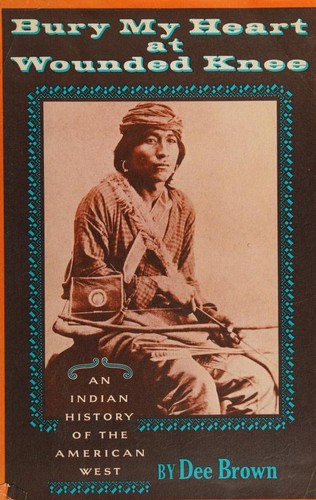
Bury My Heart at Wounded Knee: An Indian History of the American West
An Indian History of the American West
Dee Brown's 1970 history retells the conquest of the American West from the side of the Native nations who lived through it. Covering roughly 1860 to 1890, it moves from the Navajo Long Walk and the Dakota war in Minnesota through Sand Creek, Red Cloud's war, the Little Bighorn, the Nez Perce flight and the Apache surrenders, and closes with the killing of Sitting Bull and the massacre at Wounded Knee in 1890. Brown builds each episode around treaty councils, speeches and recollections, so that named leaders such as Red Cloud, Cochise, Chief Joseph and Sitting Bull speak for themselves. It remains a landmark among historical non fiction books on the American West, valued for changing whose testimony counts, and best read alongside later scholarship that has refined parts of its picture.
Where to buy or borrow
Are you selling this book? Bookstores, publishers, authors and libraries can be listed here for free. Request a listing
About this book
Deep Overview
The middle of the book turns to the northern and southern plains. Brown follows Red Cloud's successful war over the Bozeman Trail and the Treaty of Fort Laramie of 1868, then the argument over Black Hills gold that led to the Great Sioux War, Custer's defeat at the Little Bighorn in 1876, and the harrowing aftermath for the Lakota and Cheyenne. Other chapters follow the Apache under Cochise and later Geronimo, the Modoc war in the lava beds of northern California, the Kiowa and Comanche in the Red River War, and Chief Joseph's attempt to lead the Nez Perce toward Canada in 1877. He also gives space to Standing Bear's 1879 court case, in which a federal judge ruled that an Indian was a person under the law, and to the Ute crisis in Colorado.
A pattern becomes clear as the episodes accumulate. Treaties are signed under pressure and then breached by settlers, contractors or Congress. Promised rations fail to arrive, hunger drives people off reservations, and the army is sent to bring them back. Brown treats the buffalo's destruction as a deliberate and decisive blow to plains economies and spiritual life. He also shows individual officials and reformers, such as the Seneca commissioner Ely Parker, who tried to soften the policy and met resistance from those who profited from it.
The last chapters follow the spread of the Ghost Dance religion among the Lakota, the alarm it caused among agents, the killing of Sitting Bull in December 1890 and the slaughter of Big Foot's band at Wounded Knee a few days later. Brown does not present Wounded Knee as an isolated tragedy but as the end of a long sequence of choices by the United States.
What Brown is trying to demonstrate is less a new thesis than a change of vantage point. He argues, through his selection and arrangement of evidence, that the familiar story of frontier progress looks very different when told through the words of those who lost the land. The tone is elegiac and often angry, and the book's power comes from accumulation rather than from analysis of causes or comparison across regions.
Key Themes
A second theme is the contest over land and subsistence. Brown ties military conflict to the loss of hunting grounds, the slaughter of buffalo herds and the dependence on rations that reservations created. A third is the role of testimony. He treats speeches and recollections as historical evidence and argues that excluding them had distorted the national story.
Other threads include leadership under impossible choices, the cultural and religious pressures placed on Native communities, and the way ideas of progress and destiny were used to justify conquest. Brown also returns to the contrast between a few sympathetic officials and the larger system they worked within.
Historical Context
The publication moment matters as well. In 1970 the United States was divided over the Vietnam War, and reports of atrocities there made Sand Creek and Wounded Knee feel newly relevant to many readers. The civil rights movement and the growth of Native activism, including the American Indian Movement and its 1973 occupation of Wounded Knee, created an audience for histories that questioned older accounts. Until then, popular treatments of the West had been shaped by Hollywood Westerns and by memoirs written by soldiers and settlers. Brown's book belongs to the wave of revisionist work that began to alter that picture, though professional historians of Native America have since gone well beyond it.
Intended Audience
It may be less suitable for those wanting a rigorous scholarly study, a balanced survey of every Native nation or a history that reaches into the twentieth century. Readers sensitive to detailed descriptions of massacres, starvation and the killing of children should expect distressing passages throughout. Anyone seeking current Native perspectives will want to add recent books by Indigenous historians.
Reading Difficulty
The original 1970 hardcover ran to 487 pages with maps and photographs, and the exact length and extras of this Picador paperback printing are not confirmed here. Many paperback editions set the text in small type and may omit some illustrations. Pacing is steady, and the chapters can be read in short sessions.
Helpful Background Knowledge
A short look at the idea of Manifest Destiny and at the difference between treaties, agencies and reservations will make Brown's targets clearer. Readers may also want to look up the ways Native names were recorded by non-Native writers, since this affects how people appear in the text.
Why Read This Book?
The book also rewards readers who care about primary-source storytelling. Brown's skill lies in selecting a speech or a recollection that brings an abstract policy to a human scale. Anyone wanting to understand where the title comes from and why Wounded Knee became shorthand for a broader history will find that explained here.
Reader Takeaways
Readers may also notice how much any history depends on whose voices survive in the record, and how translation and transcription by non-Native recorders shape what is preserved. Finally, the book invites readers to look at their own local history and ask whose land they live on and how it changed hands.
Strengths
The work has also proved durable. It has been in print for decades, has been widely translated and remains a common starting point for readers new to the subject. Its moral seriousness, without the cynicism sometimes found in revisionist writing, gives it lasting readability.
Limitations and Cautions
The book's scope is limited to the West of the second half of the nineteenth century. It gives little attention to the Southeast and Northeast, to Alaska and Hawaii, or to Native life in the twentieth century. Some details, including figures, motives and the conduct of specific episodes, have been revised or contested by later research, and spelling conventions are dated. Readers should treat it as a powerful introduction instead of a final account.
Important Concepts, People, and Places
Manifest Destiny: the nineteenth-century belief that the United States was meant to spread across the continent, which Brown shows being used to excuse seizure of Native lands.
Sand Creek massacre (1864): the attack by Colorado militia on a peaceful Cheyenne and Arapaho camp, treated as an early example of broken trust.
Little Crow: the Dakota leader whose reluctant war in Minnesota in 1862 opens the book's account of armed resistance.
Red Cloud: the Oglala Lakota leader whose campaign closed the Bozeman Trail and led to the Treaty of Fort Laramie of 1868.
Sitting Bull: the Hunkpapa Lakota leader whose killing in 1890 preceded Wounded Knee.
Chief Joseph: the Nez Perce leader whose 1877 attempt to reach Canada is among the book's best-known narratives.
Geronimo and Cochise: Apache leaders through whom Brown follows resistance in the Southwest.
Ghost Dance: a religious movement that spread among plains peoples in 1889 and 1890 and alarmed officials.
Black Hills: the Lakota sacred land seized after gold was found, central to the Great Sioux War.
Indian Bureau: the federal agency that administered reservations and treaty obligations, portrayed here as often corrupt and underfunded.
Ely Parker (Donehogawa): the Seneca commissioner of Indian affairs who tried to reform policy.
Questions the Book Explores
The book also asks how Native leaders chose between fighting, negotiating and flight when each option carried grave costs, and what role hunger, disease and the loss of the buffalo played in shaping those decisions. Finally, it raises the question of what responsibility later generations have to remember events like Sand Creek and Wounded Knee.
Reading Group Guide
A useful exercise is to bring a map and mark each event as it is read. Groups may also want to pair a chapter with a recent article or book by an Indigenous historian to compare perspectives. Because the material includes accounts of massacre and starvation, it is helpful to agree beforehand on how to pause or step away. These book discussion questions in the next section are designed to work whether or not members have read other histories of the period.
Discussion Questions
2. How does Brown's decision to rely on speeches and recollections shape the emotional effect of the book? What might be gained or lost by this choice?
3. Treaties appear again and again in the narrative. What do their repeated failures suggest about how the United States understood its obligations?
4. Brown devotes chapters to different nations. Does this structure help you see differences among them, or does it risk flattening them?
5. How do the Native leaders in the book weigh resistance against negotiation, and how might their choices look from their own perspectives?
6. Why do you think Wounded Knee has come to stand for the whole period?
7. What would a history of the same decades look like if written entirely by those who held the Indian Bureau offices? How would this book differ?
8. How might the context of 1970 have shaped the way readers received this book, and how does it read in a different time?
9. What responsibilities do readers today have toward the history described here?
Sources and Verification
There are limits. Listings for this Picador paperback give only a year or retailer-level date and page count, which do not agree with the length of the original hardcover, so publication date and page count for this edition are not stated. Publisher attribution follows the Macmillan listing, while the series name indicates the Pan and Picador paperback line.
Comments
No published comments yet.
Available editions
Paperback
Picador Books paperback, New Impression
- Publisher
- Macmillan
- ISBN-13
- 9780330245692