
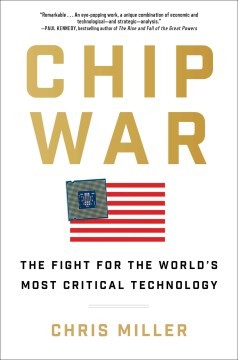
Chip War
The Fight for the World's Most Critical Technology
Chip War is a global history of the semiconductor and an argument about technological power. Chris Miller traces how transistors and integrated circuits moved from American laboratories and Cold War weapons programs into nearly every part of modern economic life. He follows the industry’s expansion through the United States, Japan, South Korea, Taiwan, Europe, and China, showing how design, fabrication, manufacturing equipment, and intellectual property became distributed across a remarkably intricate supply chain. That specialization made chips cheaper and more capable, but it also concentrated indispensable expertise in a small number of firms and locations. Miller connects business decisions by companies such as Intel and TSMC with military strategy, industrial policy, globalization, and the intensifying rivalry between the United States and China. The result is both a history of technological development and a warning that access to computing power now shapes prosperity, national…
Where to buy or borrow
Are you selling this book? Bookstores, publishers, authors and libraries can be listed here for free. Request a listing
About this book
Deep Overview
The narrative then broadens from invention to international political economy. As American companies moved labor-intensive production abroad and allied governments promoted domestic electronics industries, semiconductor manufacturing became embedded in East Asia. Japan rose through disciplined manufacturing and strength in memory chips, provoking commercial and political alarm in the United States. South Korean firms subsequently became formidable memory producers. Taiwan followed a different path: under Morris Chang, Taiwan Semiconductor Manufacturing Company developed the dedicated-foundry model, manufacturing chips designed by other firms. This division between design and fabrication enabled the growth of “fabless” companies and helped create the specialized industry structure familiar today.
Miller argues that this structure produced extraordinary innovation alongside strategic fragility. No country possesses every capability required for the most advanced chips. American firms remain influential in design, software, and key equipment; the Dutch company ASML occupies a pivotal position in advanced lithography; Taiwan and South Korea hold major manufacturing capabilities; and Japan retains important roles in materials and machinery. The system functions through trade and technical collaboration, but some of its most difficult-to-replace capacities are geographically concentrated.
Military power runs through the account. Miller links improvements in sensing, guidance, communications, and precision weapons to advances in computing. He contrasts the United States’ ability to connect commercial innovation with defense requirements against the Soviet Union’s difficulties in sustaining a competitive semiconductor ecosystem. In this telling, chips are not merely components in weapons; they influence how militaries gather information, coordinate forces, and strike targets.
The later chapters turn to China’s effort to reduce its dependence on foreign semiconductor technology and to the growing American use of export controls and supply-chain leverage. Huawei, advanced manufacturing equipment, and Taiwan’s security become central to a contest involving both economic growth and national defense. Miller’s larger claim is that technological leadership depends on ecosystems—networks of scientists, manufacturers, suppliers, capital, customers, and states—not on isolated inventions or factories. The same specialization that accelerated progress has therefore created chokepoints with global consequences.
Key Themes
**Innovation as an ecosystem:** Breakthrough inventions matter, but Miller repeatedly directs attention to manufacturing yields, production scale, specialized tools, corporate organization, financing, and customers. A design becomes historically consequential only when an ecosystem can manufacture it reliably and affordably.
**Specialization and interdependence:** The industry became more efficient by separating design, fabrication, equipment, materials, assembly, and other functions. This arrangement distributes work internationally while concentrating individual capabilities among a few leading companies.
**Government and market co-development:** Military procurement, industrial policy, trade rules, export controls, and research support interact with entrepreneurship and competition. The history resists a simple choice between a purely state-led or purely free-market explanation.
**Chokepoints and vulnerability:** Specialized production creates points at which disruption, denial, or political pressure can affect the wider system. Taiwan’s manufacturing role and ASML’s lithography equipment illustrate how narrow bottlenecks acquire geopolitical importance.
**Cycles of leadership:** Semiconductor dominance shifts as incumbent firms and countries struggle with new business models, production methods, and competitive pressures. Leadership is difficult to establish and never guaranteed to last.
Historical Context
By the 1980s, Japanese strength in memory chips had made semiconductors a central trade-policy issue. Later, South Korea and Taiwan built major positions through different combinations of state support, private investment, foreign technology, and export demand. After the Cold War, many policymakers treated economic interdependence as stabilizing, even as production became increasingly concentrated. The rise of smartphones, cloud computing, advanced weapons, and artificial intelligence made that concentration more consequential. The book was published amid pandemic-era chip shortages, heightened concern over Taiwan, China’s industrial ambitions, and renewed American interest in semiconductor subsidies and controls on advanced technology.
Intended Audience
Readers seeking circuit design instruction, semiconductor physics, or a process-by-process fabrication manual should choose a technical text instead. Those primarily interested in labor conditions, environmental effects, or detailed social histories of electronics workers may find those perspectives present but not central.
Reading Difficulty
Helpful Background Knowledge
Why Read It
Reader Takeaways
Strengths
Limitations and Scope Boundaries
The geopolitical framing is substantially centered on American strategic concerns, even though the book devotes considerable attention to Asian and European firms and governments. In addition, the first hardcover edition was completed before later phases of semiconductor subsidies, export controls, corporate responses, and technological developments unfolded. Its historical explanation remains useful, but its near-term policy picture should be read as a 2022 snapshot rather than a final account of a rapidly changing contest.
Important Concepts, People, and Institutions
**Jack Kilby and Robert Noyce:** Both are central to the development of the integrated circuit. Their work anchors the book’s transition from laboratory invention to a scalable semiconductor industry.
**Fairchild Semiconductor:** A formative Silicon Valley company whose people and practices helped seed later firms. It demonstrates how talent networks can propagate innovation beyond a single corporation.
**Gordon Moore and Intel:** Moore represents both semiconductor entrepreneurship and the expectation of continuing increases in chip complexity. Intel’s rise and later manufacturing difficulties illustrate the instability of industrial leadership.
**Morris Chang and Taiwan Semiconductor Manufacturing Company:** Chang and TSMC are crucial to the dedicated-foundry model, in which a manufacturer fabricates chips designed by other firms. That model reshaped industry organization and made Taiwan strategically important.
**Fabless companies and foundries:** Fabless firms specialize in design without owning leading-edge factories; foundries manufacture their designs. This division encourages specialization but creates dependence across corporate and national borders.
**ASML and extreme ultraviolet lithography:** ASML, based in the Netherlands, supplies exceptionally sophisticated lithography systems needed for advanced manufacturing. Its position exemplifies a supply-chain chokepoint.
**Japan and South Korea:** Japan’s challenge to American memory-chip leadership and South Korea’s subsequent rise demonstrate how manufacturing excellence, investment, and state policy can alter the industrial hierarchy.
**Huawei and China’s semiconductor drive:** Huawei embodies China’s technological ambitions and its exposure to foreign chips, software, and manufacturing equipment. Its treatment by the United States illustrates the conversion of supply-chain control into geopolitical leverage.
**The Soviet Union:** Its attempts to copy foreign semiconductor advances form a counterexample showing that espionage or design replication cannot substitute for a dynamic manufacturing and innovation ecosystem.
**Taiwan:** Taiwan is both a democratic polity under pressure from the People’s Republic of China and a center of leading-edge chip fabrication. The intersection of those facts creates one of the book’s defining strategic dilemmas.
**Supply-chain chokepoints:** These are capabilities controlled by very few firms or locations and difficult to replace quickly. They can provide leverage, but their disruption can also damage allies and adversaries alike.
Questions the Book Explores
Reading Group Guide
Compare three turning points: Japan’s rise in memory chips, the emergence of TSMC’s foundry model, and China’s campaign for technological self-reliance. Consider whether the decisive factor in each case was government policy, corporate strategy, manufacturing culture, access to markets, or some combination.
Pay particular attention to the book’s military episodes. Discuss whether defense demand accelerated technologies that civilian markets would eventually have produced anyway, and how precision-guided weapons altered the relationship between computing and force.
Finally, separate historical explanation from policy prescription. Which lessons from earlier competition genuinely apply to the present, and which may be distorted by hindsight? Groups reading the first hardcover edition may also compare its endpoint with developments after 2022 and ask which underlying structures endured.
Discussion Questions
2. Which mattered more to the industry’s development: breakthrough invention or the ability to manufacture at scale?
3. How did military procurement shape the commercial semiconductor industry, and what costs accompanied that relationship?
4. Why did different national strategies succeed at different stages of semiconductor development?
5. Did globalization make the chip industry dangerously fragile, or did it create a resilient network that no single country could have built alone?
6. What does Morris Chang’s foundry model reveal about the strategic consequences of an effective business innovation?
7. Can the United States or China achieve meaningful semiconductor self-sufficiency? Should either try?
8. How should governments balance national security controls against scientific exchange and commercial competition?
9. Does Taiwan’s semiconductor importance reduce the likelihood of conflict or increase it?
10. Whose experiences receive less attention in the book, and how might labor or environmental histories change its account?
11. When does economic competition become a security conflict?
12. Which of the book’s conclusions appear durable, and which depend most heavily on the circumstances of 2022?
Sources and Verification
Comments
No published comments yet.
Available editions
Hardcover
First Scribner hardcover edition; hardcover
- Publisher
- Scribner
- ISBN-13
- 9781982172008
- Publication date