
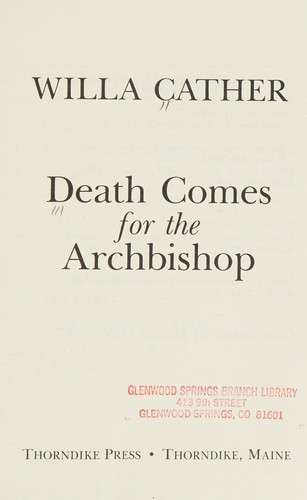
Death Comes for the Archbishop
Willa Cather's 1927 narrative follows Jean Marie Latour, a French priest sent to organize the Catholic church in newly American New Mexico, and his friend and vicar Joseph Vaillant. Loosely modeled on the real Archbishop Jean-Baptiste Lamy and Father Joseph Machebeuf, the book unfolds as a sequence of journeys, portraits and legends rather than a tightly plotted story. Its subject is the slow work of building faith, friendship and institutions across a landscape shaped by Pueblo, Navajo, Hispanic and European presences. Often counted among the major works of American historical fiction, it is valued for its restrained style, its sense of place and its quiet reflection on a life's work and its ending.
Where to buy or borrow
Are you selling this book? Bookstores, publishers, authors and libraries can be listed here for free. Request a listing
About this book
The text is organized as a Prologue set in Rome followed by nine short books, each titled for a place, person or episode, such as the Mass at Acoma, Padre Martínez, and Gold Under Pike's Peak. Cather based her two protagonists on documented people, and a biography of Machebeuf drawn partly from his letters helped spark the project. She invented freely around that frame. What distinguishes the book is its tone: spare, unhurried and visual, closer to a series of paintings than to a chain of dramatic events. For readers building a list of classic novels to read, it offers a very different pleasure from Cather's better-known Great Plains fiction.
The edition profiled here is a Thorndike Press large-print reprint, dated 1984, of the Knopf text first issued in 1927.
Deep Overview
Each of the nine books concentrates on a place, a relationship or a challenge. Latour crosses enormous distances on a mule, learning how little the maps and doctrines of Europe prepare him for the country. He attends Mass at Acoma, where he meets a Pueblo world with its own sacred geography. He confronts local clergy who have long practiced a self-governing, loosely supervised priesthood, notably Padre Martínez of Taos, whose portrayal Cather uses to dramatize the clash between reforming discipline and entrenched local authority. He hears the story of Doña Isabella, a woman whose story forms one of the book's self-contained interludes. Meanwhile Vaillant, the more practical missionary, follows opportunities to Colorado during the gold rush, extending the diocese's reach and testing the friendship at the book's centre.
Cather's method is accumulation. Latour does not win a decisive battle; his achievement is patient and visible mainly in the long run: roads travelled, churches founded, a cathedral raised in Santa Fe. The final book follows him into old age and his own death, giving the title its quiet finality. Death here is not a sudden plot event but a gradual coming into focus of a life's meaning.
The deeper argument concerns how a culture is transplanted and how it changes in the process. Latour admires the Hispanic and Native communities around him yet is also an agent of an institution that remakes them; Cather presents his respect as sincere while leaving the tension available to readers. She also treats friendship as a form of historical force: the contrast between Latour's refinement and Vaillant's practical zeal suggests that a mission needs both temperaments.
Cather draws on real people. Lamy became the first Archbishop of Santa Fe, and Machebeuf was his vicar. Historical figures such as Kit Carson also appear in fictionalized form. The book is best read as imaginative interpretation, not as a faithful account of their careers; a later Pulitzer-winning biography of Lamy by Paul Horgan offers a documented counterpart. What Cather supplies is atmosphere, moral weight and an unusual narrative design, in which landscape, legend and ritual carry as much meaning as incident.
Key Themes
Friendship and complementary temperaments. Latour and Vaillant balance each other, and their bond becomes a quiet engine of the narrative.
Landscape as moral and aesthetic presence. Mesas, deserts and skies are not just settings; they shape the characters' sense of scale, humility and beauty.
Cultural meeting and cultural change. French, Hispanic, Pueblo, Navajo and Anglo-American ways of life meet, and the book shows both mutual respect and the pressures of imposed institutions.
Reform and local custom. The conflict with clergy who had long followed their own practices raises questions about authority, discipline and what counts as genuine devotion.
Time, memory and a life's completion. The late chapters turn to old age and legacy, treating death as the ripening of a life rather than an interruption.
Historical Context
The Church that Cather's bishop inherits carried the marks of that history. Franciscan missionaries had laid its foundations during the colonial period. After Mexico became independent in 1821, there were fewer clergy, and the bishop responsible for the region lived far to the south in Durango and rarely made the long trip north. Local priests grew used to running their own affairs. In isolated villages, lay brotherhoods known as the Penitentes kept devotional life going with little clerical help. So when Rome reorganized the region after the American takeover, it was not bringing religion to a blank slate. It was placing a new chain of command over a Catholic culture that already had its own customs and its own leaders.
The real churchman behind Bishop Latour was Jean-Baptiste Lamy. He was born in the Auvergne region of France in 1814 and came to America as a young missionary priest. He served first in Ohio and later as pastor of a parish in Covington, Kentucky, just across the river from Cincinnati. In 1850 Pope Pius IX created a vicariate apostolic for New Mexico and put Lamy in charge. It became the Diocese of Santa Fe in 1853 and an archdiocese in 1875, with Lamy as its first archbishop. He brought in priests from France, invited teaching orders to open schools, and began a stone cathedral in Santa Fe in a European style quite unlike the region's adobe churches. He died in 1888. Joseph Projectus Machebeuf, his friend from France, went on to serve the growing Catholic population of Colorado. Lamy's insistence on discipline caused friction with several Hispanic priests. The best known of them was Padre Antonio José Martínez of Taos, a well-educated and politically active priest. His break with the bishop became one of the defining conflicts of the period.
Cather's own time mattered as much as Lamy's. She first went to the Southwest in 1912 and kept going back. A biography of Machebeuf built partly from his letters home gave her the documentary basis she needed, and she wrote the book in the mid-1920s. By then, cars, factories and mass entertainment were changing American life, and many artists and writers were turning to older regional cultures for something steadier. Santa Fe and Taos had become magnets for painters and authors drawn to the desert light and to the Native and Hispanic traditions of the area. Cather's focus on craft, ritual and patient endurance belongs to that wider mood of looking back.
Later scholarship has made the history behind the novel more complicated. The friar and New Mexico historian Fray Angélico Chávez wrote a biography of Padre Martínez, But Time and Chance, which presents the Taos priest as a learned defender of his community. That picture is a sharp contrast to the obstructive figure readers meet in Cather. Set beside studies written from Lamy's side, books like this show that Cather's story offers one point of view on a disputed chapter of New Mexico's past. It is not the final word on it.
Intended Audience
It also works well for book clubs and classrooms that want a text with room for discussion about history, religion, landscape and representation.
Readers who want a tightly plotted drama, strong romance or constant action may find it slow and episodic. Those seeking a documentary account of Lamy's career, or a perspective centred on Native American or Hispanic voices, will need to read other works alongside it.
Reading Difficulty
The text contains some French, Spanish and Church terms and references to Catholic ritual, saints and geography, which can slow readers who are unfamiliar with them. Annotated or scholarly editions can help, though the plain text is perfectly readable without them.
This edition is a large-print reprint running to 374 pages, which makes the text easier on the eyes for readers who prefer bigger type, though the volume is heavier and bulkier than a standard paperback. Page counts differ between editions, so pagination in this volume will not match other printings.
Helpful Background Knowledge
Basic familiarity with Catholic structures such as dioceses, bishops, vicars and priests, along with a sense of what a mission is, will clarify the characters' roles. It also helps to know that the main characters are based on real people, Jean-Baptiste Lamy and Joseph Projectus Machebeuf, though the book is not a biography.
Some knowledge of Pueblo and Navajo history, and of figures like Kit Carson, will help readers notice what the book includes and what it leaves out. Prior reading of Cather's prairie novels is not required but offers a revealing contrast.
Why Read This Book?
Its structure is also unusual. The episodic design, with legends and stories nested within the main thread, shows how a novelist can convey history through a gallery of scenes rather than a continuous chain of events.
The book rewards rereading. Its landscape writing, its portrait of friendship and its closing chapters on age and memory take on different meanings at different stages of life. It also opens useful conversations about how fiction shapes our image of a region and its peoples, which makes it valuable alongside the biography and historical studies it inspired.
Reader Takeaways
They may also reconsider what counts as achievement: a life measured in patient institution-building rather than dramatic victory.
Readers may become more alert to the gap between a historical person and his fictional counterpart, noticing what an author chooses to invent, soften or omit.
Finally, the book invites attention to how cultures meet. Readers can practise weighing the narrator's evident admiration for the communities Latour encounters against the fact that he is also an agent of change.
Strengths
The structure suits the subject. Episodes, legends and portraits convey the scale of the territory and the slow pace of the work in a way a standard plot might not.
The central friendship between Latour and Vaillant gives emotional grounding without melodrama, and the book handles religious faith with seriousness and without preaching.
It is also well documented. It draws on real people and a published biography, and scholarly editions and later historical studies provide ample supporting material for readers who want to explore further.
Limitations and Cautions
The narrative viewpoint is largely that of a European churchman. Pueblo, Navajo and Hispanic characters are seen mostly from outside, and some readers find the representation limited or idealizing. Others read the book as sympathetic to those cultures. Both views are part of the continuing discussion.
The episodic structure and slow pace may frustrate readers who expect conventional plot momentum. The edition profiled here is a large-print reprint, so readers wanting scholarly notes or an introduction should look at an annotated edition.
Important Concepts, People, and Places
Joseph Vaillant: Latour's boyhood friend and vicar, an energetic, sociable missionary who contrasts with Latour; modeled on Joseph Projectus Machebeuf.
Jean-Baptiste Lamy: the real French-born churchman who became the first Archbishop of Santa Fe; his career is the historical foundation of the story.
Joseph Projectus Machebeuf: Lamy's real-life vicar, whose published biography and letters were a key inspiration for Cather.
Santa Fe and the diocese of New Mexico: the base of Latour's work, covering a vast territory he must travel to govern.
Acoma Pueblo: the setting of an episode in which Latour experiences Pueblo society and its legends.
Padre Antonio José Martínez: the historical Taos priest on whom Cather's Padre Martínez is based; his portrayal is the book's most debated treatment of local clergy.
Kit Carson: a historical frontiersman who appears as a character, linking the church's story to the wider American expansion.
Mexican-American War: the conflict that placed New Mexico under United States control and created the occasion for Latour's appointment.
Paul Horgan, Lamy of Santa Fe: the Pulitzer-winning 1975 biography that gives a documented account of the real archbishop.
Questions the Book Explores
What kinds of strength does a life of patient service require, and how are they different from those of conquest or politics?
Can faith be both a universal truth and a local, lived practice, and who decides which practice is authentic?
How do landscape, art and ritual shape the way people experience belief?
What is the relationship between friendship and vocation, and how do contrasting temperaments sustain a shared mission?
How should a life be measured when its aims are slow and its results are only partly visible to the person living it?
Reading Group Guide
Consider pairing a session with a short introduction to the real Lamy and Machebeuf, so members can discuss the difference between history and fiction. Participants may also enjoy looking at images of Southwestern landscapes and mission architecture to discuss Cather's visual method.
Readers are likely to differ on whether the book feels moving, slow, idealized or all three. That range of reactions is a good starting point rather than a problem. Groups may want to set aside time to discuss how the book represents Native American and Hispanic communities, since opinions vary.
If the group has read other Cather books, comparing this with a prairie novel such as My Ántonia can be fruitful.
Discussion Questions
2. What qualities make Latour effective as a bishop, and where do his limitations show?
3. How do Latour and Vaillant complement each other, and what would the book lose without one of them?
4. How does the landscape function as more than a backdrop?
5. How does the book portray the clash between reforming discipline and local custom, and do you think it treats Padre Martínez fairly?
6. Whose perspectives are central and whose are marginal? How might the story look from another viewpoint?
7. What do the interludes, such as Doña Isabella's story, add to the whole?
8. How does the book treat death, and why does Cather end with a long final section on the archbishop's last years?
9. How should readers weigh a work of fiction against the historical record when the characters are based on real people?
10. How does this book compare with Cather's prairie novels in subject and tone?
Sources and Verification
Information about the book's structure and text comes from the Willa Cather Archive's digital edition of the 1927 first edition. Background on the book's composition, the historical figures and related scholarship draws on the University of Nebraska Press, Oxford University Press, Project MUSE, reference works and a state library book-club article.
Factual limits: page counts and dates vary between editions and sources, so the exact day of publication of this reprint is left blank. Some retailer listings for the same ISBN give inconsistent publisher and date data and were not relied upon. Interpretive comments, such as the debates about representation, reflect general critical discussion rather than any single cited source.
Comments
No published comments yet.
Available editions
Hardcover
Large print edition (reprint of the 1927 Knopf text)
- Publisher
- Thorndike Press
- ISBN-13
- 9780896215061
- Pages
- 374