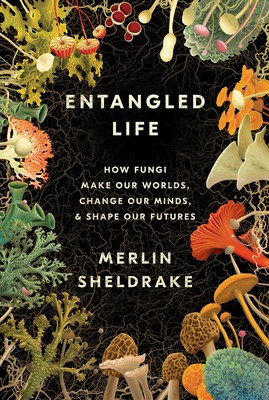
Deep Overview
Sheldrake begins by correcting a common perceptual error: a mushroom is not the whole fungus but a reproductive structure produced by an organism that may otherwise remain hidden. Much of a fungus consists of branching filaments called hyphae, which collectively form mycelium. These networks grow through soil, wood, living tissue, and other substrates, digesting their surroundings externally and absorbing the resulting nutrients. This form of life makes fixed boundaries difficult to draw. A fungal network can split, fuse, reorganize, and participate in several relationships at once.
From this biological foundation, the book explores fungi as makers and maintainers of worlds. Decomposer fungi break down resistant materials and return nutrients to circulation. Mycorrhizal fungi form intimate associations with plant roots, exchanging soil-derived nutrients for carbon compounds produced through photosynthesis. These relationships have deep evolutionary importance and helped plants establish themselves on land. Lichens demonstrate another kind of composite existence: fungi live together with photosynthetic partners, creating forms and capacities that cannot be adequately understood by considering each participant in isolation.
The book also investigates fungal behavior without assuming that purposeful action requires a brain. Mycelial networks respond to changing conditions, redirect growth, distinguish among opportunities, and solve spatial problems. Sheldrake treats claims about fungal intelligence cautiously, but he uses the evidence to ask whether conventional language restricts what scientists are prepared to recognize as behavior, memory, or decision-making. The question is not simply whether fungi think like animals. It is whether animal-centered definitions prevent people from understanding other forms of responsiveness.
Human history is deeply entangled with fungal chemistry. Yeasts make bread, beer, and wine possible. Fungal compounds have supplied medicines, including antibiotics and immunosuppressants. Other fungi cause disease, destroy crops, or manipulate animal behavior. Psychedelic mushrooms introduce questions about consciousness, ritual, medicine, and the biological effects of fungal molecules on animal nervous systems. Truffles, meanwhile, illustrate how fungi recruit animals through scent, turning appetite into a means of spore dispersal.
Environmental applications appear as possibilities rather than effortless solutions. Fungi can participate in breaking down pollutants, producing materials, restoring soils, and reshaping waste streams, but their behavior depends on ecological conditions and partnerships. Sheldrake’s broader argument is that fungi challenge habits of thought based on clean divisions: organism versus environment, competition versus cooperation, and individual versus community. By following fungal lives, the book replaces a picture of nature made from isolated units with one defined by exchange, transformation, and dependency.
Key Themes
A central theme is interdependence. Fungi live through exchanges with plants, animals, microbes, and physical environments, making relationships fundamental rather than secondary to life. A second theme is unstable individuality: mycelial networks, lichens, and mycorrhizal associations resist the idea that every organism has a simple boundary and a wholly independent identity. The book also examines non-animal agency, asking how growth, chemical signaling, adaptation, and problem-solving should be described when no brain is present. Transformation recurs throughout: fungi turn rock into soil, wood into reusable nutrients, sugars into alcohol, and organic remains into new ecological possibilities. Finally, Sheldrake considers the limits of scientific metaphors. Terms borrowed from economics, computing, and human social life can illuminate fungal activity, but they can also impose misleading assumptions about trade, communication, and control.
Historical and Scientific Context
Fungi were long treated as a subordinate branch of botany, even though they do not photosynthesize and differ fundamentally from plants in nutrition, structure, and evolutionary history. Their recognition as a distinct kingdom helped expose the inadequacy of older classifications, but fungal diversity remains incompletely documented. The book belongs to a broader shift in biology away from viewing organisms solely as autonomous competitors. Research on symbiosis, microbiomes, horizontal exchange, and ecological networks has made cooperation and dependency increasingly important to explanations of evolution and ecosystem function. Entangled Life also reflects growing scientific and public interest in underground mycorrhizal relationships, fungal biotechnology, psychedelics, and the ecological consequences of soil disruption. Because the science is active and sometimes contested, the book often focuses as much on changing questions and methods as on settled conclusions.
Intended Audience
The book is well suited to general readers interested in biology, ecology, natural history, environmental thought, fermentation, or the hidden processes supporting familiar landscapes. Readers who enjoy science writing that connects empirical research with philosophical questions are especially likely to appreciate it. It may also interest gardeners, conservationists, designers exploring biological materials, and students considering how scientific language shapes observation. It is not a field guide and will not teach mushroom identification, foraging safety, or laboratory technique. Readers seeking a short, strictly linear textbook may find its exploratory structure and conceptual digressions less direct than they prefer.
Reading Difficulty
Entangled Life is accessible popular science, although it introduces specialized vocabulary such as hyphae, mycelium, mycorrhiza, lichen, and saprotrophy. Terms are generally explained through examples rather than dense formal definitions. The main challenge is conceptual: chapters move among cellular processes, ecosystem-scale relationships, cultural history, and philosophical questions about agency and identity. The prose is vivid and frequently associative, so readers comfortable following connected investigations rather than a single linear argument will have the easiest experience. Scientific training is not required, but pausing to distinguish a fungus from its mushroom or a mycelial network from a plant-root network will improve comprehension.
Helpful Background Knowledge
Readers may benefit from a basic understanding of photosynthesis, nutrient cycles, evolution by natural selection, and the distinction between an organism and an ecosystem. It is also helpful to know that fungi obtain nutrients by secreting substances into their surroundings and absorbing what is released, rather than by eating or photosynthesizing. Familiarity with symbiosis as an umbrella term for close relationships between different organisms will clarify discussions of lichens and mycorrhizae. No prior knowledge of mushroom taxonomy is necessary. Because some chapters address psychoactive compounds and environmental technologies, readers should distinguish scientific investigation from medical advice or promises of immediate technological solutions.
Why Read This Book
Entangled Life offers a substantial introduction to organisms that are essential to everyday life but usually remain unseen. Its value lies not only in the range of fungal examples but in the intellectual work those examples perform. Fungi provide Sheldrake with a way to test assumptions about where organisms begin and end, what counts as behavior, and whether cooperation can be separated neatly from competition. The book also connects basic biology to practical domains including agriculture, medicine, food, pollution, and material design. Readers looking to understand soil, forests, fermentation, or ecological resilience will gain a stronger sense of the fungal processes beneath those subjects. It is particularly rewarding as a corrective to accounts of nature dominated by visible plants and animals.
Reader Takeaways
A careful reader should come away able to distinguish mushrooms from the larger fungal organisms that produce them and to explain why mycelium matters ecologically. The book encourages greater attention to decomposition as a creative process that makes future life possible. It also complicates the language of individual organisms by showing how plants, fungi, algae, bacteria, and animals develop through intimate associations. Readers may become more skeptical of claims that describe ecological networks as simple markets or communication systems, while still recognizing the usefulness of such metaphors when carefully limited. More broadly, the book develops a habit of looking for hidden relationships behind visible forms and of treating uncertainty as an invitation to better questions rather than as a failure of knowledge.
Strengths
The book’s strongest feature is its ability to connect scientific detail with large questions without reducing one to the other. Sheldrake uses concrete fungal activities—branching, digesting, exchanging nutrients, producing chemicals, and dispersing spores—to ground discussions of agency and identity. Its wide scope reveals links among ecology, medicine, agriculture, food, and environmental design. Firsthand encounters and field experiences give the research a physical setting, while the recurring scrutiny of scientific vocabulary helps readers understand that metaphors influence interpretation. The structure also reflects its subject: ideas branch, reconnect, and alter the meaning of earlier examples. This can make unfamiliar biology memorable without requiring the book to become a conventional survey.
Limitations and Cautions
Entangled Life covers an enormous biological kingdom through selected examples rather than offering a comprehensive account of fungal classification, evolution, or disease. Its emphasis on astonishing capacities may leave less room for ordinary or poorly understood fungal lives. Some research discussed in the book concerns active scientific debates, particularly the interpretation of signaling, resource movement, network behavior, and intelligence-like qualities. Readers should therefore separate observed processes from the metaphors used to explain them. The book was first published in 2020, so rapidly developing areas—including psychedelic medicine, fungal genomics, conservation, and biotechnology—should be supplemented with newer research. Proposed uses of fungi for remediation or sustainable materials are promising in specific settings but should not be treated as universal, proven solutions.
Important Concepts, Organisms, and Institutions
Mycelium is the interconnected mass of fungal hyphae through which many fungi grow, explore, digest, and respond to their surroundings. Hyphae are the branching tubular filaments that form much of a fungus’s body. Mycorrhizae are associations between fungi and plant roots in which nutrients and carbon compounds move between partners; they are central to the book’s account of terrestrial ecosystems. Lichens are partnerships involving fungi and photosynthetic organisms, used to challenge simple definitions of individuality. Saprotrophic fungi obtain nutrients from dead organic matter and drive decomposition and nutrient recycling. Yeasts are single-celled fungi whose fermentation underlies bread, beer, wine, and other human practices. Truffles are underground fungal fruiting bodies whose strong aromas attract animals that disperse their spores. Psilocybin-producing mushrooms connect fungal chemistry to human consciousness, ritual, and medical research. Parasitic fungi, including fungi that alter insect behavior, demonstrate how one organism can redirect another’s actions. The Smithsonian Tropical Research Institute in Panama is relevant to Sheldrake’s background in tropical ecological research and underground fungal networks. Mycoremediation refers to attempts to use fungal processes to transform or remove pollutants, a possibility the book treats alongside practical ecological constraints.
Questions the Book Explores
Where does a fungal individual begin and end when networks can fuse, fragment, and reorganize? Can responsive behavior and problem-solving be discussed without assuming the presence of a brain? How did relationships between fungi and plants help shape life on land? Are lichens best understood as partnerships, ecosystems, or new composite forms? What do decomposition and nutrient exchange reveal about the dependence of life on death and reuse? How do metaphors such as markets, networks, and communication systems help or distort ecological understanding? In what ways have fungal substances shaped human food, medicine, culture, and consciousness? What can fungi realistically contribute to pollution control, material production, agriculture, and ecological restoration?
Reading Group Guide
Begin by comparing the group’s image of fungi before and after reading the opening chapters. Track places where Sheldrake shifts from describing an experiment to questioning the concepts used to interpret it. Discussions can compare mycorrhizal partnerships, lichens, parasites, and human fermentation to see how the balance of cooperation and exploitation changes across cases. Notice when economic or technological metaphors appear and ask what each metaphor clarifies or conceals. Another productive approach is to choose one scale—cell, organism, network, forest, or planet—and examine how the book moves between it and the others. Groups may also contrast the strongest documented applications of fungal science with the more speculative possibilities. Conclude by considering whether the book’s branching structure strengthens its argument about entanglement or occasionally makes distinctions harder to maintain.
Discussion Questions
1. Which fungal example most changed your understanding of how ecosystems function, and why?
2. Does the concept of an individual remain useful after considering mycelial networks and lichens?
3. What standards should be met before behavior in a brainless organism is called intelligent?
4. When does the language of trade or communication clarify mycorrhizal relationships, and when might it mislead?
5. How does the book alter the usual distinction between cooperation and competition?
6. Why are decomposition and decay culturally undervalued despite their ecological importance?
7. Which human dependence on fungi—food, medicine, agriculture, or another area—seems most consequential?
8. How does Sheldrake balance personal experience with scientific evidence?
9. Which proposed fungal technology appears most plausible, and what limitations would need to be addressed?
10. How might a fungal perspective change approaches to conservation or environmental responsibility?
11. Does the book successfully avoid turning fungi into symbols for human ideas?
12. What questions remained unresolved for you at the end?
Sources and Verification
Edition details were checked against the U.S. publisher’s catalog and library bibliographic records. The full title, author, first U.S. edition, publication date, publisher, ISBN, and stated page count are supported by those records. The author’s professional background was checked against his official biography, while the book’s Royal Society recognition was confirmed through the awarding institution. The profile distinguishes the original 2020 work from later paperback and illustrated editions. Interpretive sections are original editorial synthesis rather than quotations from promotional copy or reviews. Because fungal ecology, psychedelic research, biotechnology, and theories of biological agency continue to develop, readers seeking current scientific conclusions should consult recent specialist literature.