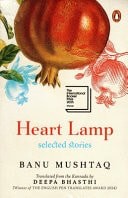
About this book
Heart Lamp: Selected Stories is a literary short story collection, and it is the first book-length English translation of Banu Mushtaq's work. Mushtaq has published six story collections, a novel, essays and poetry in Kannada. The English volume is therefore a curated sampler, not a complete edition of one original book. Its twelve stories were chosen and translated by Deepa Bhasthi. The opening six appear in order of first publication in Kannada: 1990, then four from 1999, then 2004. The book then moves through the remaining titles, ending with "Be a Woman Once, Oh Lord!".
Mushtaq came out of the Bandaya Sahitya (protest literature) movement in Karnataka, which challenged caste, class and gender hierarchies. Most of her stories stay inside a house, a courtyard, a mosque committee or a village lane, and from there they look at larger systems of power. Her tone is plain and often funny, with sudden turns into cruelty or grief. Bhasthi's translation is also part of what sets the book apart. She describes her method as translating with an accent. The English keeps the speech rhythms, address terms and some vocabulary of the original instead of smoothing them into neutral prose. Together with its prize history, this makes the book a useful entry point to translated fiction and to short story collections from India's regional-language traditions.
Deep Overview
The stories are set in and around Muslim communities in Karnataka. They mostly look at what happens to women when family, property and religion line up against them. In "Stone Slabs for Shaista Mahal", a narrator named Zeenat visits a friend whose husband makes grand romantic declarations while resisting the woman's plans for her daughter's education. In "Fire Rain", a community official, the mutawalli, resents his sister for claiming her share of the family property, while the neighbourhood is absorbed in a dispute over reburying a dead man. In "Black Cobras", a mother abandoned after bearing daughters goes to the mutawalli for help. The women of the village then respond to him in small, collective acts of contempt. In the title story, a wife whose husband has taken up with another woman returns to her parents' home with her child.
Mushtaq does not treat these situations as simple tales of victims and villains. The men are often shown as self-justifying, anxious about reputation or money, and shielded by custom, so the cruelty comes from habit and institutions as much as from individual malice. The women are not idealised either. They can be proud, jealous, petty or complicit, and their solidarity is often partial and improvised. Humour is one of the book's main tools. A sharp line of dialogue or a neighbour's taunt can expose a hypocrisy that a direct accusation would not.
Other stories widen the angle. "High-Heeled Shoe" uses the return of a brother from Saudi Arabia to examine status rivalry between spouses. "Soft Whispers" looks back at a girl's childhood, her bond with her grandmother and her defiance of her mother. The stories are not linked by a single plot. Taken in sequence, they build up an account of how authority is performed and enforced at the lowest levels of community life. It involves the mosque committee, the husband, the in-laws, the money-lender and the neighbour who watches from the doorway.
The book is also a work of translation, and that shapes how it reads. Bhasthi leaves words and speech patterns recognisably rooted in Kannada, in the Muslim speech of the region and in the Urdu and Arabic vocabulary of daily religious life. She does not translate them away. The Booker judges singled this out as unusual. They called the result a radical translation that expands what translation can do. The reader is asked to learn the setting from context, much as a visitor would, rather than being handed a simplified version of it.
Mushtaq has said she wrote in response to the pain of women who came to her for help. The collection's moral seriousness comes from that legal and activist background. Its artistry lies in refusing to turn the women into case studies.
Key Themes
Patriarchal control over marriage, motherhood and property: several stories turn on abandonment, unequal inheritance, pressure to produce sons, and who gets to decide a woman's future.
Religious and communal authority: community officials, mosque committees and custom are shown protecting men and discouraging women's claims. The author's view is that faith is being used to justify oppression. Readers will differ on how far they accept that framing.
Class, caste and money: wealth, remittances, poverty and status rivalry shape relationships and decide who can afford dignity.
Solidarity and small acts of resistance: women's support for one another is often indirect, taking the form of curses, gossip, silence or sheer persistence.
Humour as critique: irony and comic detail let the stories expose hypocrisy without becoming sermons.
Language and translation: dialect, untranslated terms and speech rhythm are part of how the stories carry their setting.
Historical Context
Mushtaq began writing in the 1970s and 1980s within the Bandaya Sahitya movement. This was a protest literature in Kannada that challenged caste and class hierarchies and brought Dalit, Muslim and other marginalised voices into Kannada writing. She was one of the few women associated with that circle. She also worked as a journalist and lawyer and was active in women's rights causes. The stories span 1990 to 2023, a period that saw sharp debates in India about religion, minority rights, women's status within communities and public dress, including protests in Karnataka over a college hijab ban in 2022. The book does not address these directly, but they form the backdrop against which international readers are likely to read it.
One of the stories, "Black Cobras", was adapted into the 2003 Kannada film Hasina, directed by Girish Kasaravalli. Mushtaq's work had previously reached readers in Urdu, Hindi, Tamil and Malayalam, but not in book form in English.
Kannada is spoken by tens of millions of people and has a long literary history, yet it had never produced an International Booker winner. The 2025 prize therefore carried weight beyond this single book. Heart Lamp was the first short story collection and the first Kannada-language book to win. Deepa Bhasthi was the first Indian translator to win, and And Other Stories, an independent publisher based in Sheffield, won for the first time.
Intended Audience
The book suits readers of literary short fiction who enjoy character-driven, socially observant stories. It will also interest readers of South Asian writing, feminist fiction and world literature who want a Kannada voice. People following the International Booker Prize, or interested in how translators shape what English readers see, will find it relevant. Students of gender, religion and postcolonial literature can use it as a primary text. Readers who want a single driving plot, fast pacing or a broad survey of Indian society may be less satisfied. The stories are short and local, and they deal with painful domestic situations. Anyone sensitive to depictions of domestic cruelty, abandonment and despair should approach it with care.
Reading Difficulty
The sentences are generally direct, and the stories are short enough to read one at a time. The difficulty comes from texture. Dialogue is idiomatic, forms of address and terms for religious and social roles are often left in the source language, and some stories move between present action and memory or digression. Most readers can follow from context, though a few terms may need looking up. Each story is self-contained, so no prior reading is needed. The collection runs a little under 200 to 224 pages depending on the edition. The emotional weight, rather than the vocabulary, is what slows many readers down, so reading it in several sittings works well.
Helpful Background Knowledge
Some familiarity with Karnataka, its main languages and its mix of rural and urban Muslim communities will help, but it is not required. It is useful to know the role of a mutawalli, a custodian or manager of community religious affairs, who appears in several stories. A general sense of South Asian marriage customs, inheritance disputes and the social meaning of family reputation will clarify the stakes. Readers may also want to look up the Bandaya Sahitya movement and the idea of translating with an accent. Short interviews with Mushtaq and Bhasthi in the Booker Prize materials give useful framing without spoiling the stories.
Why Read This Book?
It is a rare chance to read Kannada fiction in English without heavy simplification, in a translation whose choices are part of the reading experience. The stories reward close attention because they show how oppression works through everyday routines, with neighbours, relatives and officials as participants. Mushtaq's humour keeps the book from becoming bleak or didactic, and her women have sharp voices. The collection also offers a way into a widely discussed prize win, with a range of stories written over more than three decades. For readers curious about translated fiction beyond the best-known European languages, it is a strong and varied starting point.
Reader Takeaways
A careful reader may come away understanding how gendered authority operates through ordinary institutions, such as property settlements, community committees and marriage arrangements. They may notice how the stories use tone, from comic to bitter, to alter sympathies within a single scene. They may reconsider what counts as resistance when open defiance is not available. They will also have a clearer sense of what a translator does when choosing to keep a language's texture, and of how a regional literary tradition can reach a global audience.
Strengths
The collection has a consistent moral and observational intelligence. Its settings are specific and its characters are distinct, so the stories avoid generalising about Muslim women. The range of ages, relationships and situations is wide for a book of this length. The humour and irony are skilful. The translation is distinctive, giving English readers the rhythm of the original speech. Because the stories date from several decades, the book also shows how the author's technique developed. The author's courts-and-community background gives the situations credibility.
Limitations and Cautions
The book is a selection, so it does not represent the whole of Mushtaq's output, and the choice of stories reflects the translator's judgement. Almost all of the stories centre on suffering and injustice, and some readers may find the effect repetitive or the male characters lacking in nuance. Some critics have found the collection uneven. Its critique of religious and community authority is the author's view, and readers and commentators differ on how it should be read and used. The setting is regional, so the book should not be read as a general portrait of Muslim life in India. Content includes domestic violence, abandonment and despair. Bibliographic details differ between sources, including the page count and the UK and US publication dates.
Important Concepts, People, and Places
Banu Mushtaq: the Kannada-language author, lawyer and activist whose stories form the collection. Born in Hassan, Karnataka, she began writing in the 1970s.
Deepa Bhasthi: the translator and a writer based in Kodagu. She selected the stories and translated them, and her approach shaped the book's reception.
Karnataka: the south Indian state where the stories take place and where Kannada is the main language.
Kannada: the Dravidian language of the original text. Heart Lamp was the first Kannada winner of the International Booker Prize.
Bandaya Sahitya (protest literature): the movement in which Mushtaq started writing. It contested caste, class and gender hierarchies.
The mutawalli: a community custodian or administrator who appears as a figure of male and institutional authority, notably in "Fire Rain" and "Black Cobras".
The International Booker Prize: the award for fiction translated into English. The 2025 judges chose Heart Lamp, and the prize is shared by author and translator.
And Other Stories: the independent Sheffield publisher of the English edition.
Hasina (2003 film): Girish Kasaravalli's adaptation of the story that appears in this book as "Black Cobras".
Translating with an accent: Bhasthi's phrase for keeping the cultural and linguistic character of the source language in English.
Questions the Book Explores
What does it cost a woman to be dependent on a family, a husband or a community for her security? How do law, religion and custom decide who is heard in a dispute over property or care? When people cannot protest openly, what forms of resistance remain? What makes some women side with the system that constrains them? How can a story show cruelty without reducing its characters to victims or villains? What does an English translation owe to the language it comes from?
Reading Group Guide
The stories are short, so a group can read the whole book or choose a few. Starting with "Stone Slabs for Shaista Mahal", "Fire Rain" and "Black Cobras" gives a strong cross-section. Groups may find it useful to note how each story opens and ends, who gets the last word, and where the narration places its sympathy. A group could read a Booker Prize interview with the author and translator alongside the book to talk about translation choices. The material is emotionally heavy, so it helps to agree beforehand on how much personal experience members wish to share. Pairing it with another translated collection can draw out contrasts in tone and method.
Discussion Questions
1. Which story's ending stayed with you most, and why do you think the author ended it there?
2. How does Mushtaq use humour, and does it change how you feel about the characters it targets?
3. Where do the stories show community institutions helping, and where do they fail?
4. How are women's relationships with one another portrayed, and are they always supportive?
5. Are the male characters fairly drawn? What do you make of the stories that give them self-justifying voices?
6. How did the untranslated terms and speech rhythms affect your reading?
7. Does the book's critique of religious authority read as an attack on faith, a call for reform, or something else?
8. What do you gain or lose from reading a selection chosen by the translator?
9. How do the earlier and later stories differ in subject or technique?
10. What does the title image of a lamp suggest to you after reading?
Sources and Verification
This profile draws on the Booker Prize Foundation's pages and press release for the prize, the author and translator details and the judges' comments. The publisher's front-matter extract supplied the contents and the Kannada publication years of the first stories. Bibliographic details were checked against retailer and catalogue listings for the edition and ISBN. Reference works and reviews from newspapers, literary journals and study sites informed the context and the story summaries. Sources disagree on the publication date and page count, so those are not given. The identification of the Hasina film adaptation rests on one reference source.
All descriptions are written independently from these sources.