
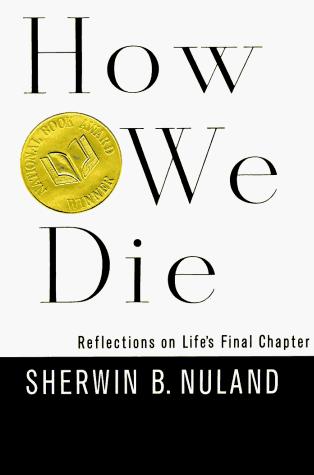
How We Die
Reflections on Life's Final Chapter
In How We Die, surgeon and medical educator Sherwin B. Nuland examines what happens to the human body during common forms of death. Moving through heart disease, aging, Alzheimer’s disease, violence, accidents, suicide, AIDS, and cancer, he combines physiological explanation with clinical observation and personal stories. His purpose is not to offer reassurance through euphemism, but to replace frightening uncertainty with a clearer understanding of dying as a biological process. The book also challenges idealized images of a peaceful, fully controlled death. Nuland argues that medicine’s power to prolong life can become harmful when treatment continues without a realistic appraisal of its burdens and prospects. The result is both an anatomy of bodily decline and a reflection on hope, dignity, physician responsibility, and the difficult choices faced by patients and families near the end of life.
Where to buy or borrow
Are you selling this book? Bookstores, publishers, authors and libraries can be listed here for free. Request a listing
About this book
Deep Overview
The book first considers the heart and circulation. Nuland explains how coronary disease, heart attacks, rhythm disturbances, and congestive failure disrupt the delivery of oxygen to tissues. The heart is not treated as an isolated pump: its failure alters the functioning of the lungs, kidneys, brain, and vascular system. This systems-based approach recurs throughout the book, demonstrating that death usually emerges through interconnected breakdown rather than the simple stopping of one organ.
Aging receives similarly layered treatment. Nuland distinguishes ordinary aging from individual diseases while showing how diminishing physiological reserves make recovery increasingly difficult. His account of his grandmother’s decline brings family memory into the medical narrative, illustrating how longevity, frailty, dependence, and bodily failure can coexist. Alzheimer’s disease adds another dimension by raising questions about identity and personhood when memory and recognition deteriorate before the rest of the body dies.
The book also examines sudden and externally caused deaths, including homicide, accidents, and suicide. These discussions emphasize that the pathway to death differs according to injury, blood loss, damage to the brain, infection, shock, and other bodily responses. Nuland approaches euthanasia within this broader inquiry into control: the desire to govern one’s death must contend with medical uncertainty, changing symptoms, ethical duties, and the limits of prediction.
His chapters on AIDS reflect the medical and social crisis of the epidemic’s early decades. By pairing the biology of HIV with the story of an individual patient, Nuland shows how an infectious agent progressively disables immune defenses and leaves the body vulnerable to opportunistic disease. The personal narrative prevents the disease from becoming merely an abstract sequence of cellular events.
Cancer occupies a major part of the book. Nuland presents malignancy as uncontrolled cellular growth that invades tissues and disrupts the cooperative organization necessary for life. He then turns from mechanism to medical culture, examining how hope can sustain patients but can also be manipulated or mistaken for evidence. His account of decisions made during his brother’s cancer treatment gives this criticism personal force: professional knowledge did not spare him from pursuing interventions he later judged too aggressive.
The closing argument is not that medicine should abandon dying people. It is that care should change when cure is no longer a realistic goal. Comfort, presence, honest communication, and attention to the life still being lived may matter more than another burdensome attempt to defeat an irreversible process.
Key Themes
• **The limits of medical intervention:** Technical capability does not by itself establish that a treatment is beneficial. Nuland repeatedly asks when intervention preserves meaningful life and when it merely extends decline.
• **Hope and honesty:** Hope may help people endure illness, yet hope detached from probability can obstruct preparation, communication, and appropriate comfort care.
• **Dignity across a lifetime:** The book questions whether dignity should be measured by the appearance of a person’s final moments. Nuland locates human worth more broadly in relationships, character, memory, and the life preceding death.
• **Biology and biography:** Every death follows bodily mechanisms, but no death is only a medical event. Personal histories and family relationships determine how illness is understood and experienced.
• **Professional fallibility:** Physicians are vulnerable to fear, attachment, ambition, and denial. Medical expertise does not automatically produce wise decisions, especially when the patient is someone the doctor loves.
Historical and Medical Context
The hospice movement and growing support for advance directives were encouraging a different approach centered on symptom relief and patient priorities. At the same time, public controversies over assisted dying and the right to refuse treatment exposed disagreements about autonomy, suffering, and professional responsibility.
Nuland’s AIDS chapters belong to the period before effective combination antiretroviral therapy transformed the prognosis of HIV infection. Readers should therefore understand them as an account grounded in the epidemic’s earlier clinical reality. The disease mechanisms remain historically and medically significant, but treatment possibilities have changed substantially since the book was written.
Intended Audience
Readers currently experiencing acute bereavement or severe health anxiety should know that the descriptions can be emotionally difficult and physically explicit. Those looking primarily for spiritual consolation, a step-by-step guide to advance care planning, or current clinical recommendations will need other resources alongside it.
Reading Difficulty
The greater difficulty is emotional rather than technical. Accounts of cancer, dementia, trauma, suicide, and terminal illness are direct and sometimes disturbing. The alternation between physiological explanation and personal case history gives the book variety, although readers may find some disease-centered chapters denser than the reflective passages.
Helpful Background Knowledge
Because medical practice has changed since the early 1990s, contemporary information is advisable for readers making real healthcare decisions. This is particularly important for HIV treatment, cancer therapies, pain management, advance directives, and laws governing assisted dying.
Why Read This Book?
The book also offers a revealing example of a doctor examining his profession from within. Nuland does not present clinicians as detached authorities who always know when to stop. By including his own errors and emotional conflicts, he demonstrates how difficult end-of-life judgment remains even for experienced practitioners.
Reader Takeaways
It may also prompt earlier conversations about acceptable burdens, desired forms of care, surrogate decision-makers, and the meaning of comfort. More broadly, Nuland encourages a view of dignity that does not depend on maintaining complete control over the body. Vulnerability at the end of life does not erase the value or individuality of the life that came before it.
Strengths
Another strength is the book’s challenge to medical triumphalism. Rather than treating every death as proof that medicine failed, Nuland asks whether the failure sometimes lies in refusing to acknowledge when dying has begun. The work also avoids reducing end-of-life ethics to a single rule; it presents hope, autonomy, professional judgment, family attachment, and suffering as forces that can conflict.
Limitations and Cautions
The book is shaped primarily by the perspective of an American surgeon. Readers receive less sustained attention to nursing, disability perspectives, cultural differences, healthcare inequality, religious interpretations, and the daily work of modern palliative-care teams. Its blunt descriptions may help some readers but overwhelm others. Finally, it should not be treated as individualized medical guidance or as a comprehensive account of every pathway to death.
Important Concepts, People, and Medical Subjects
• **Coronary artery disease and myocardial infarction:** Conditions through which restricted blood flow damages the heart and may initiate fatal rhythm disturbances or systemic organ failure.
• **Congestive heart failure:** A progressive inability of the heart to circulate blood effectively, demonstrating how the failure of one organ affects lungs, kidneys, and other systems.
• **Aging and frailty:** Declining physiological reserve makes illness, injury, and recovery increasingly consequential, even when no single disease explains the whole process.
• **Alzheimer’s disease:** A form of progressive neurological deterioration that allows Nuland to consider memory, recognition, dependence, identity, and bodily survival.
• **Human immunodeficiency virus and AIDS:** The virus and resulting immune-system collapse are examined through both biological explanation and an individual patient’s experience. These chapters reflect the epidemic before modern combination therapy.
• **Cancer:** Malignant cells escape normal regulation, invade healthy tissue, and eventually compromise organ function. Cancer also becomes the book’s principal setting for examining hope and aggressive treatment.
• **Euthanasia and assisted dying:** Ethical subjects connected to autonomy, suffering, control, and the physician’s role. The relevant laws and terminology vary by jurisdiction and have changed since publication.
• **Palliative care:** Although the modern specialty has developed since the book appeared, its central goal—relieving suffering and aligning care with patient priorities—is closely related to Nuland’s concluding argument.
• **Medical futility and disproportionate treatment:** Terms associated with interventions that impose substantial burdens while offering little realistic chance of achieving the patient’s goals.
Questions the Book Explores
• Does greater knowledge of dying reduce fear, or merely give fear a more definite form?
• When does treatment cease to serve the person receiving it?
• Can hope remain honest when recovery is improbable?
• Why do physicians and families continue burdensome interventions despite poor prospects?
• How should dignity be understood when bodily control and mental capacity are declining?
• What responsibilities do clinicians have when cure is no longer possible?
• How do personal history and family attachment alter supposedly objective medical decisions?
• Is the desire for a controlled death compatible with the uncertainty of biological decline?
Reading Group Guide
Give particular attention to the contrast between a technically successful intervention and care that benefits the whole person. Consider how this distinction changes across heart disease, dementia, AIDS, trauma, and cancer. Nuland’s account of his brother’s illness offers a useful case study in the conflict between professional expertise and family attachment.
Because the book is more than three decades old, a group may also compare its assumptions with contemporary ideas about hospice, palliative medicine, HIV, shared decision-making, and advance care planning. The goal need not be to decide whether Nuland was universally correct, but to identify which insights remain durable and which require historical qualification.
Discussion Questions
2. Which case history most effectively connects bodily mechanisms with an individual life?
3. How does the book distinguish reasonable hope from denial or false reassurance?
4. What does Nuland’s treatment of his brother reveal about the limits of clinical objectivity?
5. Does the book successfully separate dignity from the physical appearance of dying?
6. How does Alzheimer’s disease complicate ideas about identity and personhood?
7. When should the goal of care shift from extending life to relieving suffering?
8. How might a nurse, hospice worker, disabled reader, patient, or family caregiver challenge the book’s surgical perspective?
9. Which parts of the AIDS chapters should be read as historical testimony, and which remain broadly applicable?
10. Did the book change how you would approach a conversation about prognosis or treatment limits?
11. Is greater control necessarily the best measure of a good death?
12. What obligations does society have to make comfort-focused end-of-life care accessible?
Sources and Verification
Comments
No published comments yet.
Available editions
Paperback
First Vintage Books edition
- Publisher
- Vintage
- ISBN-13
- 9780679742449
- Publication date
- Pages
- 320