
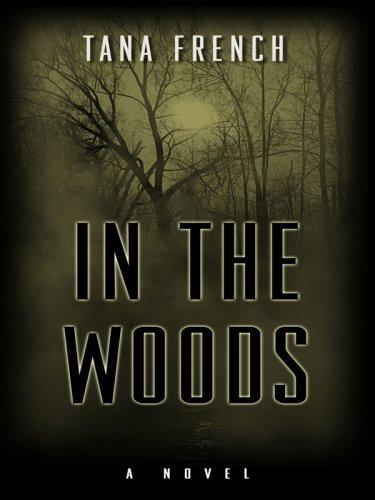
In the Woods
In a Dublin suburb, twelve-year-old Adam Ryan entered the woods with two friends in 1984 and emerged alone, blood in his shoes and unable to remember what happened. Twenty years later, living as Rob Ryan and concealing his past, he is a detective on Dublin’s murder squad. When another twelve-year-old is killed near the same place, Rob and his partner, Cassie Maddox, take the case. The investigation brings him dangerously close to the childhood mystery that has shaped his identity. Tana French’s debut combines a police procedural with an intimate study of trauma, memory, friendship, and self-deception. The immediate murder supplies the investigative momentum, but the novel’s deeper tension comes from Rob’s unreliable narration and deteriorating judgment. Rather than treating detection as a clean path from evidence to certainty, the book examines what happens when an investigator’s need for personal answers collides with his professional responsibilities.
Where to buy or borrow
Are you selling this book? Bookstores, publishers, authors and libraries can be listed here for free. Request a listing
About this book
French organizes the novel around two linked mysteries separated by roughly twenty years. Their connection creates suspense while allowing the book to question whether resemblance is evidence or merely an invitation to impose a desired pattern. The fictional Dublin suburb of Knocknaree also gives the story a layered setting: childhood territory, crime scene, archaeological landscape, and contested development site. What distinguishes the novel is its sustained interest in the investigator’s character. The case is not simply something Rob solves; it exposes how secrecy, longing, and damaged memory influence what he can perceive.
Deep Overview
As a murder-squad detective, Rob has cultivated a composed professional persona. His closest relationship is with his partner, Cassie Maddox, whose intelligence and emotional steadiness complement his instincts. Their friendship gives the investigation its human center. They understand each other through jokes, routines, and shared trust, but Rob has withheld the fact that he is the surviving child from the old Knocknaree case.
The new inquiry begins when twelve-year-old Katy Devlin is found dead at an archaeological site near the woods. The detectives investigate her family, her demanding schedule as a gifted dancer, tensions within the household, and local opposition to a planned motorway. Political maneuvering and disputes over the threatened archaeological site create plausible motives and public pressure. French uses these competing lines of inquiry to show how a murder investigation generates stories before it produces truth: relatives, activists, officials, journalists, suspects, and detectives all interpret events according to their interests.
Rob’s secret involvement creates both a procedural problem and a psychological trap. Instead of withdrawing, he convinces himself that proximity to the new murder may restore his childhood memories. Fragmentary sensations and images begin to surface, but their evidentiary value remains uncertain. Memory here is neither a dependable archive nor a simple falsehood. It is incomplete, emotionally charged material that Rob repeatedly tries to convert into certainty.
That effort damages his judgment and his relationship with Cassie. The partnership that initially makes the detectives effective becomes vulnerable to Rob’s evasions, self-absorption, and fear. His retrospective voice openly signals that the account will involve failure, yet self-awareness does not make him fully reliable. He can identify some of his mistakes while continuing to frame them defensively.
The novel ultimately distinguishes legal resolution from emotional or metaphysical closure. Evidence can establish responsibility for one crime without explaining every loss surrounding it. French makes that gap central rather than incidental. In the Woods therefore works as both a murder mystery and a critique of the expectation that every disturbing pattern must yield a complete answer.
Key Themes
**Identity as performance:** Adam Ryan becomes Rob Ryan, and the adult detective depends on appearing detached from the childhood survivor. His professional competence and social ease are partly constructed defenses.
**Truth and persuasion:** Investigative facts matter, but so do the stories built around them. Suspects manage impressions, institutions protect themselves, and Rob shapes his narration for the reader.
**Friendship, intimacy, and betrayal:** Rob and Cassie’s partnership rests on unusual closeness. The novel tests whether intimacy can survive secrecy and unequal emotional responsibility.
**The limits of detection:** Police work may prove a charge without restoring everything a crime has destroyed. The book separates solving a case from understanding an experience.
**Childhood and lost places:** The woods embody freedom, terror, and irretrievable childhood. Development around Knocknaree turns private loss into a broader conflict over what a community preserves or erases.
Historical and Cultural Context
This context matters because the setting is being physically stripped away while Rob tries to excavate his own past. Archaeology offers a suggestive counterpoint to police work: both disciplines reconstruct events from traces, but neither can guarantee a complete narrative. The book also belongs to the modern police-procedural tradition, yet it shifts emphasis from institutional mastery toward the fallibility of the detective. Its Dublin setting and Irish social texture are integral, while its concerns about memory, authority, and unresolved violence extend beyond a specifically national frame.
Intended Audience
It is less suitable for anyone seeking a brisk, clue-centered mystery in which every major question receives an explicit answer. The novel is long, deliberately paced, and emotionally dark. It includes the murder of a child, discussion of crimes against children, trauma, family manipulation, and the deterioration of an important relationship.
Reading Difficulty
The cast and procedural details are manageable, though the middle portion develops several investigative paths at once. Irish vocabulary and police terminology are generally understandable from context. The greater challenge is emotional and structural: the story asks readers to tolerate ambiguity, recognize shifts in reliability, and remain attentive when apparent parallels between the two mysteries tempt both Rob and the audience toward premature conclusions.
Helpful Background Knowledge
Familiarity with the basic conventions of police procedurals—interviews, alibis, forensic evidence, chain of command, and prosecutorial standards—may help, but French explains the investigation through the detectives’ work. The most useful preparation is an openness to an unreliable narrator and to a mystery that treats unresolved questions as part of its design.
Why Read It?
The book also offers an unusually consequential detective partnership. Cassie is not merely an assistant or sounding board, and the changes in her relationship with Rob give the procedural plot lasting emotional force. Finally, the novel makes setting perform several functions at once: Knocknaree is a crime scene, a threatened historical landscape, and the location onto which Rob projects his most urgent hopes and fears.
Reader Takeaways
The book also sharpens the distinction between facts, explanations, and closure. These may overlap, but they are not identical. Evidence can support a conviction while leaving other experiences unaccounted for. Readers may also reconsider how institutions depend on trust: police partnerships, families, and communities all require selective disclosure, yet concealed information can become destructive when circumstances change.
Most importantly, the novel demonstrates that ambiguity can be substantive rather than evasive. An unanswered question may reveal the limits of a narrator, an investigation, or the human need to force experience into a finished story.
Strengths
French also develops Rob and Cassie’s partnership with enough detail that ordinary conversations, jokes, and breaches of confidence carry genuine weight. The Knocknaree setting unifies the novel’s crime, archaeological, political, and psychological elements. Multiple suspects and motives emerge from recognizable pressures instead of arbitrary complication.
The book is especially effective at sustaining two kinds of suspense: who killed Katy Devlin, and whether Rob can confront his past without destroying his present. Those questions interact, but they do not resolve in identical ways.
Limitations and Cautions
The structure gives different degrees of closure to its central mysteries. For some readers, that choice will deepen the novel’s treatment of uncertainty; for others, it may feel like an unsatisfied narrative promise. The book also filters most events through Rob, limiting direct access to Cassie and other characters whose perspectives might alter his account.
Although the procedural detail is convincing as fiction, the novel should not be treated as a documentary account of Irish policing. Its primary purpose is dramatic and psychological rather than instructional.
Important Concepts, People, Places, and Institutions
**Cassie Maddox:** Rob’s detective partner and closest friend. Her perceptiveness, loyalty, and boundaries make her central to both the case and the book’s examination of trust.
**Katy Devlin:** The twelve-year-old murder victim whose death initiates the contemporary investigation. Her family life, ambitions, and treatment by others shape the detectives’ search for motive.
**Peter Savage and Jamie Rowan:** Adam’s childhood friends, who vanished in the Knocknaree woods. Their absence defines Rob’s adult life even though his memories of the event remain inaccessible.
**Knocknaree:** The fictional Dublin suburb where both mysteries converge. Its woods, housing, archaeological remains, and proposed development make it a landscape of competing histories.
**Dublin Murder Squad:** The fictional police unit in which Rob and Cassie work. Its procedures and professional expectations intensify the consequences of Rob hiding his connection to the old case.
**The archaeological excavation:** A threatened site near Katy’s body. It supplies witnesses and political conflict while symbolizing the difficult reconstruction of incomplete histories.
**Traumatic memory:** The problem of whether buried recollection can return accurately—and whether wanting an answer may distort what is remembered.
**Unreliable narration:** Rob admits fallibility and retrospectively interprets his own behavior, requiring readers to assess not only what he reports but how he frames it.
Questions the Book Explores
How much of personal identity depends on memories that may be partial, suppressed, or misinterpreted?
Does admitting that one is unreliable make a narrator more trustworthy, or merely more persuasive?
What obligations arise when professional partners become emotionally intimate?
How do families and institutions use secrecy to protect themselves, and when does protection become manipulation?
What is the difference between proving who committed a crime and understanding why the crime occurred?
Why do people prefer a complete but doubtful narrative to an incomplete truth?
What is lost when landscapes carrying personal or communal history are redeveloped?
Reading Group Guide
Give the Rob–Cassie partnership equal attention with the murder plot. Consider when their closeness improves their work and when it weakens professional boundaries. It can be productive to ask how the story would change if Cassie narrated it.
Examine the physical spaces—woods, archaeological site, family home, interview room, and detectives’ apartment—and how each affects power or memory. Finally, compare police investigation with archaeological excavation. Both interpret fragments, but the group can debate what standards of proof distinguish them and what neither can recover.
Discussion Questions
2. At what point, if any, should Rob have removed himself from the investigation?
3. Is Rob’s secrecy primarily an act of self-protection, professional misconduct, or both?
4. How does Cassie’s understanding of loyalty differ from Rob’s?
5. Which assumptions about Katy and her family most strongly shape the investigation?
6. How does the development dispute expand the novel beyond a private crime story?
7. What does the archaeological setting suggest about the recovery of truth from fragments?
8. Does ambiguity strengthen the novel’s central ideas, or weaken its mystery structure?
9. How would the book feel different if narrated by Cassie Maddox?
10. Does solving a crime necessarily create justice or closure for those left behind?
11. Which adult characters most clearly impose their ambitions or fears on children?
12. By the end, what has Rob learned, and what does he still avoid understanding?
Sources and Verification
Comments
No published comments yet.
Available editions
Hardcover
First American edition; hardcover
- Publisher
- Viking
- ISBN-13
- 9780670038602