
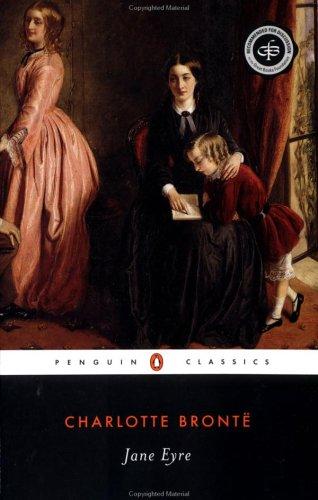
Jane Eyre
Jane Eyre follows an orphaned, plain-spoken girl from a hostile childhood home and a harsh charity school to a governess post at Thornfield Hall, where she falls in love with her brooding employer, Edward Rochester. The story is told in Jane's own retrospective voice, and it keeps asking one question: how can a woman with no money, rank or protector keep her self-respect while still wanting love? Charlotte Brontë blends domestic realism, Gothic suspense, romance and moral argument. Her heroine insists on equality, conscience and independence at a time when the options for such women were narrow. Since its publication in 1847 it has become one of the best-known classic novels to read in English. This Penguin Classics edition adds a scholarly introduction and notes by Michael Mason.
Where to buy or borrow
Are you selling this book? Bookstores, publishers, authors and libraries can be listed here for free. Request a listing
About this book
The book is organized by place. Five settings, Gateshead, Lowood, Thornfield, Moor House and Ferndean, give the narrative its rhythm, and each stage tests Jane in a new way. First-person narration sets it apart from many contemporary novels, because it gives the reader Jane's judgments and her direct address to the reader. The edition profiled here is the Penguin Classics paperback edited by Michael Mason. It is a common choice for students and for anyone looking for book club books with a strong critical apparatus. Editions differ in text and in how much commentary they provide, so readers who care about textual history should check which version they have.
Deep Overview
At Thornfield Hall, where Jane works as governess to Adèle Varens, the book changes tone. Her talks with Edward Rochester are unusual for a master and an employee. They tease and challenge each other, and each is more candid than social convention allows. Brontë surrounds this courtship with unease: a strange laugh in the night, a fire in a bedroom, and the arrival of guests such as Blanche Ingram, who represents the kind of marriage Rochester is expected to make. Jane's declaration that she is Rochester's spiritual equal is one of the novel's best-known moments. The marriage is then stopped at the altar by the revelation that Rochester is already married to Bertha Mason, who is confined in the house. Jane has to choose between the love she wants and the principle she will not abandon, and she leaves Thornfield with almost nothing.
The last third reverses the situation. Jane is taken in at Moor House by Diana and Mary Rivers and their brother, the clergyman St. John Rivers. His offer of a missionary marriage presents duty as a form of vocation, and it tests whether Jane can resist a spiritual appeal as firmly as she resisted an emotional one. A legacy gives her financial independence and kin of her own, so when she returns to Rochester she comes back as a free agent and not a dependant. The ending is a negotiated partnership, and it is not the simple reward of a conventional romance.
Throughout, Brontë tries to show that a person's moral life is more than rank, looks or sentiment. She also suggests that passion and principle need not cancel each other out, even though the book keeps testing that claim. Because Jane narrates after the fact, the story carries both lived experience and judgment. She often interrupts events to comment on them, which makes the book feel like an argument as well as an adventure.
Key Themes
The novel also treats dependence and work. A governess is respectable but vulnerable, and the plot only resolves when Jane gains money and family of her own. Gender expectations are questioned openly, most directly where Jane argues that women need activity as much as men do. Finally, the book plays with the boundary between the rational and the uncanny, using dreams, omens and a mysterious inner room. Some readers see a psychological reading of confinement and rebellion in that pattern, and others see a more conventional Gothic device.
Historical Context
The novel appeared in October 1847 from Smith, Elder & Co. The first edition is a three-volume work, the standard format for Victorian fiction sold mainly through circulating libraries. A later edition from 1851, the third, is generally treated as the authoritative text, so wording differs between editions. The novel's mix of realism and Gothic suspense also belongs to the literary climate of its decade. Later criticism has read the book through feminist, psychoanalytic and postcolonial lenses, especially its treatment of Bertha Mason and the colonial wealth behind Rochester's first marriage. Those readings are interpretations, and they continue to be debated.
Intended Audience
It may be less satisfying for readers who want fast, plot-driven pacing throughout. The long school sequence and the extended Moor House section slow the story, and the religious and class assumptions can feel distant. Readers uncomfortable with period attitudes towards race, disability or colonial subjects should expect passages that need critical reading.
Reading Difficulty
No specialized knowledge is needed, but readers new to Victorian fiction may take a few chapters to settle into the voice. This edition is a paperback with an introduction and explanatory notes, which can help with unfamiliar references. Because page counts vary between listings, check the physical copy for length. The introduction is best read after the novel if you want to avoid spoilers.
Helpful Background Knowledge
Some knowledge of Gothic fiction helps with the atmosphere of Thornfield: the isolated house, the secret, the stormy night. Readers curious about the author may want a short biography of the Brontë family and the Haworth parsonage. If you plan to read criticism or related novels, be aware that later writers have responded directly to the book, so a first reading with no commentary is a useful baseline.
Why Read This Book?
This Penguin Classics edition adds an editor's introduction and notes, which help readers who want context without a full scholarly edition. Reading the book also gives you the original that later adaptations, rewritings and critical debates keep returning to, so you can judge those responses for yourself.
Reader Takeaways
You may notice how Brontë builds a case for equality through small scenes of conversation, work and refusal, and how often Jane tests a stated principle against a concrete choice. Readers often leave with questions about what counts as a justified rebellion, and about how far the book's own assumptions about class, religion and empire hold up.
Strengths
The edition profiled here adds an introduction and notes by Michael Mason, which give useful orientation for students and general readers alike. The novel's long critical afterlife also means readers have many interpretations to compare.
Limitations and Cautions
Textual variation is another caution. Editions differ in text and apparatus, and the first edition of 1847 differs from the 1851 third edition. Anyone comparing quotations or page numbers across editions should check which version is being cited. This profile does not state which text the Mason edition follows.
Important Concepts, People, and Places
The key places are Gateshead, Lowood Institution, Thornfield Hall, Moor House and Ferndean, each marking a stage of Jane's development. Important concepts include the bildungsroman, which describes the book's coming-of-age pattern, and Gothic fiction, which supplies its atmosphere of secrecy. The pen name Currer Bell and the Smith, Elder & Co. first edition are part of the book's publishing history. The Clergy Daughters' School in Lancashire links the novel to the author's own schooling.
Questions the Book Explores
Reading Group Guide
It can help to read the introduction and notes after finishing, so the first discussion is based on the story itself. Groups may want to agree in advance how to handle spoilers about Bertha Mason, since opinions about the book often depend on when readers first learn the secret. If members use different editions, note that chapter numbers match more reliably than page numbers.
Discussion Questions
2. Which of the three models of faith in the book, Brocklehurst's, Helen Burns's or St. John Rivers's, does Jane engage with most seriously, and why?
3. In what ways does Thornfield function as both a home and a trap?
4. Is Jane's decision to leave Rochester an act of principle, self-protection or something else?
5. How does Bertha Mason's role change when you read the novel as a Gothic device, a social commentary or a character in her own right?
6. What does the final reunion suggest about equality, and does the change in circumstances undermine or support it?
7. How do money and inheritance shape what Jane is able to choose?
8. Which parts of the novel feel most modern to you, and which most tied to the 1840s?
Sources and Verification
Comments
No published comments yet.
Available editions
Paperback
Penguin Classics edition, edited with an introduction and notes by Michael Mason
- Publisher
- Penguin Classics
- ISBN-13
- 9780142437209
- Publication date