
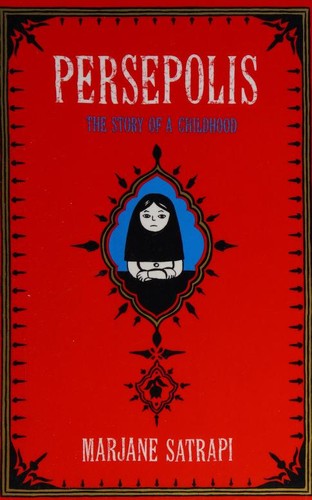
Persepolis
The Story of a Childhood
Persepolis: The Story of a Childhood is the first English-language volume of Marjane Satrapi's graphic memoir about growing up in Tehran. Told in stark black-and-white panels, it follows Marji from age six to fourteen while the Shah's monarchy collapses, the Islamic Republic tightens its grip, and war with Iraq changes daily life. Because Satrapi grew up in a secular, politically engaged family, history arrives as kitchen-table argument, family loss and a child's shifting questions about God, class and justice. Comedy and grief share the same page, and the child's viewpoint keeps vast political events personal. For anyone collecting memoirs to read about revolution, repression and coming of age, it is a compact, approachable starting point.
Where to buy or borrow
Are you selling this book? Bookstores, publishers, authors and libraries can be listed here for free. Request a listing
About this book
Deep Overview
Her family supplies the book's moral and intellectual center. Her parents are committed to leftist, secular ideas and join the street demonstrations against the Shah, while her grandmother offers frank advice, sharp humor and a model of dignity. Relatives who had been imprisoned under the monarchy, most memorably her uncle Anoosh, give Marji a kind of oral history lesson: she learns of Reza Shah, of earlier uprisings and of political prisoners through stories told at home, not through a textbook. That structure explains much of the book's method. Politics is not presented as an abstract backdrop but as a set of conversations she overhears, partly understands and then tests against her own feelings.
A second line of development follows the revolution's shift in meaning. Early optimism, shared by many people who wanted the monarchy gone, gives way to disappointment as new rules take hold: mandatory veiling, restrictions on social life, arrests, executions, and pressure to conform in school. Satrapi shows the gap between what the family says indoors and what Marji must say outside. Even her parents' decisions, including how much to protect her and how much to explain, become part of the story.
The war with Iraq brings a third layer. Air raids, shortages, funerals and the language of martyrdom enter ordinary routines. Satrapi pays attention to how the government's rhetoric reaches children, including the way boys are drawn toward the front, and to how families improvise in response, with black-market purchases, private parties, forbidden music and small acts of defiance. These episodes are often funny, but the humor rarely cancels the dread underneath.
Formally, the book depends on compression. Heavy blacks, simple figures and a reduced range of expressions let Satrapi move quickly from comic scenes to devastating ones without elaborate staging. Captions provide adult retrospective context, while the images retain a child's immediacy. That pairing is what the author is trying to demonstrate: a reader can understand a national upheaval by watching how it alters a household, a classroom and a young person's conscience.
By the end, Marji has become too outspoken for her own safety, and her parents decide that she should continue her education abroad. The ending is not a triumphant escape but a painful separation, which is why the book reads as the first half of a longer story rather than a self-contained resolution. Its larger argument is that Iranians cannot be reduced to a single image, whether of the Shah's regime, the revolutionaries or the clerics who followed; ordinary people hold contradictory loyalties, fears and senses of humor, and the book insists on showing all of them.
Key Themes
Public conformity versus private life. Satrapi repeatedly contrasts the behavior required outside the home with the freedoms, jokes and arguments permitted inside it. The contrast shows how a regime reaches into clothing, music, education and speech.
Class, privilege and complicity. Marji's family is educated and comfortable, and the book notices that fact. Her friendship with the family's maid, and the social distance that persists within it, complicates any simple story of revolution as moral rescue.
Faith and doubt. Marji's early devotion, her imagined conversations with God and her growing skepticism toward officially enforced religion are treated as part of ordinary growing up, not only as a matter of state policy.
Memory, loss and witness. Executions, imprisonments and bombings are recorded as personal losses. The book treats remembering as a form of testimony against official versions of events.
Resistance in small forms. Dissent appears as black-market music, a decorated jacket or a sharp reply in class. The book suggests that small refusals matter, while also showing that they carry real risks.
Historical Context
The second is the Islamic Revolution of 1979 and the founding of the Islamic Republic under Ayatollah Ruhollah Khomeini. The revolution drew together very different groups, and many who helped topple the Shah were later sidelined or persecuted. Satrapi's family experiences that shift from the perspective of people who expected a freer society.
The third is the Iran-Iraq War, which began in 1980 and lasted most of the decade. In the book it appears through air raids, mourning and state propaganda aimed at young people.
The book also belongs to a larger tradition. Scholars have placed it within the wave of memoirs by Iranian women, many written in exile, that followed the revolution. It further belongs to the rise of serious autobiographical comics, a lineage that French critics linked to Art Spiegelman's Maus, according to the publisher. Finally, its later history matters: it was challenged or restricted in some places, including a widely reported 2013 episode in Chicago Public Schools, and critics have debated how Western readers use it to understand Iran.
Intended Audience
It will also appeal to readers of comics who want to see how the medium handles autobiography and politics, and to teachers looking for a text that supports discussion of propaganda, censorship and identity.
Some readers may find it less suitable. The book includes depictions of torture, execution and war violence, so schools and parents sometimes weigh age-appropriateness; its drawings are simple, but the material is not light. Readers looking for a detailed, balanced political history of the revolution, or for a work covering the whole span of Satrapi's life, will want to pair it with other books, including the second volume.
Reading Difficulty
The challenge is emotional and conceptual, not linguistic. The tone shifts quickly from comic to harrowing, and some scenes assume you will read the visual detail as carefully as the captions. Iranian names and references to historical figures can feel dense at first, but they recur often enough to become familiar.
The book is in black-and-white, in a compact paperback format, and the lettering is clear. Page counts vary between sources, so readers comparing editions should check the specific printing. Because this edition ends at a turning point, readers who want closure should plan to continue to Persepolis 2.
Helpful Background Knowledge
A short orientation to the difference between Persian, Iranian and Arab identities can also be useful, since the book repeatedly pushes back on stereotypes. Readers who know how comics work, such as panels, gutters and captions, may notice more of Satrapi's choices, but the book teaches those habits as it goes.
It is also worth remembering that this is a memoir. It presents one family's recollection, shaped by an adult author, rather than a neutral history. Reading a short account of the Iranian Revolution alongside or after the book can help you see what the memoir illuminates and what it leaves in the background.
Why Read This Book?
It is also a clear example of what comics can do that prose often cannot. A single image can hold a joke and a threat together, and the visual simplicity makes the emotional turns hit quickly. For anyone curious about the graphic memoir as a form, it is a foundational example and has been widely taught.
Finally, the book rewards rereading: first for its story, then for its portrait of relationships between Marji, her parents and her grandmother, and again for how it handles complicity, class and belief.
Reader Takeaways
Readers may also notice how authoritarian systems operate through everyday regulation: dress codes, school rules, informants, and the pressure to rehearse approved answers. They may see how families develop their own forms of protection and where those protections fail.
On a craft level, the book invites attention to how a story can alternate between a child's immediate perception and an adult's retrospective framing, and how simple drawings can carry complex feeling. Finally, it prompts reflection on what responsibility a memoirist has when turning private suffering into a public account.
Strengths
The visual economy is another. The drawings are minimal, yet they communicate mood, power and fear efficiently, and the contrast between the child's playful imagination and the grim events nearby is handled with restraint.
Its organization into short, self-contained episodes makes the history approachable without simplifying it to a timeline. The family cast gives the political material emotional continuity, and the subtle treatment of class and belief adds depth beyond a simple anti-regime story.
It has also proved durable. Publisher materials list it among notable and bestselling books, and Penguin Random House reports it has reached millions of U.S. readers, which indicates how effectively it has connected with general audiences as well as classrooms.
Limitations and Cautions
Some critics have questioned its political framing. One reviewer quoted in an encyclopedia entry argued that Satrapi may underestimate how widely the new authorities were supported or accommodated; the author, by contrast, tends to present the repression as the work of a ruling minority. That disagreement is a reasonable subject for discussion, not a settled point.
The material includes scenes of torture, execution and war. It has been challenged in some school settings; in Chicago in 2013 it was restricted for certain grades and then reviewed, which prompted protests from teachers, students and free-expression groups. Educators should consider their students' maturity and offer context.
Finally, this edition stops mid-story. Its second half, in Persepolis 2, covers her time in Austria and return to Iran, so the arc here is incomplete. Bibliographic details such as page count differ among catalogues.
Important Concepts, People, and Places
Marji's parents: politically engaged, secular Iranians who attend demonstrations and try to protect her while still teaching her to think independently. They represent the educated middle class that opposed the Shah.
Marji's grandmother: a source of humor, candor and moral guidance; she links Marji to an older Iranian past.
Uncle Anoosh: a relative with a revolutionary past whose stories and fate teach Marji about political imprisonment and the cost of dissent.
Mehri: the family's maid, whose treatment and circumstances bring questions of class and social boundaries into the story.
Mohammad Reza Shah Pahlavi: the monarch whose fall opens the book's historical arc, and whose rule many in Marji's family opposed.
Ayatollah Ruhollah Khomeini: the leader of the revolution and the first supreme leader of the Islamic Republic; his government's rules shape Marji's school life and public conduct.
The Iranian Revolution (1979): the mass movement that ended the monarchy, whose promises and outcomes the book evaluates through personal experience.
The Iran-Iraq War: the long conflict that brings bombings, scarcity and martyrdom rhetoric into Tehran.
Tehran: the primary setting, depicted as a city of home, school and street.
Persepolis: the ancient Persian ceremonial capital that gives the book its title, signaling a longer history beneath the modern crisis.
The veil: the head covering mandated for girls and women, which opens the book and stands for the regime's reach into personal life.
L'Association and Pantheon: the French independent comics publisher of the original and the U.S. publisher of this English edition.
Graphic memoir: the form that combines autobiography with sequential art, and the book's chief claim to literary-historical importance.
Questions the Book Explores
What is the relationship between private conscience and public conformity under a government that regulates dress, speech and belief?
Who gets to tell the story of a revolution, and what is lost when that story is reduced to slogans or to Western headlines?
How do class differences shape which people appear as heroes, victims or bystanders in a national upheaval?
Can religious belief survive, change or be damaged when a state claims religion as its own instrument?
What does it cost a family to protect a child, and when does protection turn into separation?
Why might comics, with their mix of images and words, be especially suited to testimony about trauma and memory?
Reading Group Guide
Useful starting points include the book's opening scene about the veil, a relative's story that Marji hears at home, a moment when Marji acts impulsively, and the final departure. Ask each member to bring one panel that struck them and to explain what the image does that the caption alone would not.
Groups may also consider reading the second volume afterward, or comparing this book with another graphic memoir such as Maus. The publisher offers a readers guide, which is a convenient source of additional book discussion questions, and sensitive passages about violence merit a brief content note for the group.
Discussion Questions
2. How do the black-and-white drawings affect your reading of both comic and violent scenes?
3. In what ways do Marji's parents try to prepare her for the world outside the home? Do their choices seem wise, risky, or both?
4. How does the book portray the relationship between social class and political commitment?
5. Which characters do you see as conforming, resisting or compromising, and are those categories fair?
6. How does Marji's changing relationship with religion mirror or differ from the changes happening around her?
7. What role do stories from older relatives play in shaping what Marji believes about justice?
8. How does humor function in the book? Does it soften the events or make them sharper?
9. Why might some readers or institutions find this book challenging, and how would you respond to those concerns?
10. What do you expect from the next phase of Marji's life, and what in this volume prepares you for it?
Sources and Verification
Some limits are worth noting. Sources disagree on the page count of this edition, so none is given here. Translators are named on the basis of a bookseller listing and a reference overview. The profile does not reproduce text from the book, and the historical summary is intentionally general.
Comments
No published comments yet.
Available editions
Paperback
Pantheon Graphic Library trade paperback
- Publisher
- Pantheon
- ISBN-13
- 9780375714573
- Publication date