
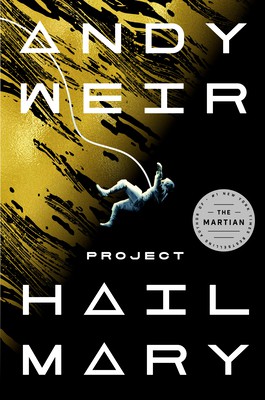
Project Hail Mary
A Novel
Ryland Grace wakes aboard a spacecraft with two dead crewmates, no accessible memories, and only fragmentary evidence of his mission. As he reconstructs his identity and purpose, he learns that Earth faces catastrophe from Astrophage, an extraterrestrial organism that is diminishing the Sun’s output. His destination, Tau Ceti, may hold the explanation—and a possible remedy. The novel combines an amnesia mystery, a sequence of scientific puzzles, and a first-contact story whose emotional center is an unexpected partnership. Andy Weir turns experiments, engineering improvisation, and competing planetary needs into suspense while asking whether courage is an inborn trait or a choice made under pressure.
Where to buy or borrow
Are you selling this book? Bookstores, publishers, authors and libraries can be listed here for free. Request a listing
About this book
Deep Overview
Recovered memories reveal the larger emergency. Astronomers have observed the Petrova line, an infrared signature connecting the Sun with Venus. The cause is Astrophage, a microscopic extraterrestrial organism that absorbs stellar energy and reproduces near carbon dioxide. Its growth is reducing solar output, threatening Earth with severe cooling and ecological collapse. A multinational effort, directed by the forceful Eva Stratt, discovers that Tau Ceti is unusually unaffected. Humanity builds the Hail Mary to investigate, accepting that its crew will probably not return.
The mission therefore operates on two timelines. In space, Grace must understand the ship, survive alone, and determine why Tau Ceti resists Astrophage. In flashbacks, he remembers his earlier role as a molecular-biologist-turned-schoolteacher, his recruitment into the global response, and the morally troubling route by which he came aboard. This delayed revelation changes the novel’s central question. Grace is not simply trying to fulfill a heroic identity; he must decide what kind of person he will become after learning uncomfortable truths about himself.
The story widens when Grace encounters Rocky, an engineer from Erid, whose people face the same stellar threat. Rocky is profoundly nonhuman in anatomy, sensory experience, atmosphere, and technology. Cooperation requires the pair to build a shared vocabulary from mathematics, physical objects, repeated demonstrations, and patient correction. Their civilizations possess complementary expertise: Grace has stronger theoretical knowledge in some areas, while Rocky’s engineering and materials science solve problems beyond human capabilities.
Their partnership redirects the book from solitary survival toward reciprocal responsibility. Grace and Rocky must identify Taumoeba, an organism that preys upon Astrophage, then determine how to contain, breed, and transport it safely. Each apparent solution produces another practical or ethical complication. Experiments fail, biological systems evolve, machines break, and choices acquire consequences for two worlds rather than one.
Weir ultimately connects scientific competence with moral growth. Intelligence alone cannot resolve the crisis; progress depends on trust, communication, humility, and a willingness to risk personal safety for another being. The mission’s title thus gains several meanings: it names a desperate planetary gamble, Grace’s opportunity to act differently from his earlier self, and the uncertain hope that knowledge shared across immense differences can preserve life.
Key Themes
• Friendship across radical difference: Grace and Rocky form trust without shared biology, culture, language, or sensory experience. Their bond grows through work, reliability, humor, and mutual care.
• Courage as action rather than identity: Grace’s recovered past complicates the heroic role assigned to him. The book distinguishes fear from cowardice and asks whether later choices can redeem earlier failures.
• Complementary knowledge: Neither humanity nor Erid possesses every necessary capability. Survival becomes possible when different kinds of intelligence and technology are combined.
• Sacrifice and ethical triage: Stratt’s emergency measures repeatedly place planetary survival above ordinary consent and individual rights, raising questions about whether necessity excuses coercion.
• Education and explanation: Grace remains a teacher even in space. His ability to break complex problems into understandable steps becomes essential to communication and cooperation.
• Adaptation and unintended consequences: Biological life does not remain static simply because engineers need it to. Evolution turns apparent solutions into new hazards.
Historical Context
Within science fiction, the novel belongs to the tradition of technically detailed problem-solving narratives, while also drawing on first-contact fiction and planetary-disaster stories. It shares The Martian’s interest in survival through applied science but expands the arena from Mars to nearby stellar systems and from individual rescue to the preservation of civilizations. Its 2022 Hugo Award nomination for Best Novel reflects its place in contemporary genre conversation, while its 2021 Goodreads Choice Award in science fiction indicates unusually broad popular reach.
The real astronomical locations—including Tau Ceti and the 40 Eridani system—anchor an invented astrobiological crisis. The story should not be mistaken for a forecast: Astrophage, Taumoeba, xenonite, and the relevant propulsion system are speculative inventions, even where their behavior is developed through recognizable physics, chemistry, and biology.
Intended Audience
It may be less satisfying for readers seeking lyrical prose, extensive interior psychology, a broad ensemble cast, political realism, or a pessimistic account of institutional behavior. Readers who dislike calculations, laboratory procedure, or repeated problem-solution cycles may find portions mechanical. The novel contains death, isolation, extinction anxiety, coercion, and sustained danger, though its prevailing outlook is hopeful rather than bleak.
Reading Difficulty
Alternating between the spacecraft and Grace’s returning memories creates suspense but initially withholds context. The first-person narration is highly conversational and includes frequent jokes, simplified analogies, and step-by-step deductions. At 496 pages in this edition, it is substantial but divided into short, eventful chapters. No specialist prerequisite is required; comfort with scientific reasoning is more useful than prior mastery of any particular subject.
Helpful Background Knowledge
It is helpful to know that Tau Ceti and 40 Eridani are real nearby star systems, whereas the organisms and technologies driving the plot are fictional. A reader should also recognize the difference between a scientific model and certainty: Grace repeatedly creates provisional explanations and changes them when evidence fails to fit. No knowledge of The Martian or Artemis is needed because this is a standalone novel.
Why Read This Book?
The book also makes intellectual work visibly dramatic. Microscopes, spreadsheets, improvised apparatus, biological samples, and failed tests become sources of suspense because every result alters the survival prospects of entire planets. Readers interested in communication may find the development of Grace and Rocky’s shared language as compelling as the mission itself. The novel further complicates its adventure with an ethical character arc: Grace’s eventual decisions matter because the recovered past prevents heroism from being treated as automatic.
Reader Takeaways
It also encourages reflection on communication across difference. Grace and Rocky succeed not by assuming similarity but by identifying shared reference points and respecting incompatible needs. Their partnership suggests that practical trust can precede complete understanding.
The story may prompt readers to reconsider simple labels such as hero, coward, expert, or alien. Competence does not eliminate fear, and unfamiliar anatomy does not prevent recognizable loyalty. Finally, the book highlights the value of complementary expertise: durable solutions emerge when theoretical insight, engineering skill, teaching ability, and local knowledge are allowed to correct one another.
Strengths
• Scientific reasoning drives the plot rather than decorating it; experiments produce discoveries, reversals, and new dangers.
• Rocky is designed as a genuinely nonhuman intelligence with distinct environmental requirements, senses, physiology, and technological strengths.
• Grace and Rocky’s relationship gives the large-scale disaster an intimate emotional core without reducing cooperation to sentiment alone.
• The alternating timeline supplies a meaningful character revelation that reframes Grace’s apparent heroism.
• Weir explains complex ideas in plain language and keeps technical sequences tied to immediate consequences.
• The novel balances bleak premises—dead crewmates and endangered worlds—with humor, curiosity, and constructive action.
Limitations and Cautions
Astrophage and several other inventions are speculative mechanisms created to make the premise work. The novel surrounds them with extensive calculation, but that detail should not be confused with complete scientific plausibility. Some technical questions are resolved through unusually convenient properties, particularly advanced Eridian materials.
Earth’s political response is compressed around Eva Stratt, who receives extraordinary authority. This keeps the story focused but limits examination of accountability, dissent, geopolitics, and the long-term consequences of emergency rule. Several supporting characters function mainly as specialists who deliver information or challenge Grace, while the central partnership receives far more development.
Discussion of the book is highly spoiler-sensitive: Grace’s recruitment, later biological complications, and final decisions are central to its ethical design. Reading groups may wish to separate spoiler-free recommendation from full analysis.
Important Concepts, People, and Places
• Rocky: An Eridian engineer encountered near Tau Ceti. His practical ingenuity, alien physiology, and endangered home world transform Grace’s solitary assignment into a cooperative mission.
• Eva Stratt: The administrator granted sweeping international authority over Earth’s emergency response. She embodies decisive coordination as well as the ethical dangers of coercive necessity.
• Astrophage: A fictional extraterrestrial microorganism that stores enormous quantities of energy and reproduces around stars. It causes the crisis but also enables interstellar propulsion.
• The Petrova line: The infrared phenomenon that alerts humanity to material moving between the Sun and Venus; it leads investigators to Astrophage.
• Project Hail Mary: Earth’s multinational last-chance program to reach Tau Ceti, learn why it resists infestation, and return findings through unmanned probes.
• Hail Mary: The mission spacecraft, equipped for laboratory research and powered by Astrophage-derived energy.
• Tau Ceti: The real nearby star system that becomes the mission’s destination because its star appears resistant to Astrophage.
• Adrian: The Tau Ceti planet where Grace and Rocky investigate the environmental basis of the star’s resistance.
• Erid and 40 Eridani: Rocky’s home planet and stellar system, threatened by the same organism endangering Earth.
• Taumoeba: A fictional predator of Astrophage and the basis of the hoped-for remedy. Its containment and evolution create major scientific challenges.
• Xenonite: Rocky’s extraordinarily capable fictional composite material, representing Erid’s superiority in materials engineering.
• Scientific method: Observation, hypothesis, experiment, and correction form the novel’s main problem-solving grammar.
• Panspermia: The idea that life or its precursors may spread between worlds helps frame questions about the organisms’ origins and relatedness.
Questions the Book Explores
• Is courage a stable personal quality, or can it emerge from a decision made after fear and failure?
• How far may governments go when ordinary rights conflict with the survival of billions?
• What makes scientific knowledge reliable when every explanation remains open to revision?
• How do different technological paths shape what civilizations can teach one another?
• Does responsibility change when saving one community places another at risk?
• Can later sacrifice repair the moral meaning of an earlier unwilling choice?
• What does teaching contribute to discovery, collaboration, and survival?
• How should researchers respond when living systems evolve around attempted controls?
• Is meaningful kinship grounded in biological similarity or in sustained acts of care?
Reading Group Guide
Ask each participant to select one experiment or engineering problem and explain why it succeeds or fails. The goal need not be checking calculations; instead, consider how Weir turns uncertainty into narrative tension. A second useful exercise is to map the resources each civilization contributes. This exposes the book’s argument that intelligence is plural and technological development is not a single ladder.
Discuss Eva Stratt separately from Grace. List her necessary achievements alongside her violations of consent, then examine whether the emergency changes the group’s judgment. Finally, trace the changing meanings of “Hail Mary”: desperate plan, institutional project, spacecraft, personal second chance, and act of faith in cooperation.
Groups interested in science can research Tau Ceti, 40 Eridani, stellar luminosity, or panspermia after the discussion, taking care to distinguish real astronomy from the novel’s invented biology.
Discussion Questions
2. At what point does Grace and Rocky’s cooperation become friendship, and what creates that change?
3. Which differences between humans and Eridians most effectively challenge human assumptions about intelligence?
4. Does the revelation of how Grace joined the mission fundamentally alter your judgment of him? Why?
5. Are Eva Stratt’s methods justified by the scale of the emergency? Where, if anywhere, should limits remain?
6. Which scientific failure in the novel is most important, and what does it reveal about the limits of prediction?
7. How does Grace’s experience as a teacher affect his survival skills and his relationship with Rocky?
8. Does the novel treat science as culturally neutral, or as a practice shaped by the needs and histories of different civilizations?
9. How does humor influence the story’s treatment of death, isolation, and extinction?
10. What does each civilization possess that the other lacks, and how does this complicate ideas of technological superiority?
11. How should Grace balance duties to Earth against obligations to Rocky and Erid?
12. What does the ending suggest about home, fulfillment, and the possibility of a second chance?
Sources and Verification
Comments
No published comments yet.
Available editions
Hardcover
First U.S. hardcover edition
- Publisher
- Ballantine Books
- ISBN-13
- 9780593135204
- Publication date
- Pages
- 496