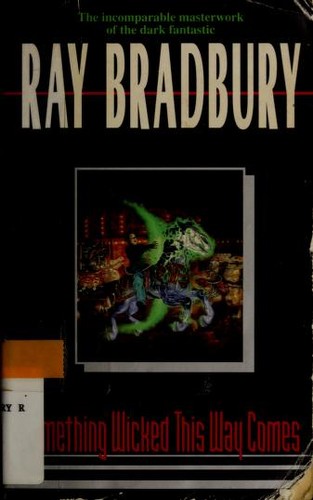
Deep Overview
The story begins with an arrival that is slightly wrong. A lightning-rod salesman warns of a coming storm, a loose handbill announces a carnival, and the season is turning toward Halloween. Cooger & Dark's Pandemonium Shadow Show appears in Green Town, Illinois, at the end of October. Will Halloway and Jim Nightshade, two best friends born on either side of midnight on October 30, sense its strangeness before any adult does. Will is cautious and tied to his home. Jim is restless and eager to leave childhood behind. That difference gives the book its engine.
The carnival's attractions, a carousel, a hall of mirrors and a cast of oddities, work by exploiting the wishes of whoever visits. Mr. Dark, its tattooed proprietor, offers people a changed version of themselves: younger, older, handsomer, or released from a loss they cannot bear. Bradbury shows that these gifts are bargains. The carnival feeds on the people it transforms, and the longer a victim stays, the less of an ordinary life remains. The boys' discovery of this, and their flight through the town's streets and its library, drive the middle of the book.
The third major figure is Will's father, Charles Halloway, who works at the library and is far older than most fathers of boys that age. He feels his years as a failure of nerve, and his sense that he has missed his life is the novel's emotional counterweight to the boys' hunger for adulthood. The carnival is dangerous to him precisely because he, too, would like to be remade. The book's crisis hinges on what he understands about the carnival's weakness: it thrives on despair and longing, and it has little defense against warmth that is freely given. The resolution is therefore moral and emotional rather than a contest of strength.
Structurally, Bradbury writes in long, rhythmic sentences, heavy with simile, and breaks the narrative into many short chapters that alternate between pursuit, reflection and set pieces. Passages in which Charles Halloway meditates in the library read almost like essays on mortality, while other chapters are pure suspense. The balance between those modes is what distinguishes the book from a straightforward monster story.
Readers who know Bradbury's other work will notice recycled material. The novel draws on stories from his early collections Dark Carnival and The Illustrated Man, and its origin lies in a film idea developed with Gene Kelly in the mid-1950s, when Bradbury expanded his short story The Black Ferris into a treatment. What he seems to be demonstrating throughout is that the supernatural is a way of dramatizing ordinary human wants. The carnival is frightening less because of its freaks than because its offers are tempting.
Key Themes
Desire and its price: the carnival grants wishes in a way that consumes the wisher, so wanting itself becomes the book's most dangerous force. Time and aging: Jim wants to grow up quickly, Charles wishes he could be younger, and the carnival's machinery makes both fantasies literal. Fear and how to face it: the boys learn that fear named and shared has less power than fear hidden. Good and evil as ordinary human choices rather than abstract opposites, since the evil here lives on human weaknesses. Friendship under strain: Will and Jim's bond is tested by their different appetites. Fatherhood and the passing of knowledge from an older generation to a younger. Laughter, joy and love as forms of resistance, set against a threat that depends on sorrow. The season itself, with its autumn light, early dark and Halloween, works as a theme about endings and renewal.
Historical Context
The book appeared in 1962, when Bradbury was already famous for Fahrenheit 451 and The Martian Chronicles, and it is set in a small-town Midwest that reflects his own Illinois boyhood rather than a specific historical year. That nostalgia sits alongside postwar American anxieties about conformity, mortality and the allure of easy transformation. The traveling carnival was a real feature of American life in the early twentieth century, and Bradbury has described a youthful encounter with a carnival performer called Mr. Electrico, who told him to live forever, as a formative moment. The novel belongs to a tradition of American Gothic and to the lineage of autumnal horror that runs through Bradbury's early stories. Its title comes from a line spoken by the witches in Shakespeare's Macbeth, which signals the book's debt to older stories about temptation and ambition. Later writers in horror, including Stephen King, have cited it as an influence.
Intended Audience
This book suits readers who enjoy atmospheric horror and fantasy more than gore, and anyone interested in Bradbury beyond his science fiction. It is a good fit for older teens and adults who like lyrical prose, for readers who return to seasonal stories each autumn, and for people looking for classic novels to read that are short and distinctive. Fans of the 1983 film will find the book considerably richer. It may frustrate readers who want fast, plot-driven suspense, because the language is dense and the story pauses often for reflection. Those who dislike heavy metaphor or sentimental treatments of small-town life may find it overwritten.
Reading Difficulty
The novel is of moderate difficulty. The plot is easy to follow, and the book is not long, but the prose is ornate, with long sentences, stacked images and unusual vocabulary. Dialogue between Charles Halloway and his son, and Charles's later speeches, carry abstract ideas about age and evil that reward slow reading. The short chapters make it easy to read in sessions. No prior knowledge is needed, though some passages assume familiarity with fairground language and with older literary references. The edition profiled here is a mass-market paperback of about 293 pages, a compact format that is easy to carry but may feel dense on the page.
Helpful Background Knowledge
None is required, but a few things enrich the experience. Knowing the line from Macbeth that supplies the title clarifies the book's sense of dread. Dandelion Wine, Bradbury's earlier Green Town book, offers a sunnier view of the same imagined town, which makes this book's darkness more striking. A general sense of the traveling carnival and sideshow tradition helps with the imagery of the carousel, mirrors and tattooed performers. Readers curious about how the novel came to exist may enjoy looking at Bradbury's earlier carnival stories and his work on the film version.
Why Read This Book?
It rewards readers who want a story where mood matters as much as plot. Few novels capture the end of childhood as vividly, and among coming of age books it is unusual in making the adult's crisis as central as the boys'. Charles Halloway's role gives it an emotional range that many horror stories lack. It is also a useful window into Bradbury's craft: you can see his habit of building a whole world from a single image, and his talent for turning folklore into modern parable. Finally, it is influential, so reading it helps explain a strand of American horror and fantasy that followed.
Reader Takeaways
A careful reader may come away with a sharper sense of how the book links desire to danger, and with a view of why Bradbury lets laughter and affection do the work that violence usually does in horror. You may notice how the setting, season and weather echo the characters' inner states. You may also reconsider what you think about regret, aging and the wish to be someone else, and how a parent and child can teach each other. For writers, the book offers a lesson in sustained imagery and in recycling earlier material into something larger.
Strengths
The atmosphere is the book's greatest asset: the opening chapters in particular create a precise and memorable sense of autumn dread. The three central characters are distinct and their relationships carry real emotion. The story's central premise, a carnival that exploits wishes, is simple, original in its details, and lends itself to many readings. The prose has a musicality that is hard to find elsewhere. The book also holds together as a moral fable without turning preachy for most of its length, and it is compact enough to reread.
Limitations and Cautions
The style is polarizing. Some readers find the metaphors overabundant, and the long reflective passages can slow the suspense. The characterization of the carnival's performers leans on the old sideshow convention of presenting physical difference as eerie, which sits uneasily with modern sensibilities. The cast is overwhelmingly male and the female characters, such as the schoolteacher and the Dust Witch, are less developed. The nostalgic portrait of small-town America is idealized and does not examine its social limits. The book's treatment of good and evil is more symbolic than psychological, and its climactic message about laughter may strike some readers as too tidy. The scenes of menace, especially those involving children, may be frightening for younger readers.
Important Concepts, People, and Places
Will Halloway: one of the two boys; cautious, loyal and the child who first senses danger, his birthday falling just before midnight on October 30.
Jim Nightshade: Will's friend, born just after midnight; impatient to grow up and therefore vulnerable to the carnival's offers.
Charles Halloway: Will's father, who works at the library; he supplies the book's reflective center and the idea that joy can defeat the carnival.
Mr. Dark: the tattooed proprietor of the carnival, the book's embodiment of temptation, who profits from other people's longing.
Mr. Cooger: Dark's partner, whose name is on the show's banner and whose fate shows what the carousel can do.
The Dust Witch: a menacing figure who travels by balloon and hunts the boys; she represents the carnival's supernatural reach.
Cooger & Dark's Pandemonium Shadow Show: the carnival itself, which arrives out of season and feeds on the people it changes.
Green Town, Illinois: the fictional small town based on Bradbury's own boyhood, also the setting of Dandelion Wine.
Macbeth: the Shakespeare play that supplies the title and its association with temptation and fate.
Mr. Electrico: the real carnival performer from Bradbury's childhood who inspired the writer and the book's sideshow imagery.
Gene Kelly: the film star with whom Bradbury first developed the idea in the 1950s.
Dark Carnival and The Illustrated Man: Bradbury's earlier collections, whose stories fed the novel.
The 1983 film: the Disney adaptation directed by Jack Clayton from Bradbury's own screenplay.
Questions the Book Explores
What happens to a person who gets exactly what they wish for? Is growing up something to hurry toward, or something to be endured with patience? How should anyone face a fear that cannot be argued with? Can an ordinary, flawed adult protect a child from forces beyond his understanding? Why does evil seem to attach itself so easily to dissatisfaction? And what kind of strength do cheerfulness and affection really offer when the threat is genuine?
Reading Group Guide
A group may find it useful to read the novel in the weeks before Halloween and to pause after each of its titled parts to compare how the mood changes. Because the language is so figurative, try reading a few pages aloud and discussing what the images add. Members who know the 1983 film could compare the two, noting what each emphasizes, with the caveat that the novel is considerably more reflective. It can also be paired with Dandelion Wine to examine how Bradbury treats the same imagined town in contrasting tones. Allow time to talk about Charles Halloway, since reactions to his speeches tend to differ widely.
Discussion Questions
1. How do Will and Jim's differing temperaments shape what the carnival offers each of them?
2. Why does Bradbury make the hero who finally confronts the carnival an aging father instead of a younger man?
3. In what ways does the setting, including the season, the weather and the town's layout, contribute to the story's suspense?
4. How convincing is the novel's claim that evil depends on other people's wants? Where does that idea seem strongest, and where does it strain?
5. What is the effect of Bradbury's heavily poetic style on the horror?
6. How does the book use the figure of the carnival performer, and how might a modern reader view those depictions?
7. What does the novel suggest about regret, and can a person be saved from regret by affection alone?
8. How does knowing the Macbeth reference change your reading of the title and the story?
9. Does the ending feel earned? Why or why not?
Sources and Verification
Bibliographic details for this edition (title, author, ISBN, publisher, publication year and page count) were checked against library catalogue records and bibliographic databases. They agree that this is an Avon Books paperback reprint of 293 pages. An exact publication day for this printing could not be confirmed, so none is given. Background on the novel's origins, publication history and film adaptation draws on reference works, encyclopedic entries, Disney's own film entry, and a study guide. The description of the story combines those sources with the text of the novel itself, and readers should treat finer plot details as an overview rather than a substitute for the book.