
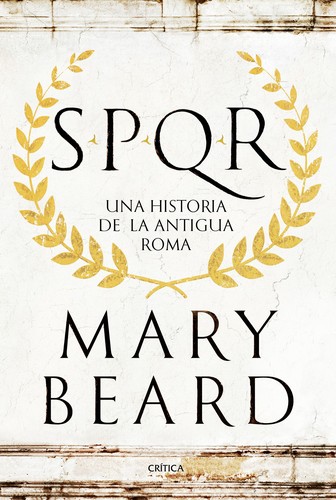
SPQR
A History of Ancient Rome
Mary Beard's SPQR examines how a small settlement in central Italy became the center of a vast and durable imperial system. Moving from Rome's uncertain beginnings and foundation legends through the Republic and early Empire, Beard asks how Roman power worked, who counted as Roman, and how conquest transformed both rulers and subjects. The account gives major figures such as Cicero, Julius Caesar, Augustus, and Caracalla their place without reducing Roman history to a procession of celebrated men. Political institutions, slavery, citizenship, migration, family life, religion, urban conditions, and social inequality are integral to the story. Beard also repeatedly exposes the difficulty of reconstructing antiquity from partisan texts, monumental self-presentation, inscriptions, coins, and incomplete archaeology. Ending in 212 CE, when Caracalla extended citizenship to almost all free inhabitants of the empire, SPQR presents Rome as a changing political community rather than a fixed mod…
Where to buy or borrow
Are you selling this book? Bookstores, publishers, authors and libraries can be listed here for free. Request a listing
About this book
Deep Overview
From there, Beard returns to early Rome, where archaeology and much later literary traditions must be handled with caution. Romulus and Remus, the rape of the Sabine women, the kings, and the expulsion of the Tarquins mattered greatly to Roman identity, but they cannot simply be treated as documentary history. Beard asks what such stories reveal about how Romans imagined incorporation, family, violence, and political liberty. Rome's origin myths are especially revealing because outsiders, rivals, refugees, and forcibly absorbed neighbors occupy the heart of them.
The book then follows the Republic's territorial growth and institutional development. Magistracies, popular assemblies, the Senate, patronage, military service, and aristocratic competition created a political order that distributed authority without producing modern equality. Expansion brought land, wealth, enslaved people, and prestige, but also intensified social conflict. Rome's defeat of Carthage, wars in the Greek world, and domination of the Mediterranean altered the scale on which Roman politicians competed. The Republic's final century—associated with figures such as Gaius Marius, Lucius Cornelius Sulla, Gnaeus Pompeius Magnus, Julius Caesar, and Marcus Antonius—appears less as a morality tale about individual ambition than as a prolonged struggle within institutions strained by empire.
Augustus's victory created monarchical power under republican language. Beard explores how emperors, senators, soldiers, provincial elites, and urban populations negotiated this arrangement. She is skeptical of lurid portraits of supposedly mad or monstrous rulers when those portraits come from hostile elite traditions. Imperial government depended not merely on an emperor's personality but on administration, military command, local cooperation, communication, and carefully staged authority.
Alongside high politics, SPQR considers housing, infrastructure, slavery, manumission, marriage, women's constrained public position, provincial diversity, religious practice, and the lives glimpsed in epitaphs and inscriptions. This wider field changes the meaning of “Romanization”: the empire was not simply a machine exporting one culture unchanged. Roman identities multiplied as conquered communities adopted, adapted, or strategically used Roman institutions.
The endpoint of 212 CE is therefore thematic. Caracalla's grant of citizenship to almost all free imperial inhabitants completed a long transformation in which citizenship expanded from the privilege of a small city to a status spanning the empire. Beard stops before late antiquity, not because Rome ceased to exist, but because the relationship among city, people, and empire had fundamentally changed.
Key Themes
**Power and political language:** Republican offices, senatorial authority, popular participation, and imperial monarchy overlap rather than replace one another cleanly. Emperors preserve republican forms even while concentrating power.
**History, myth, and evidence:** Foundation stories and famous anecdotes may reveal Roman values without recording literal events. Beard continually distinguishes what later Romans said happened from what surviving evidence can support.
**Empire and exploitation:** Conquest creates wealth, prestige, and connectivity while depending on coercion, war, taxation, and enslavement. Roman achievement cannot be separated from its human costs.
**Social visibility:** Elite men produced most surviving literature. Women, enslaved people, freed people, provincials, and the poor must often be approached through inscriptions, archaeology, legal texts, or indirect testimony.
**Identity through incorporation:** Roman culture developed through contact and exchange across Italy and the Mediterranean. Becoming Roman did not always require abandoning local identities.
Historical Context
Modern knowledge of this world is uneven. Literary narratives are much richer for the late Republic and early Empire than for early Rome, and many were composed by members of the educated elite. Archaeological sites, coins, papyri, inscriptions, epitaphs, and legal material can broaden that record but introduce their own interpretive problems. SPQR belongs to a tradition of large-scale Roman histories while reflecting modern scholarship's greater concern with source bias, provincial experience, slavery, gender, identity, and everyday life.
Intended Audience
Readers seeking a battle-by-battle military narrative, a succession-based catalogue of emperors, or a history extending through late antiquity and Rome's western collapse may find the scope different from what they expect. Its thematic detours and frequent interrogation of evidence require more attention than a simple chronological survey.
Reading Difficulty
A reader may occasionally need to consult the maps, chronology, index, or family relationships to retain orientation. The late Republic is especially dense because personal alliances and rivalries change rapidly. The prose remains conversational, but the book expects readers to tolerate uncertainty rather than receive a settled answer to every historical question.
Background Knowledge
Readers should also approach ancient dates and narratives with caution. Early Roman chronology often rests on traditions recorded centuries after the supposed events. Understanding that terms such as “democracy,” “class,” and “empire” do not map perfectly onto modern usage will help prevent false equivalences.
Why Read This Book?
Its strongest distinctive value lies in linking celebrated political crises with less visible structures: enslavement, manumission, local government, family hierarchy, migration, urban crowding, and the gradual widening of citizenship. Readers come away with a Rome that is more diverse, unstable, and institutionally inventive than the marble image inherited from later art and popular culture.
Reader Takeaways
It also changes how Roman citizenship can be understood: not as a static possession but as a flexible political instrument that helped bind communities to Roman rule. Readers may become more alert to the contrast between legal status and lived equality, to the importance of local collaboration in sustaining empires, and to the difficulty of recovering people who left few written records. More broadly, SPQR demonstrates that historical confidence should be proportional to the quality of the evidence.
Strengths
Another strength is its refusal to make Rome either a flawless ancestor of modern political life or merely a catalogue of brutality. Incorporation and exclusion, civic participation and oligarchic privilege, infrastructure and exploitation remain in tension. Beard's attention to inscriptions, graves, buildings, coins, and ordinary names also widens the range of lives considered, even when the available evidence cannot sustain complete biographies.
Limitations
Coverage is necessarily uneven across almost a thousand years. The late Republic receives especially vivid treatment because its documentary record is unusually rich, whereas early Rome remains more speculative. Major military campaigns and provincial regions sometimes serve the book's larger arguments rather than receiving comprehensive treatment. Beard's source-conscious method is intellectually productive, but readers wanting firm conclusions may find the recurring emphasis on uncertainty frustrating.
Important Concepts and People
**Roman citizenship:** A changing legal and political status central to Rome's incorporation of Italian allies and provincial populations. Its near-universal extension to free imperial inhabitants in 212 CE marks the book's endpoint.
**Marcus Tullius Cicero:** Consul, orator, and prolific writer whose account of the Catilinarian conspiracy illustrates both the richness and partiality of elite evidence.
**Lucius Sergius Catilina:** Aristocratic politician accused of leading the conspiracy of 63 BCE. His defeat demonstrates how winners can control the surviving narrative.
**Romulus and Remus:** Legendary twins associated with Rome's foundation. Beard treats their story as evidence of Roman self-imagination rather than straightforward fact.
**The Roman Republic:** The political order organized around magistrates, assemblies, the Senate, law, aristocratic rivalry, and citizen military participation before one-man rule became permanent.
**The Senate:** A council dominated by Rome's political elite. It exercised great authority but operated alongside magistrates, assemblies, popular pressure, and eventually emperors.
**The Punic Wars:** Rome's conflicts with Carthage, especially the war associated with Hannibal, which helped transform Roman power in the western Mediterranean.
**Julius Caesar:** General and dictator whose career exposed the Republic's institutional crisis; his assassination did not restore the old political balance.
**Augustus:** Caesar's adopted heir and Rome's first emperor. He created durable one-man rule while presenting his authority through republican offices and traditions.
**Slavery and manumission:** Enslaved labor was fundamental to Roman society, while the freeing of enslaved people created distinctive routes—though unequal ones—into civic and family life.
**Caracalla:** Emperor responsible for the Constitutio Antoniniana of 212 CE, which extended Roman citizenship to almost all free inhabitants of the empire.
**Romanization:** A debated way of describing cultural and institutional change under Roman rule. The book favors interaction, adaptation, and multiple identities over a one-directional transfer of culture.
Questions Explored
What combination of military force, political flexibility, citizenship, and local cooperation sustained Roman expansion?
How democratic was the Republic, and whose interests did its institutions actually protect?
Why did aristocratic competition become increasingly violent during the final century of the Republic?
How did Augustus establish monarchy while preserving the language and appearance of republican government?
What can historians responsibly claim when evidence is late, partisan, incomplete, or shaped by commemoration?
How can the experiences of women, enslaved people, freed people, provincials, and the poor be recovered from an elite record?
Why is the universalizing citizenship grant of 212 CE a meaningful dividing point in Roman history?
Reading Group Guide
Track the changing meaning of “the Roman people.” At several points—early incorporation of neighbors, Italian expansion, provincial government, and Caracalla's edict—ask who gains membership, what membership provides, and which inequalities remain.
Compare Rome's self-image with the mechanisms of conquest. Groups may examine whether openness to outsiders mitigated imperial violence or made expansion more effective. Another useful angle is the contrast between literary portraits and material evidence: note moments when an inscription, coin, tomb, building, or archaeological discovery complicates a famous written story.
Finally, identify where modern political vocabulary illuminates the Roman world and where it distorts it. Terms such as democracy, terrorism, citizenship, autocracy, and social mobility can provoke productive discussion if their ancient and modern meanings are kept distinct.
Discussion Questions
2. How should historians use foundation myths when their literal accuracy cannot be established?
3. Was Rome's willingness to incorporate outsiders a genuine civic principle, a strategy of domination, or both?
4. In what meaningful senses was the Roman Republic participatory, and in what senses was it oligarchic?
5. Which pressures created by conquest most seriously destabilized republican politics?
6. Did Augustus preserve the Republic's institutions, empty them of substance, or transform their function?
7. How does skepticism toward hostile accounts change the way notorious emperors should be assessed?
8. What kinds of evidence make non-elite Romans visible, and what remains unknowable about their lives?
9. Does the expansion of citizenship represent increasing equality, more efficient imperial control, or a mixture of the two?
10. Is 212 CE a convincing endpoint for this history? What changes if the story continues into late antiquity?
11. Which comparisons between ancient Rome and modern states are illuminating, and which risk anachronism?
12. After reading the book, what does “Roman” appear to mean: origin, legal status, culture, political allegiance, or some combination?
Sources and Verification
Comments
No published comments yet.
Available editions
Paperback
Paperback edition
- Publisher
- Profile Books
- ISBN-13
- 9781846683817
- Publication date