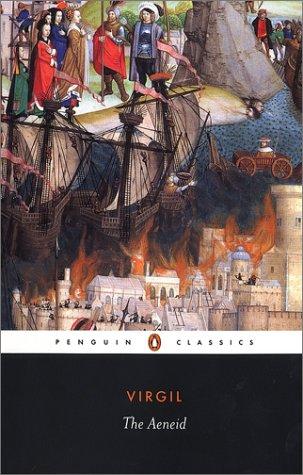
Deep Overview
The poem opens after Troy has fallen. Aeneas, son of the goddess Venus and the mortal Anchises, leads a band of survivors across the Mediterranean toward a homeland the gods have promised but not yet shown him. Juno, the queen of the gods, hates the Trojans and keeps the voyage dangerous. Her anger starts with a storm and continues through nearly every later obstacle. Early on, Jupiter foretells the long future of Rome. That prophecy tells the reader how the story ends before the hero has any idea.
The first half is a journey of loss and learning. Aeneas tells the Carthaginian queen Dido the story of Troy's last night and his wanderings. The two fall in love, and their relationship ends in Aeneas's departure and Dido's suicide. Few episodes in classical literature have been read, set to music and argued over as often. The journey then turns to the underworld, where Aeneas meets the dead and hears from his father a vision of Roman heroes yet unborn. In this way Virgil links mythic time to the recorded history his first audience knew.
The second half moves to Italy, where the Trojans' arrival provokes war with local peoples led by Turnus. These books are tougher and less consoling. They show alliances, divine interference, ambushes and the deaths of young warriors. Pallas, the son of the Arcadian king Evander, is killed by Turnus in the fighting. The consequences of his death shape the poem's ending.
The most interesting question the book poses is how to read its closing scene, and a reader of this edition should keep it in view throughout. The poem celebrates Rome's mission and the Julian family's ancestry. Yet it never lets the human price of that mission drop out of sight. Aeneas is dutiful and brave, but he is also driven and sometimes cruel. Several characters, including Dido, Turnus and the unlucky Trojan Palinurus, appear to be sacrificed to a larger plan. Readers have long disagreed about whether Virgil endorses the imperial project, doubts it, or holds both attitudes at once.
West's introduction and book-by-book prefaces help a reader keep these tensions in view. His notes, in combination with the prose, point out what is being echoed from Homer, what is distinctively Roman, and where the poem seems unfinished. The result is not a substitute for the Latin's sound, but a clear account of its narrative and rhetoric.
Key Themes
Destiny and human cost: the poem treats Rome's future as ordained, then lingers on the suffering that fulfilling it requires. Duty versus desire: Aeneas must repeatedly set aside personal wishes for a mission he did not choose, most painfully in his relationship with Dido. Divine intervention and its limits: Juno, Venus, Jupiter and other gods push events along, yet characters still act under pressure and with partial knowledge. Exile, memory and founding: the Trojans are refugees who carry a lost city's gods and stories into a new place. War and violence: the Italian campaign shows combat as both glorious and wasteful. Leadership and authority: Aeneas's piety, restraint and anger raise questions about what a ruler owes to his people and to his enemies. Ambiguity about empire: the poem honors Rome's future and shows who is crushed along the way.
Historical Context
Virgil lived through the final collapse of the Roman Republic. Civil wars ended with Octavian, later called Augustus, holding supreme power. Virgil's earlier works were the Eclogues and the Georgics. In the Aeneid he took on the national epic that Augustus's Rome seemed to need. The Georgics are generally dated to about 29 BCE, and the Aeneid occupied most of the poet's remaining years.
The patron Maecenas, close to Augustus, supported Virgil and other poets of the period, including Horace. That makes the Aeneid a work of the Augustan literary circle, which often wrote in sympathy with the new regime while keeping a poet's independence of tone. Virgil died in 19 BCE with the poem unfinished. According to later tradition, he asked that it be burned, and Augustus intervened to prevent that. Because the story comes down through tradition, its details cannot be confirmed. Virgil's literary executors, Plotius Tucca and Lucius Varius Rufus, are recorded as preparing the text for release.
The poem also draws on older history. Its account of Dido's Carthage reaches back to the origin of the long rivalry between Rome and Carthage, which readers would have connected with the Punic Wars. Homer's epics supply the model for episodes, speeches and similes. In turn, the Aeneid became the foundational Latin text for medieval and Renaissance readers, and a major influence on Dante.
Intended Audience
This edition suits students meeting Virgil for the first time, general readers who want the great epics in plain modern English, and anyone preparing for a literature, classics or Western-civilization course. It also serves readers of later epic who want to see a main source behind Dante, Milton and many other authors. Book clubs can use the twelve-book structure to divide the poem into manageable sessions.
Readers who prefer the pace of a novel, or who want the music and meter of verse in English, may find the prose version less satisfying. Those who need a close study of the Latin will want a commentary or a facing-text edition alongside it.
Reading Difficulty
The prose is clear and direct, and the vocabulary is not demanding. The difficulty lies elsewhere. The poem is full of names, gods, genealogies and allusions to myths that Virgil's audience knew well. Speeches and descriptive set pieces slow the story, and the battle books can feel repetitive at first. Pacing varies sharply: Books 1 to 4 and Book 6 are dramatic and widely accessible, while some of the middle books of the Italian war ask for patience.
The 368-page paperback is manageable in a few weeks at a book or two per sitting. West's prefaces and notes are useful but will interrupt the reading flow if consulted constantly. Many readers do best reading the preface, then the book, then the notes only when something puzzles them. No Latin or classical training is required.
Helpful Background Knowledge
A short refresher on the Trojan War helps, especially the roles of Priam, Hector, Achilles and Odysseus, and the Greek wooden horse. It also helps to know the outline of Homer's Iliad and Odyssey, since Virgil constantly echoes both. A basic sense of Roman history, particularly the end of the Republic and the rise of Augustus, supplies the political frame. Familiarity with the Greek and Roman gods and their Roman names, such as Juno for Hera and Jupiter for Zeus, will save confusion. Reading West's introduction before starting is the most efficient preparation, because it explains the poem's aims in the terms of this edition.
Why Read This Book?
Choose this edition if you want a faithful, readable prose rendering that keeps the story moving and does not demand experience with poetry. The accompanying material is part of the reason: a revised introduction and separate prefaces for each of the twelve books mean the reader is guided through a long, layered poem. Beyond the edition, the Aeneid repays attention because it shaped how later writers imagined heroism, empire, exile and love. Its central episodes, from the fall of Troy to Dido's tragedy to the visit to the dead, have been retold and reinterpreted for two thousand years. Reading it gives direct access to the original of stories that many other works refer to.
Reader Takeaways
A careful reader will come away able to trace how Virgil adapts Homeric models to a Roman purpose, and to explain why the poem's two halves differ in tone and subject. They may also reconsider the idea that an official, patriotic epic must be simple in its message. Attentive readers will notice how suffering is distributed in the poem and who benefits from the destined outcome. They may find that the ending resists easy approval or condemnation, and that the same lines support quite different readings. They will also be better placed to recognize Virgilian echoes in later literature, art and music.
Strengths
The edition's greatest strength is accessibility without superficiality. West's translation is generally praised for staying close to the Latin, and its prose lets the narrative and speeches carry the weight. The introduction and book-by-book prefaces give orientation at the exact points where first-time readers often lose their bearings. The format is compact and reasonably priced, which suits classroom and book-club use. The poem itself offers an unusually wide emotional range, from tenderness and grief to ferocity and political reflection.
Limitations and Cautions
A prose translation cannot reproduce Virgil's hexameter, sound patterns or verse rhythm, and readers who want those qualities should compare a verse translation. Every translation embodies interpretive choices, so some phrasing will differ from other versions. The poem is unfinished, and a few lines were left incomplete or awkward; readers should not treat every inconsistency as intentional. The Aeneid is also tied to Augustan ideology, and scholars disagree about how far it endorses or questions imperial power. The edition's introduction represents one scholar's view, not the only reasonable one. Finally, the poem's treatment of gods, women, conquered peoples and war reflects ancient values that some modern readers will find troubling.
Important Concepts, People, and Places
Aeneas: Trojan prince and hero, the poem's protagonist and the legendary ancestor of the Romans. Virgil: the Roman poet who composed the work, patronized by Maecenas and linked to Augustus. Augustus: the first Roman emperor, whose rule is the poem's political backdrop and whose family claimed descent from Aeneas. Dido: queen of Carthage, whose love for Aeneas and death form the emotional center of Book 4. Turnus: leader of the Italian forces and Aeneas's chief opponent in the later books. Juno and Venus: the divine rivals whose opposing aims drive much of the plot. Jupiter: the ruler of the gods, who presents the long view of Roman history. Anchises: Aeneas's father, who guides his son through the underworld vision. Pallas and Evander: the young warrior and his father, whose story deepens the war's moral weight. Troy, Carthage, Latium and the underworld: the settings that mark the stages of the story. Pietas: the Roman idea of dutiful devotion to gods, family and country, central to Aeneas's character. Epic tradition: the Homeric models that Virgil adopts and transforms. Fatum: the idea of destiny that organizes the narrative. Dactylic hexameter: the verse form that West's prose translation does not attempt to reproduce.
Questions the Book Explores
Can a nation's founding be celebrated without hiding what it destroyed? What does duty demand when it conflicts with love, grief or anger? How far are human beings responsible for their actions when gods and fate seem to guide events? What makes a leader legitimate, and what makes force justified? Is Aeneas's final act an expression of justice, vengeance or something harder to name? How does a displaced people carry its identity into a new land? And how should a poet write for a powerful patron while keeping a sense of what that power costs?
Reading Group Guide
The poem divides naturally into groups of two or three books. One plan is Books 1 to 2 (storm, arrival and the fall of Troy), 3 to 4 (wandering and Dido), 5 to 6 (games and the underworld), 7 to 9 (war begins), 10 to 11 (Pallas and the escalating conflict) and 12 (resolution). Members can read West's prefaces aloud at the start of each session and use them as a springboard. Because translations vary, a group may enjoy comparing a short passage, such as the opening or the death of Dido, across two versions. It is helpful to agree beforehand whether the group will discuss the poem as literature, as political writing, or as both. Allow time for the final book, since the ending tends to divide opinion.
Discussion Questions
1. How does Virgil's use of Homeric models shape your expectations in the first six books versus the last six?
2. Is Aeneas a heroic figure, a tragic one, or both? What moments most influence your view?
3. How should we understand Dido's role: victim, rival, queen, or a force opposed to destiny?
4. What does the vision of future Romans in the underworld accomplish for the poem's argument?
5. Where do the gods seem to help human action, and where do they seem to override it?
6. How does the death of Pallas change the way the final duel reads?
7. Do you read the ending as celebration, warning or something more ambivalent?
8. What does reading a prose translation add or take away compared with verse?
9. Which scenes make the strongest case that Virgil is sympathetic to those who lose?
Sources and Verification
The edition details come from the publisher's own listing and the Penguin Random House higher-education page, cross-checked against bibliographic and retailer records for the ISBN-10, page count and format. Background on the poem, Virgil's career and its Augustan setting draws on reference works on world literature, a university reading list entry and a reference article on the translator. Page counts and dates can vary between printings and territories, and this profile follows the publisher's record for the 2003 paperback. The interpretive discussion is the editor's own synthesis, and scholars debate many of the readings summarized here.