
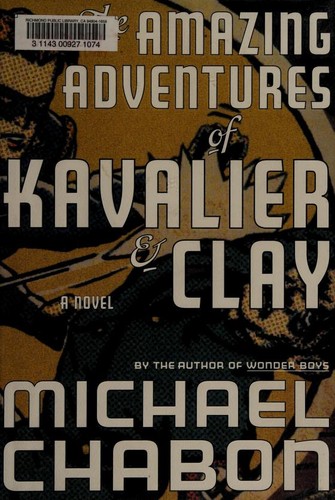
The Amazing Adventures of Kavalier & Clay
A Novel
Beginning in 1939, Michael Chabon’s historical novel brings together Josef “Joe” Kavalier, a Jewish artist who has escaped Nazi-occupied Prague, and his Brooklyn cousin, Sammy Klayman, who adopts the professional name Sam Clay. Their complementary talents—Joe’s visual imagination and Sammy’s instinct for stories—produce the Escapist, a superhero whose battles transform private longings into colorful public fantasy. Success in the emerging comic-book business offers money, recognition, and a symbolic weapon against fascism, but it cannot rescue Joe’s family or release either cousin from grief, fear, secrecy, and compromise. Moving through wartime New York and beyond, the novel links the rise of American superhero comics with refugee experience, Jewish identity, artistic ownership, queer life under repression, and the uneasy promise of reinvention. Its central insight is that escape can be necessary and creative without ever being complete.
Where to buy or borrow
Are you selling this book? Bookstores, publishers, authors and libraries can be listed here for free. Request a listing
About this book
Deep Overview
The partnership joins distinct motives. Joe sees comics as a source of money for bringing his family to America and as a fantasy battlefield on which he can strike at Hitler. Sammy sees them as an entrance into authorship, professional independence, and a larger identity than the one available to him in his mother’s Brooklyn home. Their success exposes a foundational conflict in commercial art: the young creators supply the imagination, but publishers and owners possess the leverage. The Escapist becomes famous without granting his creators equivalent control, making the cousins’ triumph inseparable from exploitation.
Joe’s relationship with artist Rosa Saks opens a different possibility for creation and intimacy, yet the catastrophe in Europe continually interrupts any simple American success story. His efforts to save his family, especially his younger brother Thomas, reveal the cruel distance between symbolic victories and political reality. The more brilliantly Joe draws impossible rescues, the more painfully he confronts what art cannot reverse. His later withdrawal and wartime experiences intensify the novel’s examination of survivor guilt, punishment, disappearance, and return.
Sammy’s conflict is less geographically dramatic but equally bound to concealment. His relationship with actor Tracy Bacon forces him to recognize desires that mid-century American law and convention render dangerous. Public persecution and private fear teach him to treat secrecy as protection. The domestic arrangement that eventually joins Sammy, Rosa, and her son Thomas offers care and stability, yet it also rests on withheld truths and deferred choices.
Across these parallel lives, escape changes meaning. It may be bodily survival, artistic invention, sexual concealment, career ambition, military service, suburban respectability, or abandonment. Chabon neither dismisses fantasy as evasion nor presents it as a cure. Comics allow the characters to protest, remember, earn a living, and imagine justice; they also turn anguish into a commodity and sometimes postpone direct engagement with pain. The novel ultimately treats art as a beautifully imperfect escape device: it cannot free everyone, but it can reveal the shape of the cage.
Key Themes
**Art as action and refuge:** Comics offer Joe and Sammy a means to answer fascism and personal powerlessness, even when their invented victories cannot alter events in Europe.
**Creation and ownership:** The Escapist’s commercial success highlights the divide between making a cultural property and controlling its profits, reputation, or future.
**Jewish migration and American reinvention:** Joe’s refugee experience and Sammy’s American upbringing represent different relationships to Europe, memory, assimilation, and the promise of a self-made life.
**Queer identity and concealment:** Sammy’s story explores how desire, shame, law, public exposure, and family obligation interact in a hostile social climate.
**Heroism versus ordinary responsibility:** Spectacular rescues are contrasted with quieter and more difficult acts of loyalty, caregiving, honesty, and return.
**Family built through love and secrecy:** Biological ties matter deeply, but the novel also examines improvised households whose tenderness coexists with unresolved truths.
Historical Context
Its American cultural setting is the Golden Age of comic books. Superman, created by Jerry Siegel and Joe Shuster, debuted in 1938 and helped establish the superhero as a mass-market form. Many early publishers, editors, writers, and artists in the industry were Jewish, and wartime comics frequently turned fascism into a visibly defeatable enemy. Chabon’s fictional partnership echoes this history without reducing Joe and Sammy to portraits of any single real creative team.
The later narrative also draws upon the postwar climate in which comics came under public suspicion and queer Americans faced legal danger, social stigma, and pressure to hide. These contexts make the book’s recurring concern with masks more than a superhero convention: concealment can provide temporary safety while carrying lasting personal costs.
Intended Audience
Readers looking for a brisk, narrowly focused adventure should expect something broader and more digressive. The novel contains adult sexuality, antisemitism, homophobia, wartime loss, suicide, grief, and Holocaust-related material. Its playful invention and humor coexist with sustained tragedy.
Reading Difficulty
The emotional difficulty may exceed the technical difficulty. Comic-book exuberance is repeatedly interrupted by persecution, bereavement, guilt, and repression. A reader comfortable with ambitious literary sagas should find it accessible, but it is not a lightweight superhero adventure despite its premise.
Helpful Background Knowledge
None of this is essential preparation. The novel supplies enough context to follow the characters, and unfamiliar references can be treated as part of its densely reconstructed world rather than as prerequisites.
Why Read It?
The book also offers a layered portrait of creative partnership. Joe and Sammy need each other’s abilities, yet they do not share identical motives, wounds, or definitions of freedom. Their collaboration makes artistic creation feel at once technical, emotional, economic, and political. Readers interested in how private fantasies become public myths will find the novel particularly rewarding.
Reader Takeaways
The novel also encourages attention to the workers behind cultural icons. A successful character may conceal the precarious labor, unequal contracts, and personal histories of its creators. More broadly, the book shows how national myths of reinvention can both liberate and mislead: a new name, career, home, or family arrangement may create real possibilities without erasing loss.
Finally, the cousins’ differing stories suggest that freedom is not a single decisive exit. It requires continuing choices about truth, responsibility, intimacy, and what one owes to both the living and the dead.
Strengths
Chabon also sustains a productive contrast between exuberance and sorrow. The language can imitate the oversized energy of pulp adventure without trivializing refugee trauma or private shame. Joe and Sammy are linked by talent and affection but remain psychologically distinct, allowing the central metaphor of escape to develop differently in each life.
The invented publication history of the Escapist is another notable achievement. It creates the impression that a missing strand of American popular culture has been restored, which strengthens the novel’s meditation on memory and authorship.
Limitations and Considerations
The storytelling often favors dramatic coincidence, symbolic patterning, and heightened adventure over strict realism. That is central to the design, but readers seeking restrained historical reconstruction may find it conspicuous. The industry portrayed is also a fictional composite rather than a substitute for nonfiction comics history.
Its treatment of the Holocaust, queer repression, family secrecy, and disappearance is emotionally demanding. Readers may also debate whether Rosa and other supporting characters receive interior development equal to the two title figures.
Important Concepts, People, and Places
**Sammy Klayman / Sam Clay:** Joe’s Brooklyn cousin and writing partner. His professional reinvention and concealed sexuality make naming, performance, and secrecy central to his story.
**Rosa Saks:** A New York artist whose relationship with Joe and Sammy connects romantic love, creative work, caregiving, and the novel’s unconventional family structure.
**Thomas Kavalier:** Joe’s younger brother in Europe. The effort to bring him to safety gives the cousins’ commercial success an urgent moral purpose.
**Tracy Bacon:** An actor associated with the Escapist’s media life and Sammy’s awakening to romantic possibility. He represents a path Sammy desires but fears he cannot safely inhabit.
**Bernard Kornblum:** Joe’s Prague teacher in stage magic and escape. His craft establishes the physical techniques that later become an artistic and ethical metaphor.
**The Escapist:** The cousins’ fictional superhero, a liberator who breaks chains and defeats tyrants. He embodies wish fulfillment, political anger, commercial property, and the uncertain value of fantasy.
**The Golem of Prague:** A figure from Jewish legend associated with protection and created life. Within the novel’s symbolic system, the Golem links European Jewish memory to the creation of American superheroes.
**Prague:** Joe’s lost home and the site of occupation, family danger, and inherited legend. It stands in painful tension with New York’s apparent openness.
**New York City:** The center of the cousins’ artistic partnership and commercial ascent. Its publishing offices, apartments, theaters, and social worlds make it both a refuge and a system of new constraints.
**Golden Age of Comics:** The period beginning around the late 1930s when superheroes became a major American popular form. The novel embeds its fictional creators within this real cultural transformation.
**Jerry Siegel and Joe Shuster:** The real writer and artist who created Superman. Their breakthrough and the broader history of creator exploitation provide essential context for Joe and Sammy’s fictional careers.
**Harry Houdini:** The celebrated escape artist whose cultural image helps shape Joe’s training and the novel’s vocabulary of confinement, spectacle, and liberation.
**The Second World War and the Holocaust:** Historical forces that determine Joe’s exile, bereavement, anger, and inability to separate artistic fantasy from events in Europe.
Questions the Book Explores
Can fantasy oppose political evil if it cannot directly rescue its victims?
Who owns an artistic creation: the person who imagines it, the collaborators who realize it, or the company that purchases and distributes it?
How do migration and professional renaming change identity without erasing the past?
What does secrecy protect, and what does it damage?
Why do cultures transform vulnerable outsiders into invulnerable heroes?
Can a family built partly upon concealment still provide genuine love and security?
What forms of courage remain when spectacular heroism is impossible?
Reading Group Guide
Compare the cousins as collaborators rather than treating them as a single creative unit. Notice what each contributes, what each expects from success, and how their ideas of escape diverge. The business arrangements surrounding the Escapist offer a useful entry into questions about labor, ownership, and the American success story.
Groups may also compare Prague and New York as imagined spaces: one is associated with danger and memory, the other with opportunity, commerce, and new forms of confinement. Consider how the Golem, Houdini, and the superhero become three different models of protective power.
For a final discussion, examine the domestic relationships in the later novel. Ask whether stability founded on partial truths should be understood as refuge, compromise, sacrifice, or another enclosure.
Discussion Questions
2. Why is the Escapist the right hero for Joe and Sammy to create together?
3. In what ways does their comic express sincere political resistance, and in what ways does it turn resistance into a product?
4. How do Joe and Sammy understand success differently?
5. What does Rosa contribute to the novel’s account of art and authorship?
6. How does the book distinguish physical freedom from emotional or social freedom?
7. What parallels exist between the Golem legend and the creation of a superhero?
8. How does the danger surrounding Sammy’s sexuality affect his understanding of home and responsibility?
9. Does the novel ultimately defend escapist entertainment, criticize it, or hold both positions at once?
10. How does creator exploitation complicate the idea that talent guarantees opportunity in America?
11. Which acts in the novel deserve to be called heroic even though they lack spectacle?
12. What does the ending suggest about whether a person can return from prolonged self-concealment?
Sources and Verification
Comments
No published comments yet.
Available editions
Hardcover
First U.S. edition; hardcover
- Publisher
- Random House
- ISBN-13
- 9780679450047
- Publication date