
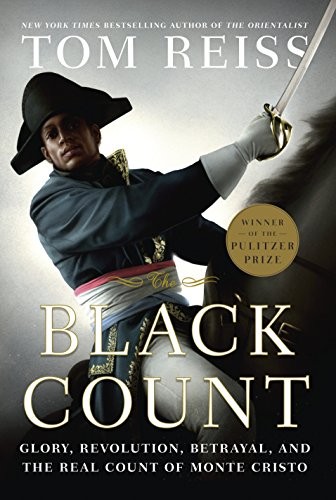
The Black Count
Glory, Revolution, Betrayal, and the Real Count of Monte Cristo
Tom Reiss reconstructs the life of Thomas-Alexandre Dumas, the father of novelist Alexandre Dumas and one of the most remarkable military figures of Revolutionary France. Born in colonial Saint-Domingue to an enslaved Black woman and a French nobleman, Dumas traveled to France, enlisted as an ordinary cavalryman, and rose to the rank of general during a brief revolutionary period of expanded opportunity for men of color. His campaigns in the Alps, Italy, and Egypt established his reputation for courage, physical power, and independence. Those same qualities eventually brought him into conflict with Napoleon Bonaparte. Capture, imprisonment, political abandonment, and the restoration of racial discrimination transformed his final years. Reiss connects this history to the fiction of Dumas’s celebrated son, showing how the general’s heroism, captivity, betrayal, and longing for justice helped shape works including The Count of Monte Cristo and The Three Musketeers. The result is simultan…
Where to buy or borrow
Are you selling this book? Bookstores, publishers, authors and libraries can be listed here for free. Request a listing
About this book
Deep Overview
After arriving in France with his father, Dumas entered a society governed by aristocratic privilege but also influenced by legal traditions under which slavery did not have the same standing it possessed in the colonies. He received the education and training associated with a young gentleman, yet a break with his father led him to enlist in the army under his mother’s surname. Reiss presents this choice as both a personal reinvention and the beginning of an extraordinary military career.
The French Revolution disrupted conventional hierarchies and created opportunities for talent, courage, and political commitment to outweigh birth. Dumas advanced from cavalryman to general with remarkable speed. His battlefield leadership, physical daring, and concern for ordinary soldiers helped make him a prominent republican commander. Campaigns in the Alps and Italy demonstrate both his tactical effectiveness and his willingness to take personal risks. They also establish the values that later separated him from Napoleon Bonaparte: Dumas could be severe in war, but he retained a strong attachment to republican principle and resisted brutality, corruption, and personal dictatorship.
The Egyptian expedition marks a decisive turn. Dumas served under Napoleon but became openly critical of the campaign and its leadership. On his return journey, he was captured and imprisoned in the Kingdom of Naples. His prolonged confinement, declining health, and fear of poisoning form the biographical experience most clearly echoed in The Count of Monte Cristo, whose hero survives unjust imprisonment before seeking redress.
When Dumas finally returned to France, the political environment had changed. Napoleon’s government reversed important revolutionary advances for people of color and rebuilt a racial order connected to colonial slavery. Dumas received neither the recognition nor the financial support that his service merited. He died in 1806, when his son Alexandre was still a small child.
Reiss therefore tells two related stories. One concerns the creation and destruction of an unusual opening for racial equality in Revolutionary France. The other concerns the survival of a father through a son’s imagination. Alexandre Dumas transformed inherited memories of courage, imprisonment, loyalty, and betrayal into popular fiction. The biography argues that recovering General Dumas changes how readers understand both the revolutionary era and some of the nineteenth century’s most enduring adventure novels.
Key Themes
Another major theme is the conflict between republican service and personal ambition. Dumas embodies an ideal of command based on duty, restraint, and solidarity with soldiers, while Napoleon increasingly represents centralized authority and imperial self-promotion. Finally, the book considers how experience becomes legend. The general’s life survives less through official commemoration than through the stories, memories, and fictional heroes created by his son.
Historical Context
The French Revolution beginning in 1789 challenged inherited privilege and proclaimed universal rights, although the application of those principles remained inconsistent and contested. Revolutionary warfare created rapid opportunities for capable soldiers, while debates over slavery and citizenship reached France’s colonies. France abolished slavery in its colonies in 1794, but Napoleon restored it in 1802 and imposed discriminatory measures against people of color. Dumas’s career spans this reversal.
His military service also belongs to the French Revolutionary Wars, including campaigns in the Alps and Italy, followed by Napoleon’s Egyptian expedition. These conflicts helped turn a revolution defended by citizen armies into a system increasingly dominated by Napoleon. Understanding that transition is essential to recognizing why Dumas could rise so high under the Republic and then lose status under the regime that followed.
Intended Audience
Readers who usually avoid military history may still appreciate the strong biographical arc and attention to family, identity, and memory. Those seeking a narrowly documented campaign history or a full biography of the novelist Alexandre Dumas should note that the book’s main subject is the novelist’s father. Some readers may also find the descriptions of colonial exploitation, combat, captivity, illness, and racial oppression emotionally demanding.
Reading Difficulty
The chronological structure generally provides a clear path through complicated events. The prose is aimed at general adult readers, while advanced secondary-school and college readers can approach it with guidance. No knowledge of French is required. Familiarity with the basic sequence from the ancien régime through the Revolution and Napoleon will make the political transitions easier to follow.
Helpful Background Knowledge
Readers may also benefit from knowing that Alexandre Dumas, the general’s son, wrote The Three Musketeers and The Count of Monte Cristo. Reading those novels is not a prerequisite, but awareness of their major concerns—loyal comradeship, unjust imprisonment, disguised identity, revenge, and restored honor—makes the biographical connections more visible.
Why Read This Book?
The book also offers an unusually concrete bridge between history and literature. Rather than treating classic adventure fiction as detached invention, Reiss traces how family memory and historical trauma can be transformed into characters and plots. Readers interested in the making of public heroes will find a further reason to choose the book: it asks why some figures enter national memory while others survive only indirectly, hidden inside stories attributed to someone else.
Reader Takeaways
Readers may reconsider Napoleon through the experience of a subordinate whose republican ideals and independence became liabilities. They may also recognize how literary creation preserves personal history while reshaping it. More broadly, the book encourages attention to the archival, political, and cultural forces that determine who is remembered as a national figure and who disappears from conventional accounts.
Strengths
The work also makes productive use of varied evidence, including family material, military documentation, legal records, correspondence, memoirs, and records associated with Dumas’s captivity. Its literary analysis is valuable because it does not simply search for exact one-to-one models. Instead, it identifies recurring experiences—betrayal, imprisonment, loyalty, lost status, and the pursuit of justice—that passed from family memory into fiction.
Limitations and Cautions
Because the narrative covers colonial society, family history, revolution, several military campaigns, imprisonment, and literary influence, some subjects receive less detailed treatment than they would in a dedicated study. The connection between General Dumas and his son’s fiction is persuasive as a pattern of influence, but literary works have multiple sources and should not be reduced to disguised biography.
Important Concepts, People, Places, and Institutions
Marie-Cessette Dumas was his enslaved mother in Saint-Domingue. The limited documentary record surrounding her illustrates how slavery shaped both the Dumas family and the historical archive.
Alexandre Antoine Davy de la Pailleterie was Dumas’s white aristocratic father. His choices connected his son to both colonial exploitation and French elite society.
Alexandre Dumas was the general’s son and the author of The Count of Monte Cristo and The Three Musketeers. His memories of his father helped preserve the elder Dumas’s experiences in transformed literary form.
Napoleon Bonaparte was Dumas’s commander and eventual political adversary. Their strained relationship represents a larger conflict between republican military ideals and Napoleon’s increasingly personal and imperial authority.
Saint-Domingue, now Haiti, was France’s plantation colony in the western part of Hispaniola. It was the setting of Dumas’s birth and an essential part of the book’s examination of slavery, race, and Atlantic wealth.
The French Revolution created the political and military conditions for Dumas’s rapid advancement while proclaiming ideals of liberty and equality whose application remained unstable.
The French Revolutionary Wars provided the campaigns in which Dumas established his reputation, particularly in Alpine and Italian operations.
The Egyptian expedition brought Dumas into sharper conflict with Napoleon and preceded the voyage on which he was captured.
The Kingdom of Naples held Dumas after his capture. His confinement damaged his health and became an important biographical source for the imprisonment motif associated with The Count of Monte Cristo.
The abolition of slavery by revolutionary France in 1794 and its restoration under Napoleon in 1802 define the political reversal surrounding Dumas’s rise and marginalization.
Historical memory is a governing concept throughout the book: Dumas’s disappearance from official commemoration contrasts with his indirect survival in his son’s globally influential fiction.
Questions the Book Explores
What political and legal conditions made that rise possible, and why were those conditions reversed?
How did Dumas’s understanding of military honor differ from Napoleon’s approach to power and command?
What can one officer’s career reveal about the distance between revolutionary declarations and lived equality?
How did imprisonment, abandonment, and the denial of recognition shape the Dumas family’s memory?
In what ways did Alexandre Dumas transform his father’s experiences into adventure fiction?
Why did General Dumas fade from public history even as stories resembling his life became internationally famous?
Reading Group Guide
A second approach is to compare forms of heroism. Notice when the book emphasizes physical courage, tactical judgment, humane restraint, loyalty, or resistance to authority. Consider whether these qualities can coexist comfortably within a military hierarchy.
Readers familiar with The Count of Monte Cristo or The Three Musketeers can identify parallels involving unjust confinement, comradeship, concealed origins, betrayal, and recovered honor. The goal need not be to locate exact fictional copies of historical events, but to consider how emotional patterns travel across generations.
Finally, examine the book’s treatment of evidence. Pay attention to moments when official records, family memory, memoir, and literary invention offer different versions of a person or event. These differences provide a useful starting point for discussing how biographies are constructed.
Discussion Questions
2. Does the book present Revolutionary France as genuinely advancing racial equality, or as creating only a temporary exception?
3. How does Dumas’s concern for soldiers and civilians affect the book’s definition of military greatness?
4. What is the deepest source of conflict between Dumas and Napoleon: personality, strategy, political principle, race, or a combination of these?
5. How does the history of Saint-Domingue change the meaning of Dumas’s later success in France?
6. What responsibilities does a biographer have when the archive preserves the powerful more fully than the enslaved or marginalized?
7. In what ways does Dumas’s imprisonment illuminate the emotional power of The Count of Monte Cristo?
8. Does literary survival compensate in any meaningful way for erasure from public history?
9. How might the story look different if told primarily from the perspective of Marie-Cessette Dumas, Dumas’s wife Marie-Louise Labouret, or an ordinary soldier under his command?
10. What does the book suggest about the durability of rights during periods of political reaction?
Sources and Verification
Comments
No published comments yet.
Available editions
Hardcover
First edition (hardcover)
- Publisher
- Crown
- ISBN-13
- 9780307382467
- Publication date