
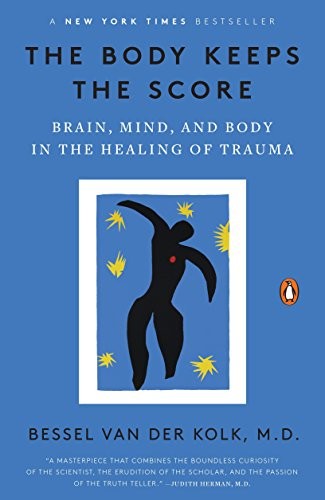
The Body Keeps the Score
Brain, Mind, and Body in the Healing of Trauma
In The Body Keeps the Score, psychiatrist Bessel van der Kolk presents trauma as an experience that can persist through bodily reactions, disrupted attention, emotional dysregulation, dissociation, and altered relationships—not merely through consciously remembered events. Drawing on clinical cases, the history of post-traumatic stress research, neuroscience, developmental psychology, and his own professional experience, he examines how overwhelming experiences can affect a person’s sense of safety and control. The book moves from the recognition and diagnosis of traumatic stress to an account of memory and brain-body responses, then surveys approaches to recovery, including established trauma-focused psychotherapy and several body-, movement-, and attention-based practices. Its broad synthesis helped bring embodied accounts of trauma into mainstream discussion. Readers should also treat its strongest scientific and therapeutic claims critically, because subsequent scholarship has cha…
Where to buy or borrow
Are you selling this book? Bookstores, publishers, authors and libraries can be listed here for free. Request a listing
About this book
Deep Overview
From there, the book develops an embodied model of traumatic stress. Van der Kolk argues that when defensive responses cannot resolve a threat, the nervous system may continue reacting as though the emergency were present. A survivor may become hypervigilant and impulsive, or detached and unresponsive; some people alternate between these states. The book connects these patterns with changes in attention, emotional regulation, bodily awareness, memory, and the ability to interpret social signals. Dissociation receives particular emphasis because it can separate thoughts, sensations, emotions, and autobiographical experience that would ordinarily feel integrated.
Childhood adversity broadens the inquiry beyond conventional accounts of single-event PTSD. Chronic abuse, neglect, instability, or frightening caregiving can shape development while a child is learning what relationships and safety mean. Van der Kolk presents attachment as both a source of vulnerability and a potential foundation for recovery. When the person responsible for protection is also a source of danger, survival adaptations may later complicate intimacy, self-understanding, and emotional control. The book therefore argues for recognizing developmental forms of trauma that may not fit neatly within a narrow diagnostic framework.
The later chapters turn toward treatment. Their organizing principle is the restoration of agency: the capacity to notice internal experience, remain oriented to the present, tolerate emotion, make choices, and participate in reciprocal relationships. Van der Kolk discusses medication and verbal therapy but resists treating either as universally sufficient. He gives substantial attention to eye movement desensitization and reprocessing, yoga, neurofeedback, mindfulness, theater, movement, and other approaches intended to engage attention or bodily regulation.
The book’s enduring contribution is its integrative picture of trauma as psychological, relational, and physiological at once. Yet the synthesis also creates its main scientific vulnerability. Clinical observations, evocative brain images, theoretical models, and controlled treatment evidence do not all provide the same degree of proof. Current readers can benefit from the framework while distinguishing the book’s compassionate descriptions from its more contested claims about memory, brain alteration, and the comparative effectiveness of treatments.
Key Themes
• Loss and recovery of agency: Trauma often involves helplessness. The book treats recovery partly as the gradual restoration of choice, bodily ownership, self-observation, and effective action.
• Fragmented experience: Dissociation and traumatic memory may separate sensations, emotions, images, and personal narrative, leaving experience difficult to describe or place securely in the past.
• Attachment and relational safety: Relationships can transmit fear and injury, but trustworthy human connection can also support regulation, meaning, and recovery.
• Developmental consequences: Repeated childhood adversity may influence identity, emotional development, behavior, and expectations of other people, not only produce isolated symptoms.
• Limits of purely verbal explanation: Insight may help without automatically quieting physiological alarm. Van der Kolk consequently argues for therapies that engage attention, movement, sensation, and present-moment experience.
• Scientific authority and clinical judgment: The book repeatedly moves between research findings and the author’s interpretations of patient care, making the difference between evidence, hypothesis, and experience an important theme for critical readers.
Historical and Intellectual Context
The book also belongs to debates about the relationship among mind, brain, and body. Late twentieth-century research increasingly examined stress hormones, autonomic arousal, memory, attachment, neuroplasticity, and brain activity alongside traditional psychiatric symptoms. Van der Kolk interprets this interdisciplinary work as a challenge to models that treat distress primarily as faulty thinking, disordered chemistry, or a story that can be resolved through verbal insight alone.
Another relevant context is the long-running controversy over traumatic memory. Researchers have debated fragmentation, dissociative amnesia, delayed recall, reconstruction, and susceptibility to suggestion. These disputes matter because claims about how trauma is remembered have clinical, personal, and legal consequences. The book presents a strong position within that contested field rather than a final consensus.
Intended Audience
It may be less suitable for someone seeking a brief, step-by-step recovery program or an emotionally neutral introduction. The clinical histories include war, abuse, neglect, violence, and severe psychiatric distress. Survivors may find parts illuminating but also activating or overwhelming. Because the book does not offer individualized assessment, readers making treatment decisions should use it as a starting point for informed discussion with a qualified professional, not as a substitute for care.
Reading Difficulty
A different kind of difficulty comes from the subject matter. Case histories can be graphic or emotionally intense, and the accumulation of traumatic experiences may make sustained reading tiring. Reading in shorter sections, pausing after case material, and separating explanatory chapters from treatment chapters may help. The book requires no formal medical training, but critical reading is important because scientific observations, case-based conclusions, and treatment claims are sometimes presented in close proximity.
Helpful Background Knowledge
Readers may also benefit from a simple understanding of the autonomic nervous system, stress responses, attachment, memory reconstruction, and the hierarchy of clinical evidence. A personal history or a compelling case can generate a valuable hypothesis, but it cannot by itself establish that a treatment is effective across populations. Knowing this distinction makes it easier to appreciate the book’s clinical insight while evaluating its scientific claims carefully.
Why Read This Book?
The book is especially valuable as a map of a major shift in public and clinical thinking: from asking only what symptoms a person has toward asking what survival adaptations those symptoms may represent. Even readers who dispute some of its claims can use it to examine how persuasive metaphors, clinical authority, neuroscience, and patient stories interact in popular medical writing.
Reader Takeaways
Readers may also reconsider recovery as more than eliminating symptoms. Safety, connection, bodily awareness, choice, play, and participation in community can all matter. At the same time, the book offers a lesson in scientific literacy: an intuitively powerful framework can contain both well-supported observations and claims that remain disputed. Treatment choices should therefore be guided by current evidence, individual circumstances, professional competence, and shared decision-making.
Strengths
Van der Kolk consistently emphasizes dignity and adaptation. Instead of depicting survivors as collections of defective symptoms, he asks how distressing patterns may reflect attempts to endure danger. The book also widens the discussion of recovery beyond medication and conversation, drawing attention to bodily awareness, relationships, movement, creativity, and the experience of control. Its breadth has made it an important reference point in public debates about trauma, even where later scholars contest its conclusions.
Limitations and Cautions
The treatment discussion also gives substantial attention to approaches whose evidence bases differ greatly in size and quality. Current major PTSD guidance places strong emphasis on trauma-focused psychotherapies such as prolonged exposure, cognitive processing therapy, and EMDR; readers should not infer from this book that verbal or exposure-based treatments are generally ineffective. Recent peer-reviewed criticism has additionally challenged some of the book’s neurobiological claims, presentation of treatment evidence, and limited engagement with research on memory distortion and suggestion.
Finally, its graphic clinical material and authoritative tone may be difficult for vulnerable readers. It is neither a diagnostic instrument nor a personalized treatment plan.
Important Concepts, People, and Institutions
• Post-traumatic stress disorder: The diagnostic category through which the book examines intrusive recollection, avoidance, changes in mood and cognition, heightened reactivity, and functional impairment following trauma.
• Vietnam War veterans: Early patients in van der Kolk’s account whose persistent combat-related symptoms helped shape his understanding of traumatic stress and the limitations of the care then available.
• Dissociation: A disruption in the ordinary integration of memory, awareness, identity, emotion, or bodily experience. It helps explain why some survivors report numbness, unreality, missing continuity, or sensations that feel detached from narrative memory.
• Traumatic memory: The book distinguishes integrated autobiographical recollection from sensory, emotional, or bodily fragments that may be triggered as present experience. This is also one of its most debated areas.
• Attachment: The developing bond between a child and caregiver. The book uses attachment to explain how safety and emotional regulation are learned, and why frightening or neglectful caregiving can have wide developmental consequences.
• Developmental trauma: A framework for understanding the cumulative effects of chronic childhood adversity. Van der Kolk argues that some complex patterns are inadequately represented by a diagnosis designed around a discrete traumatic event.
• American Psychiatric Association and the Diagnostic and Statistical Manual of Mental Disorders: The institution and classification system that determine formal diagnostic recognition in the United States. Their treatment of PTSD and proposed developmental diagnoses is an important institutional thread.
• Eye movement desensitization and reprocessing: A structured trauma-focused psychotherapy involving recall or processing of traumatic material alongside bilateral stimulation. The book presents it favorably; contemporary guidelines also recognize EMDR as an evidence-supported PTSD treatment, although aspects of its mechanism remain debated.
• Prolonged exposure and cognitive processing therapy: Prominent trauma-focused treatments that provide important context for assessing the book’s treatment claims. Current clinical guidance identifies them among the best-supported PTSD psychotherapies.
• Neurofeedback: Training based on feedback about measured brain activity. Van der Kolk treats it as promising, but readers should distinguish promising or emerging evidence from treatments supported by larger and more replicated research literatures.
• Yoga, mindfulness, movement, and theater: Practices the book explores as ways to develop bodily awareness, regulation, coordination, voice, and social participation. Their roles and evidence bases are not interchangeable.
• Neuroplasticity: The nervous system’s capacity to change through experience. In the book, it supports the hopeful claim that entrenched responses are not necessarily immutable.
Questions the Book Explores
• How do chronic childhood adversity and disrupted caregiving influence emotional regulation, identity, and relationships?
• Why can a person understand a traumatic experience intellectually while still experiencing involuntary bodily alarm or numbness?
• What is the relationship among traumatic memory, dissociation, sensory fragments, and autobiographical narrative?
• How do diagnostic systems shape which kinds of suffering receive recognition and treatment?
• What roles should bodily awareness, movement, relationships, medication, exposure, and verbal meaning-making play in recovery?
• How should clinicians distinguish an innovative treatment from one that has accumulated strong comparative evidence?
• Can scientific language clarify lived experience without reducing a person to brain regions, hormones, or diagnostic labels?
Reading Group Guide
Track the meaning of agency throughout the work. Notice moments involving choice, bodily ownership, voice, movement, social participation, and the capacity to remain present. Groups can compare this conception of recovery with a narrower focus on symptom reduction.
Another productive approach is to examine the tension between diagnostic recognition and diagnostic limitation. Consider what PTSD makes visible, what the proposed idea of developmental trauma attempts to capture, and what risks come with expanding trauma language too broadly.
For the treatment chapters, compare the author’s enthusiasm with current clinical guidelines. Ask whether the book gives readers enough information to distinguish complementary practices, emerging interventions, and first-line therapies. Because the case material can be distressing, groups should permit members to skip descriptions, pause discussion, or participate without disclosing personal histories.
Discussion Questions
2. Which clinical stories clarify the book’s ideas, and where might emotionally powerful stories encourage conclusions beyond the available evidence?
3. What does van der Kolk mean by restoring agency, and how is that goal different from reducing symptoms?
4. How persuasive is the book’s distinction between narrative memory and bodily or sensory forms of traumatic recall?
5. What are the benefits and dangers of using neuroscience to explain psychological suffering to a general audience?
6. How does the book portray relationships as both sources of injury and conditions for healing?
7. Does the concept of developmental trauma identify an important diagnostic gap, or does it risk making the category of trauma too expansive?
8. How should readers evaluate treatments when clinical experience, patient preference, and controlled research point in different directions?
9. Which of the book’s claims appear to be metaphors, which are testable scientific propositions, and why does the distinction matter?
10. How would the treatment chapters differ if rewritten around present-day PTSD guidelines and newer evidence reviews?
Sources and Verification
Comments
No published comments yet.
Available editions
Hardcover
hardcover
- Publisher
- Viking
- ISBN-13
- 9780670785933
- Publication date
- Pages
- 464