
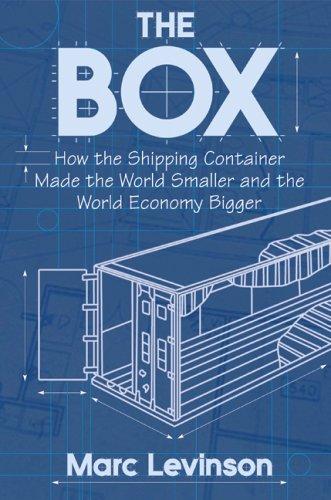
The Box
How the Shipping Container Made the World Smaller and the World Economy Bigger
A standardized steel box might seem an unlikely agent of economic transformation, but Marc Levinson shows how container shipping reorganized the movement of goods and helped create the infrastructure of globalization. Beginning with Malcom McLean’s 1956 experiment aboard the Ideal-X, the book follows containerization through technical disputes, labor conflict, costly port reconstruction, military logistics, international standardization, and commercial expansion. Its subject is not merely an invention but an interconnected system of ships, cranes, trucks, railways, terminals, regulations, and business practices. Levinson explains how sharply lower freight-handling costs altered the location of factories and warehouses, weakened older waterfront economies, strengthened new ports, and enabled longer supply chains. The result is both a history of modern logistics and an argument about technological change: simple devices become revolutionary only when institutions, infrastructure, invest…
Where to buy or borrow
Are you selling this book? Bookstores, publishers, authors and libraries can be listed here for free. Request a listing
About this book
Deep Overview
Against this background, the book follows Malcom McLean, a trucking entrepreneur who became convinced that freight could move more efficiently if the cargo compartment itself passed between truck and ship. The voyage of the converted tanker Ideal-X from Newark to Houston in April 1956 demonstrated the commercial possibility, but it did not by itself create a global system. Shipping lines promoted incompatible container sizes, ports hesitated to invest in specialized cranes and terminals, regulators oversaw transport industries organized around separate modes, and unions faced a technology that threatened established waterfront jobs and practices.
The book’s central insight is that the container’s power came from coordination. Keith Tantlinger’s engineering work, including equipment that allowed containers to be secured and handled safely, mattered alongside negotiations over dimensions, structural requirements, and interchangeability. National and international standards helped turn proprietary equipment into a network technology. Once compatible containers could move among ships, trucks, and trains, firms could plan transportation as a continuous process rather than as a succession of disconnected journeys.
Levinson also treats organized labor as central to the story. Leaders including Harry Bridges of the International Longshore and Warehouse Union and Thomas “Teddy” Gleason of the International Longshoremen’s Association confronted a technology that promised productivity gains partly by reducing the need for dock labor. The resulting bargains concerned compensation, work rules, jurisdiction, and the distribution of benefits from mechanization. Containerization brought cheaper freight, but its gains and losses were unevenly shared.
The Vietnam War became an important proving ground. The demands of supplying American forces exposed severe logistical failures while creating an opportunity for Sea-Land’s container system to demonstrate reliability at scale. Commercial adoption subsequently accelerated, ports invested heavily, and maritime geography changed. Older waterfronts lost traffic when they lacked space or suitable inland connections, while terminals such as those around Newark and Oakland gained importance.
The later chapters connect these physical changes to manufacturing and retail strategy. Cheap, predictable transportation allowed factories to be located farther from customers, encouraged just-in-time inventory practices, and supported complex international supply chains. Yet Levinson avoids presenting containerization as a frictionless success. Shipping remained cyclical, capital intensive, and vulnerable to overinvestment. The second edition’s additional material examines how the pursuit of ever-larger ships could lower costs at sea while creating congestion, financial risk, and new pressures elsewhere in the logistics system.
Key Themes
• Standardization and network effects: Compatibility allowed equipment owned by different organizations to function within one intermodal network. A common standard was economically significant because each additional participant made the system more useful to others.
• Hidden transportation costs: Levinson challenges accounts of globalization that concentrate mainly on tariffs, wages, or trade agreements. The cost and reliability of physically moving goods can determine where firms produce and sell them.
• Creative destruction: Containerization generated broad efficiencies while eliminating jobs, weakening traditional waterfront districts, and leaving expensive facilities obsolete. Technological progress appears as a redistribution of economic power as well as an increase in productivity.
• Labor and bargaining power: Longshore unions did not merely resist machinery. They negotiated over who would bear the disruption and how workers might share in productivity gains.
• Scale and its limits: Larger ships and terminals can reduce unit costs, but economies of scale may shift expense and risk to ports, inland transport, customers, and the wider supply chain.
• Infrastructure and economic geography: Ports prosper or decline according to land availability, water depth, cranes, road and rail links, and the willingness of public authorities to make large, uncertain investments.
Historical Context
Containerization coincided with major changes in American transportation policy, the growing use of highways, expanding trade in manufactured goods, and the Cold War demand for large-scale military logistics. The Vietnam War supplied an unusually demanding test of intermodal freight. During the same broad period, decolonization, industrial growth in East Asia, falling trade barriers, and advances in telecommunications created conditions in which cheaper and more dependable shipping could have worldwide effects.
The transformation also formed part of a longer history of mechanization on the waterfront. Cranes and cargo containers did more than accelerate existing work: they reduced the need for some forms of manual handling and encouraged ports to move from city-center piers to spacious terminals with strong highway and rail access. This helps explain why containerization reshaped metropolitan land use and labor markets as well as maritime commerce.
Intended Audience
It may also appeal to readers who enjoy histories that reveal the large consequences of an ordinary object. The emphasis remains on institutions, companies, negotiations, and economic effects rather than mechanical design, so it does not require engineering expertise. Readers seeking a short overview may find the detail substantial, and those wanting a contemporary operational guide to supply-chain management should note that this is primarily a historical analysis rather than a practical handbook.
Reading Difficulty
The broadly chronological structure helps orient the reader, although chapters sometimes shift among entrepreneurial biography, policy, engineering, and macroeconomic consequences. Maps are not central to the presentation, so readers unfamiliar with major port regions may occasionally benefit from consulting a map. The notes and bibliography make the book useful for deeper research but need not be read alongside the main text.
Helpful Background Knowledge
Readers may wish to know that intermodal transportation means moving the same freight unit by more than one mode, such as truck, rail, and ship, without repeatedly unpacking its contents. Basic awareness of postwar trade growth, American transportation regulation, the Vietnam War, and the rise of East Asian manufacturing provides additional context, but Levinson develops the relevant connections within the narrative.
Why Read This Book?
The book is valuable as a study of innovation because it rejects a simple breakthrough narrative. McLean’s vision mattered, but adoption depended on engineers, standards committees, investors, military customers, public authorities, shipping competitors, and labor unions. Readers therefore encounter a more realistic picture of technological change—one involving incompatible systems, failed investments, political bargaining, and unintended consequences.
It also provides historical perspective on modern supply-chain debates. Contemporary concerns about port congestion, oversized vessels, logistical concentration, and network fragility become easier to understand when placed against the system’s development.
Reader Takeaways
The book encourages readers to notice transportation costs hidden inside everyday products and to see logistics as a force that shapes factory location, urban development, employment, consumer choice, and international trade. It also complicates the assumption that greater efficiency benefits everyone in the same way. Consumers and expanding ports may gain while workers, established businesses, and older waterfront communities absorb severe losses.
Finally, the book offers a durable analytical lesson: reducing cost in one part of a system does not necessarily reduce cost or risk everywhere. Giant ships, centralized terminals, and lean inventories may create efficiencies while increasing dependence on tightly coordinated infrastructure.
Strengths
Levinson also avoids attributing containerization to a single cause. Entrepreneurial initiative, engineering, public investment, military demand, union bargaining, regulation, and international standards all receive meaningful attention. This makes the account more persuasive than a conventional story of an inventor whose idea automatically conquered the market.
The chronological narrative gives human and institutional form to economic concepts. Named entrepreneurs, engineers, labor leaders, ports, and companies allow readers to follow conflict and uncertainty rather than viewing globalization as an inevitable outcome. Extensive notes and a substantial bibliography further strengthen the book as an entry point for historical research.
Limitations and Scope Boundaries
Environmental consequences are not developed to the same extent as business organization, labor, and economic geography. Container shipping’s relationship to emissions, marine ecosystems, port pollution, and environmental justice therefore lies largely outside the book’s principal scope.
The narrative explains how containerization enabled global production networks, but it should not be read as claiming that the container alone caused globalization. Trade policy, communications technology, finance, political change, wage differences, and corporate strategy also mattered. In addition, even the expanded 2016 edition predates later disruptions that brought supply-chain resilience and geopolitical concentration renewed public attention.
Important Concepts, People, Organizations, and Places
• Keith Walton Tantlinger: An engineer whose work on container handling and securing systems helped make containers practical, stackable, and transferable. His contribution illustrates why engineering compatibility was essential to McLean’s commercial vision.
• Ideal-X: The converted tanker that carried container units from Newark to Houston in April 1956. Its voyage serves as the symbolic beginning of McLean’s container-shipping system.
• Sea-Land Service: The company associated with McLean’s expanding container operations. Its growth, equipment, military work, and competitive strategy form a major thread in the narrative.
• Harry Bridges: Leader of the International Longshore and Warehouse Union, which represented West Coast dockworkers. His negotiations demonstrate how organized labor sought compensation and protections amid mechanization.
• Thomas “Teddy” Gleason: Leader of the International Longshoremen’s Association, an important union on the Atlantic and Gulf coasts. He figures in the struggle over jobs, work jurisdiction, and the terms under which containerization advanced.
• International Longshore and Warehouse Union: A major West Coast labor organization whose mechanization agreement became central to the changing waterfront workplace.
• International Longshoremen’s Association: The union representing many East and Gulf Coast longshore workers, where containerization produced difficult disputes over established work and employment.
• International Organization for Standardization: The international standards body whose freight-container work helped establish compatibility in dimensions, testing, handling, and related specifications.
• ISO/TC 104: The ISO technical committee for freight containers. Its role demonstrates that common standards were institutional achievements rather than automatic consequences of technical superiority.
• Port of New York and New Jersey: A central setting for the transition from traditional Manhattan and Brooklyn piers to large container terminals across the Hudson River, particularly around Newark and Elizabeth.
• Port of Oakland: An example of a port whose location, land, and transportation connections allowed it to benefit from containerization and changing Pacific trade.
• Port of London: One of the historically important waterfront systems challenged by the spatial and technological requirements of container terminals.
• Vietnam War logistics: Military supply difficulties created an opportunity for container shipping to prove its effectiveness at scale, accelerating confidence in the system.
• Breakbulk shipping: The older practice of handling cargo as individual pieces. Its costs, delays, and labor requirements provide the baseline against which containerization’s impact becomes clear.
• Intermodal transportation: The coordinated movement of a single freight unit by ship, truck, or rail. It is the organizing principle that turns the box into a transportation system.
• Standardization: Agreement on dimensions, fittings, strength, identification, and handling requirements. Standardization enabled interoperability and allowed investment in a shared network.
• Just-in-time production: An inventory approach that depends on frequent and predictable deliveries. Container shipping helped make it more practical while also increasing dependence on reliable transport networks.
• Economic geography: The spatial distribution of production, trade, employment, and infrastructure. Levinson uses containerization to show how lower transportation costs can change which ports, cities, and industrial regions prosper.
Questions the Book Explores
• What distinguishes a useful container from a functioning container-transport system?
• How do standards transform competing proprietary technologies into a shared commercial network?
• Why were ports, governments, and private companies willing to make large investments before container traffic was assured?
• How did longshore workers and unions respond when productivity improvements threatened employment and established work rules?
• What role did military logistics play in proving the value of commercial container shipping?
• How did lower freight costs alter the location of factories, warehouses, ports, and urban employment?
• Who captured the economic gains from containerization, and who bore the adjustment costs?
• When do economies of scale become sources of congestion, overcapacity, or systemic fragility?
• To what extent can a transportation technology be said to have caused the expansion of global trade?
Reading Group Guide
Track moments when progress depends on cooperation among competitors. Standards, shared terminals, labor agreements, and regulatory changes complicate the familiar image of innovation as the product of individual entrepreneurship. A group might compare McLean’s contribution with those of Keith Tantlinger, union leaders, standards specialists, military customers, and public port authorities.
Pay particular attention to places. Compare the experience of old urban waterfronts with that of spacious container ports such as Newark-area terminals and Oakland. Consider what physical characteristics made one location adaptable and another vulnerable.
For the later chapters, identify examples in which efficiency in one area creates expense or risk elsewhere. Relate this tension to just-in-time production and the pursuit of larger vessels. Groups reading the second edition may also compare its added chapter with earlier expectations about endless growth and economies of scale.
Discussion Questions
2. How does the book revise the idea that innovation begins with an invention and proceeds naturally toward adoption?
3. Which contribution was most important: McLean’s commercial vision, Tantlinger’s engineering, labor agreements, public investment, military demand, or international standardization?
4. Were unions primarily obstacles to containerization, negotiators of a difficult transition, or both?
5. How should the benefits of lower consumer prices be weighed against lost waterfront jobs and damaged port communities?
6. Why did some ports adapt successfully while others declined? How much control did local leaders have over the outcome?
7. What does the history of incompatible container sizes reveal about competition and cooperation in technological markets?
8. Did the Vietnam War merely accelerate an inevitable transition, or did it materially change the prospects of container shipping?
9. How does containerization change the meaning of distance for manufacturers without eliminating geography altogether?
10. What parallels can be drawn between freight-container standards and standards in computing, communications, or finance?
11. At what point can larger ships cease to be efficient from the perspective of the transportation network as a whole?
12. Which assumptions about modern supply chains appear most vulnerable when viewed through the book’s historical account?
Sources and Verification
Comments
No published comments yet.
Available editions
Paperback
Second edition, paperback
- Publisher
- Princeton University Press
- ISBN-13
- 9780691170817
- Publication date
- Pages
- 544