
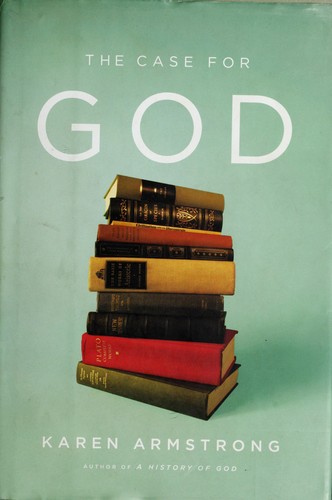
The Case for God
Karen Armstrong presents a wide-ranging intellectual history of how human beings have approached God, sacred reality, and religious knowledge. Moving from Paleolithic ritual through ancient philosophy, Judaism, Christianity, Islam, medieval theology, the scientific revolution, the Enlightenment, modern atheism, and fundamentalism, she argues that religion was traditionally understood less as assent to factual propositions than as a disciplined way of life. Ritual, ethical conduct, contemplation, myth, and compassion were practices through which people sought transformation and transcendence. Central to her account is the apophatic tradition: the recognition that ultimate reality exceeds literal description and conceptual mastery. Armstrong contends that modern believers and critics often share an overly rationalized picture of God, treating religious language as if it were scientific explanation. The book therefore makes its “case” not by proving a supernatural being, but by recoverin…
Where to buy or borrow
Are you selling this book? Bookstores, publishers, authors and libraries can be listed here for free. Request a listing
About this book
Deep Overview
Across ancient Greek, Israelite, Indian, and Chinese traditions, Armstrong identifies disciplines intended to move practitioners beyond habitual self-interest. Socratic awareness of ignorance, Buddhist detachment, Daoist resistance to fixed definitions, prophetic ethics, and ritual observance differ greatly, yet each illustrates her claim that religious understanding was supposed to emerge through practice. Doctrines and myths functioned as guides to transformation rather than as isolated propositions demanding simple agreement.
The book’s central historical thread is apophatic theology, sometimes called negative theology. Thinkers in this tradition insist that language about God is necessarily inadequate. Armstrong traces versions of this restraint through figures and movements associated with classical philosophy, rabbinic interpretation, early Christianity, Eastern Christian theology, Jewish and Islamic mysticism, and medieval scholastic thought. Figures such as Socrates, Augustine of Hippo, Pseudo-Dionysius the Areopagite, Thomas Aquinas, and Muslim philosophers or mystics appear within a history of repeated attempts to use reason while recognizing reason’s limits.
Armstrong then examines the transformations produced by early modernity. Scientific inquiry, political upheaval, commercial change, and new habits of reading altered Western conceptions of knowledge. Religion increasingly had to defend itself in the language of demonstrable fact. Scripture was more often treated as literally informative, while God was imagined as a supreme explanatory being. In Armstrong’s account, this development contributed both to modern fundamentalism and to forms of atheism directed against that same literalized deity.
The later chapters consider Enlightenment thought, scientific religion, secular criticism, the “death of God,” fundamentalism, and postmodern challenges to certainty. Armstrong does not propose returning wholesale to a premodern worldview. Instead, she argues for recovering its discipline of intellectual humility: religious language should point beyond itself, practice should precede claims of certainty, and authentic spirituality should be judged partly by its capacity to reduce egoism and encourage compassion. Her conclusion leaves the modern meaning of God deliberately open, making uncertainty a condition of serious religious reflection rather than a failure of it.
Key Themes
**Apophatic restraint:** The divine cannot be captured adequately in human categories. Silence, paradox, negation, and confessed ignorance protect religious language from becoming idolatrous certainty.
**Mythos and logos:** Symbolic narratives and practical reason perform different tasks. Trouble arises when myth is treated as primitive science or when scientific method is expected to answer every question of value and meaning.
**Transformation of belief:** The modern sense of belief as confident intellectual agreement differs from older notions involving trust, commitment, and faithful action.
**Religion and modernity:** Scientific, economic, political, and intellectual changes reshaped both theology and unbelief. Armstrong portrays fundamentalism and militant atheism as opposing responses to a shared modern framework.
**Compassion and self-transcendence:** Religious practice succeeds, in Armstrong’s account, when it weakens self-centeredness and enlarges concern for others—not when it merely enforces doctrinal conformity.
Historical Context
The work also belongs to a longer modern conversation about science and religion. Developments associated with the scientific revolution and Enlightenment changed standards of evidence and encouraged the idea that knowledge should be empirically or rationally demonstrable. Biblical criticism, evolutionary theory, industrialization, and secular political institutions further unsettled inherited authority. Armstrong interprets literalism and fundamentalism as comparatively modern efforts to secure certainty under those pressures.
Her argument draws upon ancient and medieval traditions of negative theology as well as twentieth-century theology and continental philosophy. The result is neither a conventional defense of church doctrine nor a secular history detached from present concerns; it is an attempt to retrieve older resources for a pluralistic, scientifically informed age.
Intended Audience
It is less suitable for someone seeking a concise logical proof of God, a devotional introduction to one faith, or a neutral chronological textbook. Readers committed to strongly propositional or confessional definitions of religion may dispute Armstrong’s interpretive priorities.
Reading Difficulty
The broad chronological structure provides direction, but the accumulation of names and condensed historical transitions can feel dense. Readers may benefit from taking one chapter at a time and keeping brief notes on recurring concepts. No ancient languages or formal theological training are required, although familiarity with major developments in Western religious history will make the argument easier to evaluate.
Helpful Background Knowledge
Before beginning, it is useful to understand that “apophatic” theology approaches God through negation: it emphasizes what cannot properly be said about the divine. Familiarity with the difference between symbolic and literal interpretation will also clarify Armstrong’s treatment of scripture and myth. This preparation is useful but not essential because the book introduces the relevant issues as its history unfolds.
Why Read It?
The book is also valuable as a map of connections among thinkers and traditions rarely discussed together in popular writing. It places ancient ritual, Greek philosophy, rabbinic interpretation, Christian and Islamic theology, mysticism, Enlightenment criticism, fundamentalism, and postmodern thought within one sustained argument. Even readers who reject Armstrong’s historical synthesis can use it to identify where their own understanding of faith, reason, and proof comes from.
Reader Takeaways
Readers may also become more alert to category errors in debates between science and religion: empirical inquiry, symbolic interpretation, moral formation, and metaphysical reflection do not necessarily answer the same kinds of questions. Armstrong’s account further encourages skepticism toward absolute certainty on either side of the argument. Its practical challenge is to assess religious traditions by the forms of attention, humility, and compassion they cultivate, while remaining aware that these traditions also contain conflict, exclusion, and competing claims.
Strengths
The book also complicates the familiar “science versus religion” narrative by distinguishing multiple forms of religious interpretation. Its comparative reach helps readers see that uncertainty and disciplined practice are not confined to one tradition. The argument is intellectually provocative because it changes the terms of the question promised by the title: the issue becomes not simply whether God exists, but whether modern debaters understand what serious God-language has historically attempted to express.
Limitations and Cautions
Her tendency to contrast nuanced premodern religion with modern literalism can understate the importance that doctrines, truth claims, and institutional authority held in earlier communities. Critics from both confessional and secular perspectives have argued that she privileges mystical or liberal forms of religion and does not fully represent believers who understand faith in more propositional terms.
The comparative approach can also make unlike traditions seem more unified than they are. Because Armstrong’s judgments are selective and contested, readers interested in a particular thinker or tradition should consult specialized scholarship before accepting the book’s account as definitive.
Important Concepts, People, and Movements
**Mythos and logos:** Armstrong’s terms for symbolic, meaning-oriented understanding and practical, rational inquiry. She argues that premodern societies treated them as complementary rather than interchangeable.
**Socrates:** His disciplined acknowledgment of ignorance exemplifies the intellectual humility Armstrong associates with authentic religious inquiry.
**The Buddha and Laozi:** They represent traditions in which transformation, disciplined practice, and resistance to fixed metaphysical language matter more than defining a personal creator God.
**Rabbinic Judaism:** Its interpretive practices illustrate scripture as a continuing field of discussion rather than a text exhausted by one literal meaning.
**Pseudo-Dionysius the Areopagite:** A major Christian voice of negative theology whose treatment of divine unknowability is central to Armstrong’s historical case.
**Augustine of Hippo and Thomas Aquinas:** Armstrong uses these influential Christian thinkers to explore the interaction of faith, reason, interpretation, and the limits of human speech about God.
**Islamic philosophy and Sufism:** Muslim philosophers and mystics broaden the book beyond Christian theology and demonstrate distinct ways of joining disciplined reason with awareness of transcendence.
**Martin Luther and the Protestant Reformation:** These mark major changes in authority, scripture, faith, and the religious individual, contributing to the conditions of modern Western belief.
**The scientific revolution and Enlightenment:** These movements transformed standards of knowledge and encouraged increasingly rationalized or empirical approaches to religion.
**Paul Tillich:** His description of God as beyond ordinary existence offers Armstrong a modern theological alternative to treating God as one being among others.
**Jacques Derrida and deconstruction:** Armstrong finds parallels between postmodern suspicion of fixed meanings and older interpretive or apophatic traditions.
**Fundamentalism and the New Atheism:** These opposing modern movements are presented as sharing a literalized, propositional conception of religion, despite reaching contrary conclusions.
Questions the Book Explores
Can religious practice yield a form of understanding that abstract argument alone cannot provide?
What is lost when myths and scriptures are read as scientific or straightforwardly historical explanations?
Why have many theologians regarded confident definitions of God as a form of idolatry?
How did the scientific revolution, Enlightenment, and modern social change reshape both religion and atheism?
Are fundamentalists and militant atheists arguing about the same modernized conception of God?
Can apophatic humility offer a viable religious language for a pluralistic and scientifically informed society?
By what standards should a religious tradition be judged: doctrinal correctness, historical truth, personal experience, moral consequences, or transformative practice?
Reading Group Guide
Track the distinction between mythos and logos across several periods. Discuss whether it clarifies the traditions examined or divides modes of thought too neatly. Groups may also select one premodern thinker and one modern figure to compare their assumptions about language, evidence, and divine reality.
Give special attention to the transition into modernity. Identify the social and intellectual changes Armstrong believes altered religion, then ask which changes are most persuasive and which require more evidence.
A productive discussion should test the book against competing perspectives. Consider whether Armstrong describes ordinary religious life or mainly its philosophical and mystical elites. Finally, discuss whether compassion and self-transcendence provide adequate criteria for evaluating religion, especially when traditions also make historical, moral, and metaphysical claims.
Discussion Questions
2. How useful is the division between mythos and logos? Where might the two overlap?
3. Can language that refuses definite claims about God remain meaningful?
4. Does apophatic theology protect religion from criticism, or does it deepen intellectual honesty?
5. Which historical transition most clearly supports Armstrong’s argument about the modernization of God?
6. Does the book represent Judaism, Christianity, Islam, Buddhism, Hindu traditions, and Chinese thought with sufficient attention to their differences?
7. How convincingly does Armstrong connect biblical literalism to modern rather than ancient habits of thought?
8. Do fundamentalism and the New Atheism share the conception of religion that Armstrong attributes to them?
9. Should the value of religion be judged primarily by its ethical and transformative effects?
10. Whose experience is missing when religious history is told mainly through philosophers, theologians, and mystics?
11. Can Armstrong’s recovery of premodern insights work without restoring premodern institutions and cosmologies?
12. What might a contemporary understanding of God look like if uncertainty were treated as a virtue rather than a defect?
Sources and Verification
Comments
No published comments yet.
Available editions
Paperback
First Anchor Books edition; paperback
- Publisher
- Anchor Books
- ISBN-13
- 9780307389800
- Publication date