
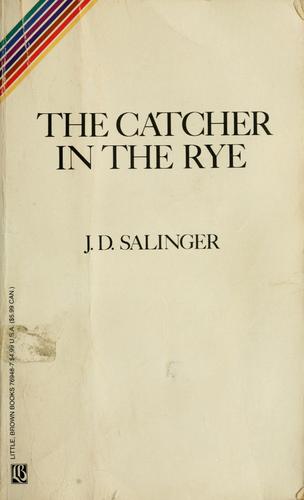
The Catcher in the Rye
J. D. Salinger's only full-length novel, first published in 1951, is narrated by Holden Caulfield, a teenager expelled from his prep school who drifts around New York City for a few days before Christmas. His voice is chatty, funny, judgmental and increasingly shaky. The book follows what he does and also shows how he talks himself out of what he feels: grief, loneliness, and fear of growing up. It became one of the most widely taught and widely argued-over American novels of the twentieth century. It is still a common pick for anyone assembling classic novels to read, and it remains a touchstone among coming-of-age books because it treats adolescent alienation as something to listen to, not merely correct.
Where to buy or borrow
Are you selling this book? Bookstores, publishers, authors and libraries can be listed here for free. Request a listing
About this book
Deep Overview
Structurally, the book is a series of encounters. Holden leaves school early and drifts through New York, where he meets taxi drivers, nuns, old acquaintances and women he half-wants to impress. He also revisits places that anchor his memory, such as the Museum of Natural History and Central Park. Each encounter tests the same question: is anyone genuine? Holden condemns "phoniness" in nearly everyone, but the book keeps showing him lying, posturing and craving company. His judgments are sharp and often funny, and they are also a defence. Salinger lets readers see the gap between what Holden says he despises and what he plainly needs.
The emotional centre is family. His brother Allie is dead, his older brother D.B. has gone to Hollywood, and his younger sister Phoebe is the one person to whom he speaks without much pose. Holden never narrates his grief directly. It leaks out in odd places: in an obsession with preserving things unchanged, in sudden physical symptoms, and in sentimental fantasies about protecting children. The title's image, a figure who stands at the edge of a field and keeps children from falling, is how Holden imagines a version of adulthood he could bear. It is a rescue fantasy, and the book lets us see both its tenderness and its inadequacy.
Salinger is not offering a straightforward case that Holden is right and the adult world is corrupt, nor that Holden is simply immature. The narration invites sympathy and scepticism at once. Holden notices real hypocrisy in school, in money-minded social life and in performance of every kind, yet he also misreads people, avoids intimacy and drifts toward collapse. Much of the book's lasting energy comes from this refusal to settle the question.
The prose is the main achievement. Salinger reproduces the cadence of a talkative, educated, anxious sixteen-year-old: asides, intensifiers, running jokes and abrupt shifts from comedy to something raw. That style made the book feel intimate on publication and still shapes how readers judge whether a narrator seems real. History.com describes it as an instant hit that went on to be taught in high schools for decades, a trajectory that made Holden a fixture of classroom and cultural conversation. The book is best read as a portrait of a mind trying and failing to cope, and the interest lies as much in how Holden narrates as in what happens to him.
Key Themes
Grief and avoidance: the loss of Allie sits under much of Holden's behaviour, yet it is approached indirectly. The novel is a study of how unprocessed mourning can surface as irritability, restlessness and withdrawal.
Innocence and the fear of change: Holden idealises childhood as a place free from corruption, and he is distressed by the idea that things must be altered by time. The book tests whether that ideal is protective or paralysing.
Alienation and the wish for connection: he repeatedly reaches for human contact, by phone, in conversation and through talk with strangers, and then sabotages it.
Unreliable narration and self-presentation: Holden's account is shaped by mood, exaggeration and omission, so readers must read through his claims.
Adolescence and adult responsibility: school, sexuality, money and class appear as pressures that Holden cannot quite name or face.
Historical Context
The book's setting is a milieu of private boarding schools, Manhattan hotels and Upper East Side social life, which Salinger knew well. Its reception also became part of its history. The American Library Association's records show the novel among books challenged in schools and libraries, including a 1987 challenge at a Baptist college in South Carolina over language and sexual references. Those controversies, together with its steady classroom use, make the book as much a case study in how American readers have argued over literature for young people as a novel of the early 1950s.
Intended Audience
It may be less satisfying for readers who want a strongly plotted story with a clear arc and resolution. Those who find irritable, self-absorbed narrators hard to spend time with may struggle. Parents, teachers and librarians should also know that the book contains profanity and frank references to sex, which are the grounds on which it has often been challenged.
Reading Difficulty
This 1991 mass-market paperback is a compact pocket-size format. Listings give differing page counts, from the low 200s to about 240, which is normal for reprints with different typesetting. Anyone who prefers larger type may want to check a trade or library edition.
Helpful Background Knowledge
Why Read This Book?
It is brief and well suited to rereading. Many readers find that the book changes with age, because the same behaviour can seem rebellious at sixteen and painfully defensive at forty. Because it has been so widely taught and challenged, it also lets you see for yourself what the argument has been about.
Reader Takeaways
Strengths
Limitations and Cautions
Important Concepts, People, and Places
Phoebe Caulfield: Holden's younger sister, the character with whom he is most open, and whose reactions test his fantasies.
Allie Caulfield: Holden's deceased younger brother, whose death underlies much of Holden's behaviour.
D. B. Caulfield: Holden's older brother, a writer who has gone to Hollywood; Holden resents what he sees as a compromise of talent.
Pencey Prep: the Pennsylvania boarding school from which Holden is expelled, where the story begins.
New York City: the setting for most of the action, from hotels and bars to the Museum of Natural History and Central Park.
"Phoniness": Holden's key term of condemnation, which the book turns back on him.
The catcher in the rye: Holden's image of protecting children from a fall, drawn from a line of verse he misremembers; it expresses his longing to preserve innocence.
The New Yorker: the magazine that published early Holden stories, linking the novel to Salinger's short-fiction career.
Little, Brown and Company: the publisher of the 1951 first edition and of this 1991 paperback.
American Library Association: the organisation whose challenge records document the novel's censorship history.
Questions the Book Explores
Reading Group Guide
Discussion Questions
2. What does the structure of the narration, told after the fact from a place of treatment, change about how you read his story?
3. How does Holden's relationship with Phoebe differ from his relationships with other characters, and why?
4. Why does the novel approach Allie's death so indirectly?
5. Is Holden's wish to protect children admirable, misguided, or both?
6. Do you read Holden's attitudes toward women and other people as the book's own or as part of his limitations?
7. Did your reading of Holden change from the first time you read the book, if you had read it before?
8. What do the book's challenges in schools and libraries say about what communities fear or value in young readers' books?
9. How does Salinger's use of everyday speech affect the book's intimacy and humour?
10. What would a different ending, or a different narrator, have changed?
Sources and Verification
Comments
No published comments yet.
Available editions
Paperback
1st LB Books mass market paperback edition
- Publisher
- Little, Brown and Company
- ISBN-13
- 9780316769488