
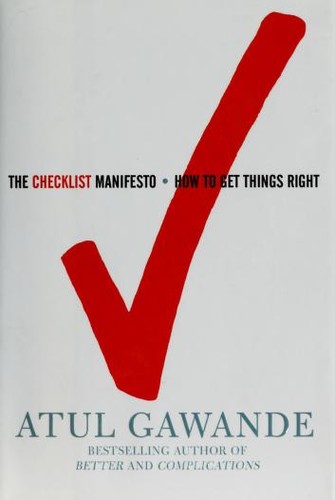
The Checklist Manifesto
How to Get Things Right
Modern professionals possess extraordinary knowledge, yet serious mistakes persist because knowledge must be applied amid expanding complexity, time pressure, specialization, and imperfect communication. In The Checklist Manifesto, surgeon and writer Atul Gawande argues that well-designed checklists can make demanding work more reliable without replacing judgment or expertise. Drawing on medicine, aviation, construction, disaster response, and investment, he examines how brief prompts help teams remember essential steps, exchange critical information, and prepare for predictable trouble. The book gives particular attention to hospital infections and the development and testing of the World Health Organization Surgical Safety Checklist. Its larger argument concerns professional culture: experts often resist simple procedural aids because they appear to diminish autonomy, but disciplined coordination can be as important as individual brilliance. Gawande presents the checklist not as a u…
Where to buy or borrow
Are you selling this book? Bookstores, publishers, authors and libraries can be listed here for free. Request a listing
About this book
Deep Overview
Medicine makes this distinction urgent. Intensive care and surgery require many people, technologies, medications, and decisions to work together under pressure. A small omission can undermine an otherwise sophisticated course of treatment. Gawande examines efforts to reduce central-line infections in Michigan intensive care units, associated especially with critical-care physician Peter Pronovost. A short set of evidence-based steps helped make basic infection-prevention practices more consistent. Yet the intervention also depended on measurement, institutional support, nursing participation, and a willingness to challenge hierarchy. The list mattered because it changed how teams worked, not merely because someone wrote instructions on paper.
The book then looks beyond health care. Aviation illustrates the development of concise procedures for routine operations and emergencies that may overwhelm memory. Construction offers a different lesson: no single master builder can personally command every technical detail of a modern project. Reliable performance therefore requires systems that coordinate specialists and ensure that unexpected problems are communicated to the right people. These examples lead Gawande to distinguish between checklists that confirm critical actions and those that guide action through a sequence. In either case, a useful list must concentrate on essential failure points rather than attempt to document everything.
The central narrative follows the creation and testing of the World Health Organization Surgical Safety Checklist. Its elements include checks related to patient identity, the planned procedure, anesthesia, infection prevention, expected complications, equipment, and communication among operating-room personnel. The team tests revisions in varied hospitals, seeking a tool brief enough to use yet substantial enough to improve safety. The process reveals that checklist design is an empirical discipline: wording, timing, length, leadership, and local culture all affect whether the tool functions in practice.
Ultimately, Gawande challenges the heroic model of professional competence. Individual skill remains indispensable, but complex work increasingly depends on teams whose members must coordinate reliably. A checklist can support that coordination by creating planned moments to pause, verify, speak, and listen. The book's argument is therefore less about list-making than about humility: excellence requires acknowledging the limits of memory and accepting disciplined systems that help expertise produce dependable results.
Key Themes
• **Reliability without rigidity:** A good checklist protects crucial steps while leaving room for professional judgment in circumstances that cannot be scripted.
• **Team communication:** Introductions, briefings, and explicit confirmation can expose misunderstandings that hierarchy or routine might otherwise conceal.
• **Humility and professional identity:** Experts may interpret procedural support as an insult to competence. Gawande argues that recognizing human limits is itself a mark of professionalism.
• **Design through testing:** Effective checklists are selective, clearly timed, easy to use, and revised through real-world observation rather than produced as exhaustive desk-bound documents.
• **Systems and individual responsibility:** The book shifts attention from blaming a single fallible person to constructing environments in which predictable errors are less likely to reach patients, passengers, clients, or the public.
Historical and Professional Context
The aviation comparison has a longer history. As aircraft became more complicated, pilots adopted structured checks to support memory and crew coordination. Modern construction underwent a parallel transition away from dependence on a single all-commanding master builder toward networks of architects, engineers, contractors, and specialists. Gawande uses these developments to place the checklist within the broader twentieth-century transformation of expert work from individual craft to coordinated systems.
Intended Audience
Readers seeking a conventional productivity manual filled with personal to-do-list templates may find it less directly applicable. The emphasis is on shared procedures, communication, and organizational implementation rather than scheduling an individual's day. Medical professionals should also approach it as an accessible argument and case-based exploration, not as a current clinical protocol or substitute for institution-specific safety guidance.
Reading Difficulty
Helpful Background Knowledge
Why Read This Book?
Reader Takeaways
Strengths
Limitations and Cautions
Important Concepts, People, and Institutions
• **Peter Pronovost:** A critical-care physician closely associated with the Michigan initiative to reduce central-line bloodstream infections. His work demonstrates that simple clinical steps require data, organizational backing, and enforcement mechanisms to become reliable practice.
• **World Health Organization:** The international public-health institution behind the Safe Surgery Saves Lives program and the Surgical Safety Checklist examined in the book.
• **Safe Surgery Saves Lives Study Group:** The international collaboration that developed and evaluated a surgical checklist in hospitals representing varied health-care environments.
• **WHO Surgical Safety Checklist:** A structured set of checks performed at critical stages around an operation. It addresses essential safety practices while encouraging the operating team to share information about the patient, procedure, risks, and anticipated problems.
• **Michigan Keystone ICU Project:** A patient-safety initiative involving intensive care units and practices intended to prevent central-line infections. It serves as a major example of converting established medical knowledge into consistent action.
• **Boeing and aviation checklists:** Aviation's experience with increasingly complex aircraft provides a model for concise, tested checklists that support pilots during routine and emergency operations.
• **Pause points:** Predetermined moments when work briefly stops so that a team can complete checks before proceeding. Their placement is fundamental to whether a checklist fits the actual workflow.
• **Do-confirm and read-do checklists:** Two broad approaches discussed in the book. In one, people complete tasks and then verify them; in the other, they consult the list while carrying out the required sequence.
• **Failures of ignorance and failures of ineptitude:** A distinction between not possessing the necessary knowledge and failing to apply knowledge that already exists. The book concentrates primarily on the second problem.
• **Professional hierarchy:** Differences in authority can prevent junior staff or other specialists from voicing concerns. Checklist-based briefings can create explicit opportunities for participation, although a form alone cannot eliminate cultural barriers.
Questions the Book Explores
• When does complexity exceed the dependable limits of memory and individual expertise?
• What separates a useful checklist from bureaucratic paperwork?
• How can standardization protect safety without suppressing judgment and adaptation?
• Why do professional pride and organizational hierarchy obstruct simple improvements?
• What can medicine learn from aviation, construction, and other coordinated technical fields?
• Should competence be measured only by individual skill, or also by the ability to participate in reliable systems?
• How can teams build communication into work before an emergency exposes its absence?
Reading Group Guide
Pay particular attention to moments when people resist a checklist. Discuss whether the resistance arises from poor design, professional pride, additional workload, loss of autonomy, or distrust of management. Groups with professional diversity can compare how hierarchy operates in their own fields. As a practical exercise, select one recurring process and propose no more than five critical checks, a specific pause point, and a method for testing whether the list helps. The purpose is not to prove that every activity needs a checklist, but to explore the design choices and cultural conditions emphasized by the book.
Discussion Questions
2. Where does the book draw the boundary between standard procedure and expert discretion?
3. Can a checklist create a culture of communication, or must that culture already exist?
4. Why might an experienced professional resent a tool intended to prevent avoidable mistakes?
5. What risks emerge when organizations use checklists mainly to document compliance or assign blame?
6. How do the construction examples complicate the popular image of leadership as individual command?
7. Does the distinction between ignorance and poor execution adequately explain organizational failure?
8. Which recurring task in your own experience might benefit from a checklist, and which would be harmed by one?
9. How should checklist designers decide what to leave out?
10. What evidence would persuade you that a checklist was improving outcomes rather than merely changing documentation?
11. Who should have the authority to stop a process when an essential check fails?
12. How does the book redefine heroism and competence in high-stakes professions?
Sources and Verification
Comments
No published comments yet.
Available editions
Hardcover
First edition, hardcover
- Publisher
- Metropolitan Books
- ISBN-13
- 9780805091748
- Publication date
- Pages
- 224