
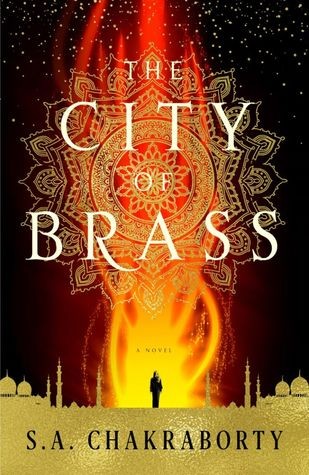
The City of Brass
A Novel
In eighteenth-century Cairo, Nahri survives by selling false magic to wealthy clients, even though her unexplained healing ability is real. A ritual performed as part of a con unexpectedly summons Dara, a formidable djinn warrior who recognizes something in Nahri that she cannot explain. Their flight from Cairo carries her into a hidden supernatural world and eventually to Daevabad, a brass-walled city divided by dynastic conquest, religious loyalties, ethnic hierarchy, and memories of violence. There Nahri becomes entangled with the ruling Qahtani family, especially the principled but politically inexperienced Prince Alizayd. The novel combines an adventurous journey with court intrigue, gradually shifting its central question from whether magic exists to who controls the history and institutions of the magical world. As the opening volume of the Daevabad Trilogy, it establishes a conflict in which inherited identity can confer power while also trapping individuals inside struggles b…
Where to buy or borrow
Are you selling this book? Bookstores, publishers, authors and libraries can be listed here for free. Request a listing
About this book
Deep Overview
That plan collapses when a ceremonial performance summons Dara, an ancient warrior belonging to the Daeva tribe. His arrival turns Nahri’s doubtful relationship with magic into an immediate struggle for survival. Dara believes that her abilities and ancestry connect her to the Nahids, a celebrated family of healers that once ruled Daevabad. Their journey toward the hidden city expands the book’s scale, introducing a supernatural geography inhabited by dangerous beings and marked by the ruins of earlier encounters between humans and magical peoples.
Daevabad initially appears to promise answers, security, and belonging. Instead, it places Nahri at the center of a political order whose factions assign radically different meanings to her existence. The Qahtani dynasty governs the city under King Ghassan, but its authority rests upon a conquest that displaced Nahid rule. The Daevas preserve a powerful communal memory of dispossession, while the mixed human-djinn shafit occupy a vulnerable social position. Nahri’s ancestry therefore makes her more than a gifted healer: she becomes a potential religious symbol, dynastic claimant, political bargaining piece, and source of instability.
The parallel narrative of Prince Alizayd al Qahtani reveals how these divisions look from inside the ruling family. Ali is devout, intellectually serious, and troubled by the mistreatment of the shafit, yet his sympathy does not free him from privilege or from the consequences of secret political involvement. His father values order and dynastic survival; his elder brother Muntadhir is being prepared to inherit; and Ali’s ideals repeatedly collide with the methods required to exercise power.
Dara provides a third, less stable relationship to the past. He is charismatic and protective, but his memories, loyalties, and participation in earlier violence complicate the heroic role Nahri initially assigns him. Through him, the novel asks whether trauma explains destructive conduct without excusing it. Across these intertwined stories, Chakraborty presents history not as settled background but as a weapon. Every community possesses memories of betrayal, and every political actor interprets justice through a different account of what happened. The result is a fantasy of discovery that becomes an examination of how difficult it is to build a shared future when identity, faith, and authority depend upon incompatible versions of the past.
Key Themes
**History as political power:** Accounts of conquest, rebellion, persecution, and heroism differ across communities. Control over the accepted version of the past helps determine who may rule and whose suffering receives recognition.
**Faith, law, and hypocrisy:** Religious conviction motivates sincere ethical concern, but sacred authority can also be used to defend hierarchy or justify violence. Ali’s ideals expose the gap between moral principles and political practice.
**Prejudice and unequal citizenship:** The treatment of the shafit shows how legal restrictions, social contempt, and economic vulnerability reinforce one another. The book examines both overt hostility and paternalistic attitudes presented as protection.
**Agency within protection:** Nahri repeatedly encounters people who claim to know what is best for her. Their protection often carries demands for obedience, making independence a central part of her struggle.
**The moral cost of revolution and order:** Reform, rebellion, and state stability each have human consequences. The novel resists portraying any political program as harmless merely because its declared goal is admirable.
Historical and Literary Context
The book’s fantasy draws broadly from Islamic-era storytelling and Middle Eastern and Persianate traditions concerning djinn and other beings. Its title recalls the City of Brass tale associated with the Arabic story tradition commonly known in English through collections of the Thousand and One Nights. The novel reimagines such materials rather than retelling that tale directly.
Daevabad’s political culture also evokes multiple historical patterns without functioning as a one-to-one allegory: dynastic succession, sectarian division, conquered communities, mixed populations, and rulers who claim legitimacy through both force and sacred history. Recognizing this composite method is important. The invented tribes and conflicts should not be treated as simple stand-ins for a single real ethnic or religious division.
Intended Audience
Readers who prefer quick, self-contained adventures should know that this is the first installment of a trilogy and devotes substantial space to establishing factions, grievances, and relationships that continue beyond the volume. The romantic elements matter to the characters but do not make the novel primarily a romance. Its violence, political coercion, prejudice, and morally troubling decisions make it a better fit for readers comfortable with darker conflict inside an adventurous fantasy framework.
Reading Difficulty
The first portion moves as a dangerous journey, while the Daevabad chapters slow down to explain institutions and deepen court intrigue. Alternating viewpoints require readers to hold two incomplete interpretations of events at once. A map, glossary, or brief personal list of factions may be helpful, though no specialist historical knowledge is required. The novel is long, but its chapter-level action generally keeps the exposition connected to immediate character conflicts.
Useful Background Knowledge
Basic familiarity with Ottoman Cairo can add texture: Egypt was formally part of the Ottoman Empire, and Cairo was a major urban center shaped by layered political, commercial, and religious institutions. It is equally useful to recognize that the Thousand and One Nights is a diverse story tradition assembled and transmitted across languages and centuries, not a single uniform sourcebook. Readers do not need detailed knowledge of any of these subjects, because the novel supplies the information necessary to follow its plot.
Why Read This Book
The novel is also valuable for readers who like protagonists with sharply different forms of intelligence. Nahri understands bargaining, performance, and survival; Ali understands texts, law, and the formal workings of power; Dara carries experiential knowledge of a past that others mythologize. Their limitations are as consequential as their talents. The book’s strongest reason for reading is this collision between discovery and politics: each new answer about the world creates a more difficult ethical problem instead of simply resolving a mystery.
Reader Takeaways
The story also encourages skepticism toward uncomplicated legends. Revered warriors may have victims; reformers may underestimate the consequences of their alliances; and rulers who preserve peace may do so through systematic injustice. Nahri’s experience demonstrates that recovering a lost heritage does not automatically produce belonging. Ali’s experience shows that recognizing injustice is different from understanding how to change the institutions that sustain it. Together, their stories invite reflection on whether people can inherit responsibility for history without being imprisoned by it.
Strengths
The alternating perspectives create productive tension: readers see the vulnerabilities of an outsider and the compromises of an insider. Dara’s mixture of appeal and menace further prevents the central relationships from settling into simple heroic patterns. The book also balances distinct modes—urban historical fantasy, wilderness adventure, magical wonder, and dynastic intrigue—while preparing a larger trilogy without making this volume feel like a mere prologue.
Limitations and Cautions
Because this is the trilogy’s opening volume, several institutional conflicts and personal arcs remain unsettled. Readers seeking complete resolution will need to continue the series. The book also combines invented peoples with cultural and religious materials drawn from a wide geographical range. That composite fantasy approach produces richness, but it should not be used as a factual guide to Islamic belief, Middle Eastern history, or any single folklore tradition. The narrative includes violence, persecution, coercive politics, and references to sexual situations.
Important Concepts, People, and Places
**Darayavahoush e-Afshin, or Dara:** An ancient Daeva warrior summoned by Nahri. His fierce loyalty, fragmented history, and role in past conflicts make him both protector and source of danger.
**Prince Alizayd al Qahtani:** The younger son of Daevabad’s king. Often called Ali, he is a devout scholar and trained warrior whose concern for the shafit conflicts with his obligations to the dynasty.
**King Ghassan al Qahtani:** Daevabad’s ruler and the principal defender of its existing political order. He governs through calculation, coercion, and careful management of tribal rivalry.
**Prince Muntadhir al Qahtani:** Ghassan’s elder son and intended heir. His social and political role differs sharply from Ali’s, illustrating competing models of royal duty.
**Daevabad:** The hidden brass-walled capital of the djinn world. It is both an object of wonder and a segregated political city whose districts, gates, and institutions embody historical division.
**The Nahids:** A family of gifted healers associated with Daevabad’s former rulers. Their legacy carries medical, religious, and dynastic authority.
**The Qahtanis:** The ruling dynasty that replaced Nahid power. Their government must balance tribal interests while containing challenges to its legitimacy.
**Shafit:** People of mixed human and djinn ancestry. Their restricted status exposes the inequality beneath Daevabad’s claims to unity and order.
**The Daevas:** One of Daevabad’s major djinn tribes and the community most closely associated with Dara and the Nahid legacy. Memories of conquest strongly shape their political identity.
**The Tanzeem:** A movement connected to resistance against shafit oppression. Its activities test the boundary between reform, solidarity, secrecy, and rebellion.
**Marid:** Powerful water-associated beings whose history and motives remain partly mysterious. They represent forces older than Daevabad’s present political settlement.
**Suleiman’s seal:** A potent object of authority linked to the legendary King Suleiman. Its ability to constrain magic makes possession of it politically decisive.
Questions the Book Explores
Can a person accept an inherited identity without accepting every political demand attached to it?
When does protection become a form of control?
Can reform occur from inside an unjust royal system, or does participation inevitably strengthen that system?
How should societies respond when different groups possess genuine but incompatible memories of violence?
Does trauma mitigate responsibility for harm, and where should understanding end and accountability begin?
What distinguishes sincere faith from the political use of religious authority?
Can a revolutionary movement preserve its moral purpose when secrecy and violence become part of its strategy?
Reading Group Guide
Track moments when characters invoke history to demand loyalty. A group might note who tells each story, what present interest it serves, and which people are absent from the account. Dara is especially useful for discussing the difference between personal memory and public legend.
Consider the book’s forms of power separately: healing, magical force, royal office, religious legitimacy, money, information, and the ability to move safely through the city. Which forms can Nahri access, and which remain controlled by others?
For a focused conversation, compare Ghassan’s defense of stability with Ali’s desire for reform and the Tanzeem’s resistance. Avoid reducing the debate to good intentions; examine methods, risks, and who bears the consequences. Conclude by discussing how the novel changes the meaning of “home” for Nahri.
Discussion Questions
2. How do her skills as a con artist help her in Daevabad, and where do they fail her?
3. What does Dara offer Nahri emotionally and practically? What warning signs complicate their bond?
4. How does Ali’s privileged position limit his understanding of the people he hopes to help?
5. Is King Ghassan primarily protecting his family, his city, his dynasty, or himself? Can those goals be separated?
6. Which characters treat Nahri as a person, and which treat her as a symbol or resource?
7. How does the social position of the shafit shape the novel’s treatment of law and citizenship?
8. When characters disagree about the past, how does the narrative encourage readers to evaluate their claims?
9. What is gained by beginning the story in Cairo rather than opening directly in Daevabad?
10. How does the book complicate the familiar fantasy role of the ancient warrior-protector?
11. Which character has the clearest view of Daevabad’s problems, and which has the most realistic plan for addressing them?
12. By the end, how has Nahri’s idea of freedom changed?
Sources and Verification
Comments
No published comments yet.
Available editions
Hardcover
hardcover
- Publisher
- Harper Voyager
- ISBN-13
- 9780062678102
- Publication date
- Pages
- 544