Deep Overview
The play unfolds in the Wingfield apartment, but its real setting is Tom's memory. Tom opens as narrator and tells the audience that what follows is selective, sentimental, and not strictly factual. That framing matters. The action is a past he can neither forgive nor leave behind, and the staging is meant to carry that feeling through dim light, music, and a non-naturalistic design.
The household is held together by absence. Mr. Wingfield, the father, left years earlier. Only his smiling photograph remains, a standing reminder that leaving is possible. Amanda, who grew up in Blue Mountain, Mississippi, tells and retells stories of her youthful popularity and the many gentlemen who once called on her. Her love for her children is fierce, and so is her anxiety about their future. She nags, plans, and controls, often in the name of protecting them. Tom works at a shoe warehouse he hates, writes poetry when he can, and goes to the movies at night to escape. Laura, left with a limp after childhood illness and a deep self-consciousness, withdraws into a small world of glass figures and old phonograph records. Her favourite piece is a glass unicorn.
The middle of the play is driven by one practical idea. If Laura has a suitor, the family may be secure. Tom reluctantly brings a colleague, Jim O'Connor, to dinner. Jim was a high school hero, and Laura remembers him with a private ache. The evening is the play's emotional centre. Jim is friendly and confident, and he treats Laura kindly, which allows her to open up. Williams then lets the moment break through an accident with the unicorn and a revelation about Jim's own life. Nothing monstrous happens; ordinary good intentions and ordinary limits do the damage. This restraint is part of the play's power.
The argument underneath is that escape is never complete. Tom does leave, as his father did, and the closing speech shows that distance has not released him from Laura's image. Williams does not simply condemn Tom, Amanda, or Jim. Each is shown with enough sympathy that the reader sees why they act as they do, and enough fault that the cost is clear. The structure is simple and elegant. Scenes of pressure alternate with moments of tenderness, and the final movement returns us to Tom's narration and its unsettled conclusion.
The play also reflects its author's life. Williams drew on his mother, his sister Rose, and his own restless years in St. Louis, so the work has a confessional undertone. Readers do not need that biography to be moved, but knowing it helps explain the mixture of love, resentment, and guilt in Tom's voice.
Key Themes
Memory and its distortions: Tom's narration shapes what we see, so the play asks how a remembered family differs from the one that lived. Escape and entrapment: the warehouse, the fire escape, the movies, and the missing father all point to different ways of fleeing, and to their costs. Illusion versus reality: Amanda's Southern past, Laura's glass world, and Jim's faith in self-improvement each offer comfort while also limiting the person who holds it. Family obligation and guilt: love is bound up with duty, and the play examines what a son or daughter owes and what it costs to refuse. Fragility and difference: Laura's shyness and disability, symbolised by glass, raise questions about how a society treats people who do not fit its expectations. Economic pressure: the Depression-era setting makes money and marriage prospects matter to the Wingfields' survival, not only to their dreams.
Historical Context
The story is set in the late 1930s, when the Great Depression had left many urban families short of money and options. The same period saw growing unease about war abroad, which the play touches through Tom's longing for movement and adventure. The play was written during the Second World War, and it reached audiences in Chicago in December 1944 and on Broadway in March 1945. It belongs to a moment when American theatre was moving beyond strict realism. Williams's production notes call for what he named a plastic theatre, using light, music, and images to convey feeling directly. In the original script, he envisioned projected slides and captions; scholars note that these were left out of the first staging, though they remain in the published text. The play also belongs to the Southern literary tradition, since Amanda is a displaced Southern woman living in the Midwest. Williams drew on an earlier short story and an unproduced screenplay called The Gentleman Caller, and he based the Wingfields on his own family, including his sister Rose, whose mental illness and lobotomy deeply shaped his writing.
Intended Audience
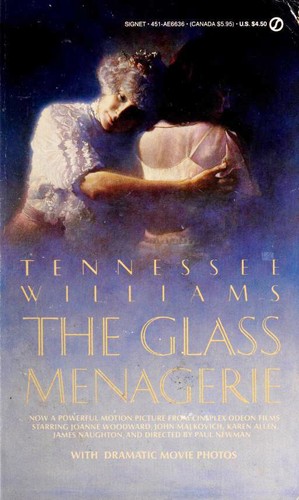
The play suits high school and college students, general readers who want a short classic of American drama, and theatre-goers preparing to see a production. It also appeals to readers interested in family dynamics, memory, and Southern literature. People who like quiet character studies will be most at home with it. Readers who want a fast, plot-heavy story may find it slow, and those who dislike reading dialogue and stage directions on the page may need a little patience. Because the 1987 mass market format is small and compact, it is practical for classroom use and travel, though not ideal for readers who prefer large type.
Reading Difficulty
The language is not hard. The dialogue is plain, and the poetic touches are mostly in Tom's speeches and the stage directions. The main challenge is the play's form. Readers must picture a staging that is deliberately non-realistic, track Tom's shifts between narrator and participant, and notice symbolism without being told what it means. The play is brief, with seven scenes and a single main setting, so pacing is steady. The emotional difficulty is greater than the intellectual difficulty. Some scenes are painful because they depict a vulnerable young woman and a mother who does not see how her pressure hurts. No special prerequisites are needed. A first-time reader of drama may find it useful to read the stage directions slowly, since they carry real information.
Helpful Background Knowledge
A basic picture of the Depression in an American city helps explain why a job at a shoe warehouse, a gentleman caller, and a failed typing course all matter. It also helps to know that a memory play is told from one person's point of view, so events are not guaranteed to be neutral. A short look at Tennessee Williams's life, especially his relationship with his sister Rose and his mother Edwina, adds depth, but it is better read after the play so it does not turn the story into a puzzle. Familiarity with the idea of stage directions and production notes helps, because Williams's notes explain why he wanted music, lighting, and a loose, expressive style. No knowledge of Southern history is required, though Amanda's references to Blue Mountain and her many suitors are easier to appreciate with a sense of Southern gentility.
Why Read This Book?
Among plays to read, this one gives an unusually complete experience in a short span. In a handful of scenes it presents a fully drawn family, a clear symbolic system, and a narrator whose unreliability is part of the point. It was the work that made Williams famous, so reading it shows where his later, better-known plays began. It is also a useful introduction to how a playwright can use theatrical technique, such as narration, music, and lighting, to express feeling rather than simply report events. Finally, it is a rare work in which the sympathy is shared out among all the characters, which makes it good for conversation and argument.
Reader Takeaways
A careful reader may come away with a sharper sense of how a narrator's guilt can shape a story. They may reconsider Amanda, who can seem comic or cruel at first and is more complex on reflection. They may notice how small objects, such as a unicorn, a photograph, or a record, carry the emotional weight of a scene. They may also see how Williams uses ordinary kindness, in Jim's case, to cause harm without villainy. Practising a close reading of stage directions is another benefit, since they reveal how Williams wanted the play to feel as well as look.
Strengths
The play is economical. Four characters and one main setting produce a surprisingly wide range of feeling. Its characters are nuanced, and none can be reduced to hero or villain. The memory-play frame gives the story a distinctive structure, and the production notes make it valuable for readers interested in theatre craft. The symbolism is clear without being heavy-handed, which makes the work suitable for first-time readers and for deeper study. Its autobiographical basis lends emotional truth, and its short length makes it easy to reread.
Limitations and Cautions
A play is written to be performed, and reading it on the page can flatten the effects of music, light, and acting. The 1987 Signet mass market printing is a compact, text-focused edition; readers who want extensive notes, essays, or scholarly apparatus may prefer another edition. The play reflects the attitudes of its time toward gender, courtship, and disability, and some readers may find Laura's portrayal limiting. Readings that treat the play as direct autobiography are common, but they are interpretations, and critics differ over how closely the characters match Williams's family and how much weight biography should carry. Finally, the ending is deliberately unresolved, which some readers find unsatisfying.
Important Concepts, People, and Places
Tennessee Williams: the American playwright whose family experiences underlie the drama and whose career took off with it. Tom Wingfield: the narrator and son, who works in a warehouse, writes poetry, and eventually leaves. Amanda Wingfield: the mother, shaped by a Southern girlhood in Blue Mountain, Mississippi, who tries to secure her children's future. Laura Wingfield: the shy daughter, whose glass collection and glass unicorn give the play its title image. Jim O'Connor: the gentleman caller, a former school acquaintance who represents the outside world of ambition. Mr. Wingfield: the absent father whose photograph is a constant presence. Memory play: Williams's term for a drama presented as one person's recollection, with liberties of form. Plastic theatre: Williams's idea of using light, sound, and image alongside words. St. Louis: the city of the setting and of Williams's own youth. Laurette Taylor and Eddie Dowling: the actress who played Amanda and the actor-director who played Tom in the original production. Ashton Stevens and Claudia Cassidy: Chicago critics whose enthusiasm helped the play survive its early run. New York Drama Critics' Circle: the group that gave the play its 1945 award. Rose Williams: the playwright's sister, whose illness is the personal background to Laura.
Questions the Book Explores
Can a person escape a family without carrying it away? How reliable is a story told by someone who feels responsible for what happened? When does a comforting fantasy become a form of harm? What do adult children owe a parent who has sacrificed for them, and what do parents owe in return? How do economic hardship and social expectations shape the choices open to women and to artists? Is kindness enough when it comes without commitment?
Reading Group Guide
This play can be read aloud in a single sitting, which makes it well suited to groups. One approach is to assign parts and read Scenes Six and Seven together, then pause to discuss how voice and pacing change the meaning. Another is to compare the production notes with the dialogue and ask which effects the group would stage. It can help to begin by asking what each member thinks Tom is withholding from the audience. If the group has seen a film or stage version, compare how it handled narration, lighting, and the unicorn scene. Keep an eye on stage directions, which often reveal tone and mood. The book discussion questions below are suitable for either a single meeting or a two-part discussion.
Discussion Questions
1. Tom tells us at the start that the play is a memory. How does that statement change the way you judge his account?
2. Is Amanda a figure of sympathy, criticism, or both? Which scenes shaped your view?
3. What does Laura's glass collection allow her to do, and what does it prevent?
4. Why might Williams have chosen to keep Mr. Wingfield visible only as a photograph?
5. How does Jim's version of success differ from Tom's, and what does the play suggest about each?
6. What do you make of Tom's closing address? Has he escaped, or only moved?
7. How do light, music, and setting contribute to meaning in a text you are reading rather than watching?
8. Which of the characters seems most responsible for the family's situation, and does that question have a clear answer?
Sources and Verification
This profile draws on library and bibliographic catalogue records and bookseller listings to confirm the title, author, ISBN, format, and page count of the 1987 Signet printing. Information about the play's origins, premiere, awards, and critical history comes from reference works, theatre journalism, a university-hosted scholarly journal and thesis, a national arts-education resource, and a university news article. Sources disagree about the imprint of this printing, listing it as Signet and New American Library in some places and Berkley in others, and none gave a reliable exact publication day, so the date is omitted. The edition's front matter and any introductory material were not examined.