About this book
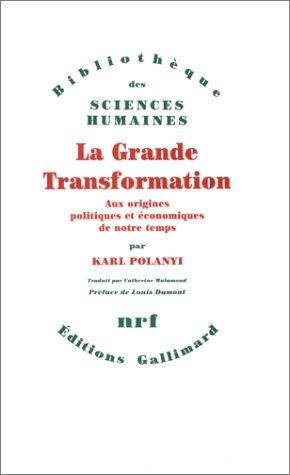
Polanyi sets out to explain the breakdown of nineteenth-century European civilization and the political disasters that followed it. His account connects four institutions: the balance-of-power system, the international gold standard, the liberal state, and—most importantly—the ideal of a self-regulating market. Rather than treating markets as timeless or naturally dominant, he distinguishes ordinary markets from a market society in which production and social life are organized around market prices. The book moves across diplomatic history, industrialization, English poor relief, classical political economy, labor legislation, monetary institutions, imperialism, depression, fascism, and socialism. Its governing argument is that constructing a self-regulating market required extensive political intervention and the treatment of labor, land, and money as commodities. Because those elements are inseparable from human beings, nature, and public institutions, unrestricted commodification generated social disruption and protective reactions. Polanyi calls the resulting conflict between market expansion and social protection the “double movement.” ([eh.net](https://eh.net/book_reviews/the-great-transformation-the-political-and-economic-origins-of-our-time/?utm_source=openai))
Deep Overview
Polanyi sets out to explain the breakdown of nineteenth-century European civilization and the political disasters that followed it. His account connects four institutions: the balance-of-power system, the international gold standard, the liberal state, and—most importantly—the ideal of a self-regulating market. Rather than treating markets as timeless or naturally dominant, he distinguishes ordinary markets from a market society in which production and social life are organized around market prices. The book moves across diplomatic history, industrialization, English poor relief, classical political economy, labor legislation, monetary institutions, imperialism, depression, fascism, and socialism. Its governing argument is that constructing a self-regulating market required extensive political intervention and the treatment of labor, land, and money as commodities. Because those elements are inseparable from human beings, nature, and public institutions, unrestricted commodification generated social disruption and protective reactions. Polanyi calls the resulting conflict between market expansion and social protection the “double movement.” ([eh.net](https://eh.net/book_reviews/the-great-transformation-the-political-and-economic-origins-of-our-time/?utm_source=openai))
Key Themes
Major themes include the political construction of markets; the difference between markets and a market society; the social consequences of industrialization; the limits of economic liberalism; and the relationship between domestic institutions and the international gold standard. Polanyi also examines how attempts to protect people and productive systems can take democratic, conservative, nationalist, authoritarian, or fascist forms. The book therefore does not present every reaction against markets as humane or progressive. Its deeper concern is the danger of subordinating society to an allegedly autonomous economic mechanism. ([eh.net](https://eh.net/book_reviews/the-great-transformation-the-political-and-economic-origins-of-our-time/?utm_source=openai))
Historical and Intellectual Context
First published during World War II, the book was shaped by Polanyi’s effort to understand the collapse of Europe’s nineteenth-century liberal order and the rise of fascism. Its historical center is Britain’s Industrial Revolution, but its frame extends from the long European peace after 1815 through World War I, the interwar restoration of the gold standard, the Great Depression, and the political crises of the 1930s. Research associated with the Karl Polanyi Institute reports that the book grew partly from lectures Polanyi delivered in England and that he completed it in the United States during the war. The original American edition appeared in 1944; a British version followed under the title The Origins of Our Time. ([concordia.ca](https://www.concordia.ca/research/polanyi/publications.html?utm_source=openai))
Intended Audience
This book is especially valuable for readers interested in economic history, political economy, sociology, social theory, modern European history, labor, globalization, environmental politics, or the relationship between states and markets. It suits advanced undergraduates, graduate students, researchers, policy readers, and general readers willing to work through a dense historical argument. Readers seeking a neutral survey of economic thought or a straightforward chronological history may find it less suitable: Polanyi advances a strong interpretive thesis and frequently shifts between historical narrative, institutional analysis, and moral argument.
Reading Difficulty
The difficulty is moderate to high. Polanyi assumes some familiarity with European history, industrialization, classical liberalism, the gold standard, and nineteenth-century British social policy. His prose can be compressed and categorical, and the overall argument is distributed across historical chapters rather than presented as a simple sequence of propositions. Terms such as “embeddedness,” “self-regulating market,” “fictitious commodities,” and “double movement” require attention because later scholars sometimes use them differently from Polanyi. Reading the chapter titles in advance and keeping a short concept glossary can make the structure easier to follow. The 2001 Beacon edition adds a foreword by Joseph E. Stiglitz and an introduction by Fred Block, which may help contemporary readers orient themselves. ([search.worldcat.org](https://search.worldcat.org/title/The-great-transformation-%3A-the-political-and-economic-origins-of-our-time/oclc/44869073?utm_source=openai))
Helpful Background Knowledge
Useful preparation includes a basic understanding of the Industrial Revolution; British poor relief and the 1834 Poor Law reform; classical economists such as Adam Smith, David Ricardo, and Thomas Malthus; free trade and protectionism; the gold standard; and the political history of Europe between 1815 and 1945. Readers should also distinguish capitalism in general from Polanyi’s more specific target: the project of organizing society around a self-regulating system of markets. Prior knowledge is helpful but not mandatory if readers are prepared to consult historical references as they proceed. ([eh.net](https://eh.net/book_reviews/the-great-transformation-the-political-and-economic-origins-of-our-time/?utm_source=openai))
Why Read This Book?
The Great Transformation offers a powerful alternative to accounts in which markets emerge spontaneously when governments withdraw. Polanyi asks readers to examine the legal and political work required to create labor, land, and monetary markets. His framework also connects economic policy to social belonging, ecological conditions, democratic legitimacy, and international order. The book remains useful not because every historical claim is settled, but because it supplies a vocabulary for asking who constructs markets, what must be protected from market pressures, and what political forms protection may take. Its concepts continue to be debated and applied across sociology, political economy, labor studies, law, international relations, and environmental analysis. ([cambridge.org](https://www.cambridge.org/core/journals/the-economic-and-labour-relations-review/article/abs/labour-as-a-fictitious-commodity-polanyi-and-the-capitalist-market-economy/99AED22B4D351D5C3B776AD1DA8B1A43?utm_source=openai))
Reader Takeaways
A careful reader may come away with four durable insights. First, the existence of trade does not by itself prove that an entire society is governed by markets. Second, laissez-faire institutions can depend upon deliberate legislation and administrative power rather than simple government withdrawal. Third, labor, land, and money cannot be managed exactly like ordinary goods without consequences for people, ecosystems, and monetary stability. Fourth, resistance to market disruption is politically open-ended: it may support democratic welfare institutions, but it may also fuel exclusionary nationalism or authoritarian rule. These are analytical propositions to examine, not formulas that automatically explain every historical case. ([eh.net](https://eh.net/book_reviews/the-great-transformation-the-political-and-economic-origins-of-our-time/?utm_source=openai))
Strengths
The book’s principal strength is its synthesis. It joins economic, social, political, and international history rather than isolating them in separate narratives. Polanyi also draws a consequential distinction between societies containing markets and societies institutionally subordinated to a market mechanism. His concepts of fictitious commodities and the double movement make visible connections among labor policy, environmental use, finance, social protection, and political conflict. Even scholars who revise his conclusions continue to treat these ideas as productive tools for studying institutional change. ([eh.net](https://eh.net/book_reviews/the-great-transformation-the-political-and-economic-origins-of-our-time/?utm_source=openai))
Limitations and Cautions
The Great Transformation should not be treated as uncontested economic history. Scholars have challenged elements of Polanyi’s account of premodern exchange, his interpretation of the Speenhamland poor-relief system, and the chronology through which market society developed. Critics also argue that he gives insufficient attention to class structure and sometimes describes “society” as if its protective interests were unified. His use of embeddedness contains a noted tension: if all economies are socially instituted, it is difficult to describe a market economy as literally disembedded. The double movement can likewise become too mechanical when later readers assume that market expansion will automatically produce progressive protection. These criticisms limit overly literal applications of the thesis but do not erase the book’s value as an interpretive framework. ([cambridge.org](https://www.cambridge.org/core/journals/modern-intellectual-history/article/abs/karl-polanyi-at-the-margins-of-english-socialism-19341947/8DA2E087CAAA3A5605077055692C94DA?utm_source=openai))
Important Concepts
“Self-regulating market” refers to the ideal of an economic system coordinated through prices with minimal nonmarket direction. “Market society” describes a social order organized to serve that mechanism, rather than merely a society in which buying and selling occur. “Fictitious commodities” are labor, land, and money: they are traded through markets but were not originally produced as ordinary goods for sale. “Double movement” names the simultaneous extension of market organization and the growth of measures intended to protect society from its effects. “Embeddedness” concerns the economy’s institutional location within social and political relationships, although scholars dispute how consistently Polanyi uses the idea. “Social protection” includes regulations, associations, policies, and political responses that constrain market exposure; it is not necessarily egalitarian or democratic. ([assets.cambridge.org](https://assets.cambridge.org/97805215/19656/excerpt/9780521519656_excerpt.pdf?utm_source=openai))
Questions the Book Explores
The book investigates whether a self-regulating market can exist without damaging the social and natural foundations on which economic activity depends. It asks whether laissez-faire develops spontaneously or must be politically created; why nineteenth-century liberal civilization collapsed; how the gold standard restricted democratic and national policy choices; why industrialization produced demands for protection; and how the interwar attempt to restore the old economic order contributed to political crisis. It also raises a larger normative question: how can economic coordination coexist with substantive freedom without allowing either markets or state power to dominate society? ([eh.net](https://eh.net/book_reviews/the-great-transformation-the-political-and-economic-origins-of-our-time/?utm_source=openai))
Reading Group Guide
A group may benefit from dividing the book into three stages: the collapse of nineteenth-century civilization; the rise and institutional construction of market society; and the double movement followed by the interwar crisis. Before each meeting, participants can identify one historical claim, one analytical concept, and one normative judgment. Assigning members to trace labor, land, money, and the gold standard separately helps reveal how Polanyi connects domestic social policy with international institutions. For the final meeting, test the framework against one contemporary case while explicitly considering the historical and conceptual criticisms summarized in this profile.
Discussion Questions
1. What is gained by distinguishing markets from a market society? 2. How does Polanyi challenge the idea that laissez-faire means an absence of government action? 3. Why does he call labor, land, and money fictitious commodities, and are all three fictitious in the same sense? 4. Does the double movement explain historical change, or mainly provide a way of organizing observations after the fact? 5. Who speaks for “society” in a protective countermovement, and whose interests may remain unprotected? 6. Can social protection preserve freedom, or does it inherently increase coercive power? 7. How important is the gold standard to the book’s explanation of the interwar crisis? 8. Do disputed historical claims weaken the whole thesis or only particular parts of its narrative? 9. How might climate policy, labor platforms, housing, or financial regulation be analyzed through Polanyi’s framework? 10. What would a democratically embedded economy look like in practice?
Sources and Verification
Bibliographic identity was checked against the Library of Congress, the Karl Polanyi Institute of Political Economy, WorldCat, and a digitized bibliographic record of the original publication. These establish the title, author, original publisher, 1944 publication year, and the existence of later Beacon editions. Page counts vary among catalog records and editions; 305 pages is used here for the original U.S. publication based on the available 1944 record. The work predates ISBN assignment, so no ISBN is supplied for the first edition. Interpretation and cautions were informed by the text, institutional scholarship, and peer-reviewed academic discussions of Polanyi’s concepts and historical claims. Verification needed for the original edition’s exact day and month of publication and its specific binding designation. ([loc.gov](https://www.loc.gov/item/00064156/?utm_source=openai))