
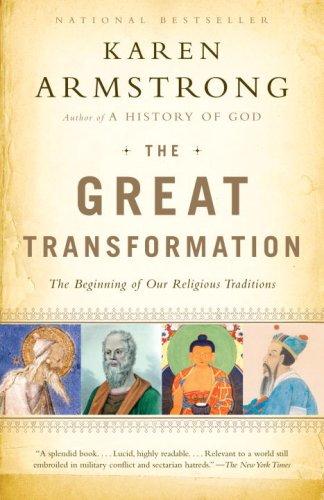
The Great Transformation
The Beginning of Our Religious Traditions
Karen Armstrong examines the formative centuries commonly called the Axial Age, when major religious and philosophical traditions developed across China, India, Israel, and Greece. Moving among Confucianism, Daoism, Hindu traditions, Buddhism, Israelite monotheism, and Greek rational inquiry, she asks why comparable ethical and spiritual innovations appeared in societies with no single shared history. Armstrong connects these developments to political upheaval, warfare, urbanization, and changing social structures. Her central emphasis is not doctrinal agreement but a recurring turn away from ritual performed for its own sake and toward inward discipline, compassion, self-criticism, and responsibility for others. Figures including Confucius, the Buddha, Socrates, and the prophet Jeremiah become part of a comparative account of humanity’s attempts to answer violence without reproducing it. The result is an ambitious history of ideas that also challenges modern readers to reconsider wha…
Where to buy or borrow
Are you selling this book? Bookstores, publishers, authors and libraries can be listed here for free. Request a listing
About this book
Deep Overview
The book places ideas inside unsettled societies. Warfare, expanding states, economic change, the weakening of older tribal arrangements, and the growth of cities disturbed inherited patterns of life. Older sacrificial systems and mythic worldviews did not simply disappear, but reformers increasingly questioned whether ritual alone could answer suffering and disorder. Armstrong argues that the resulting traditions asked people to examine their conduct, restrain the ego, and recognize the humanity of those beyond their immediate group.
In China, she follows the decline of the Zhou political order and the search for social harmony. Confucius becomes important not as a remote theorist but as a teacher who reinterprets ritual as training in humane relationships. Daoist currents offer a contrasting suspicion of social striving and rigid control. In India, Armstrong traces the movement from Vedic sacrifice toward interior spiritual exploration, followed by the renunciant challenge to ordinary social and religious expectations. Siddhartha Gautama, the Buddha, presents liberation as a disciplined response to craving and suffering rather than dependence on metaphysical speculation.
The Israelite material connects conquest, monarchy, imperial pressure, exile, and prophetic criticism. Prophets such as Amos, Hosea, Isaiah, and Jeremiah insist that worship without justice is inadequate. Their God demands moral responsibility, especially toward vulnerable people. In Greece, the narrative moves through heroic culture, the polis, tragedy, and philosophy. Socrates embodies an insistence on self-examination and ethical inquiry, even when that inquiry brings him into conflict with Athens.
Armstrong does not claim that these traditions taught identical doctrines. Their ideas about divinity, society, selfhood, and liberation often differ sharply. Her comparison instead emphasizes a family resemblance: distrust of egotism, concern with suffering, disciplined self-transcendence, and an enlarged moral imagination. The book’s final implication is contemporary. Religious traditions, Armstrong suggests, become distorted when reduced to rigid propositions or group identity; their transformative power lies in practices that weaken self-centeredness and cultivate compassion.
Key Themes
**Responses to violence and disorder:** Political instability and warfare form the setting in which thinkers and prophets reconsider inherited values.
**From external ritual to ethical interiority:** Ritual remains important in several traditions, but its value increasingly depends on the character and relationships it cultivates.
**The critique of ego:** Craving, pride, status, and possessiveness appear in different vocabularies as obstacles to wisdom and humane conduct.
**Independent but comparable developments:** China, India, Israel, and Greece do not converge on one creed. Their importance lies in distinct attempts to widen moral responsibility.
**Religion as action rather than mere belief:** Armstrong repeatedly privileges what a tradition asks practitioners to do over later efforts to define faith principally through propositions.
Historical Context
Intended Audience
Reading Difficulty
Helpful Background Knowledge
Why Read This Book?
Reader Takeaways
Strengths
Limitations
Important Concepts, People, and Places
**Karl Jaspers:** The twentieth-century philosopher whose formulation of the Axial Age strongly shaped later discussion of the period.
**Confucius:** A Chinese teacher who reinterpreted inherited ritual as moral cultivation and humane participation in relationships.
**Daoism and Laozi:** A tradition and emblematic sage associated with simplicity, non-coercive action, and criticism of artificial striving.
**Siddhartha Gautama, the Buddha:** The Indian teacher whose path addresses suffering by transforming craving, perception, and conduct.
**The Upanishads:** Indian texts that redirect attention from external sacrifice toward knowledge of ultimate reality and the inner self.
**Mahavira and Jainism:** Mahavira represents a rigorous renunciant path in which nonviolence and release from karmic bondage are central.
**Jeremiah and the Israelite prophets:** Voices that connect fidelity to God with justice, moral accountability, and criticism of complacent worship.
**Socrates:** The Athenian philosopher who makes questioning, ethical consistency, and the examined life central to philosophy.
**Zhou China:** The political and ritual order whose weakening provides the background to classical Chinese reflection.
**Israel, Judah, and Babylon:** Kingdoms and imperial settings crucial to the prophetic tradition and the religious consequences of conquest and exile.
**The Greek polis:** The city-state environment in which civic identity, tragedy, political conflict, and philosophical argument developed.
Questions the Book Explores
Reading Group Guide
Discussion Questions
2. Which social or political crisis appears to have the strongest relationship to religious change?
3. How does Armstrong distinguish compassion from emotion, politeness, or charity?
4. What roles do ritual and tradition retain after reformers criticize them?
5. How do Confucian social cultivation and Indian renunciation offer contrasting paths beyond egotism?
6. In what ways are the Israelite prophets and Socrates comparable as critics of their societies?
7. Does Armstrong give sufficient attention to power, class, and gender within the traditions she discusses?
8. Which of the book’s comparisons seems most convincing, and which seems least convincing?
9. Can ethical practices be separated from the metaphysical beliefs that originally supported them?
10. How persuasive is the book’s application of ancient ideas to contemporary religious conflict?
Sources and Verification
Comments
No published comments yet.
Available editions
Paperback
Anchor paperback edition
- Publisher
- Anchor
- ISBN-13
- 9780385721240
- Publication date