
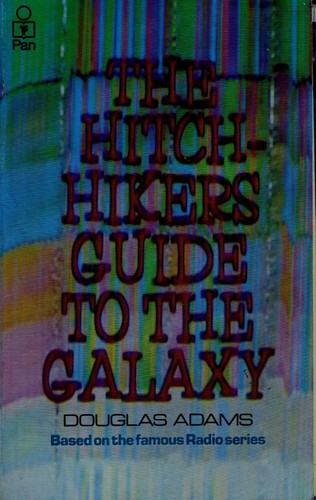
The Hitchhiker's Guide to the Galaxy
Seconds before Earth is demolished for an interstellar bypass, the bewildered Englishman Arthur Dent is rescued by his friend Ford Prefect, secretly a researcher for a galactic travel guide. Their escape leads to the stolen spaceship Heart of Gold and its unlikely crew: the recklessly self-involved president Zaphod Beeblebrox, the capable Trillian, and the chronically miserable robot Marvin. As the survivors encounter bureaucratic aliens, improbable technology, and unsettling revelations about Earth, Douglas Adams turns space adventure into an absurdist examination of authority, knowledge, meaning, and humanity's place in the universe. The novel is both a brisk comic journey and a foundational work of modern science-fiction satire.
Where to buy or borrow
Are you selling this book? Bookstores, publishers, authors and libraries can be listed here for free. Request a listing
About this book
Deep Overview
Ford Prefect rescues Arthur because he is not actually an unemployed actor from Guildford but an alien researcher for The Hitchhiker's Guide to the Galaxy, an electronic reference work for budget travelers. The Guide is useful, entertaining, frequently incomplete, and not necessarily true. It acts as a comic narrator within the narrative, explaining alien customs and technologies while repeatedly demonstrating how information can be shaped by convenience, editorial whim, and commercial priorities.
After surviving an encounter with the Vogons—whose bureaucracy, emotional dullness, and poetry all become instruments of suffering—Arthur and Ford are improbably collected by the Heart of Gold. The ship is powered by the Infinite Improbability Drive, a device that turns impossibility into propulsion and gives Adams license to convert coincidence into a governing principle. Its crew joins several radically different dispositions: Zaphod Beeblebrox pursues excitement and a half-concealed purpose; Trillian approaches danger with more competence than the men around her; Marvin interprets superior intelligence as a reason for despair; and Arthur clings to tea, ordinary language, and the remnants of terrestrial common sense.
The apparent randomness gradually gives way to a larger mystery involving Magrathea, a legendary planet associated with the construction of custom-made worlds. Earth itself is reframed not as the center of creation but as part of an immense intellectual project connected to Deep Thought, a computer asked to determine the Answer to the Ultimate Question of Life, the Universe, and Everything. The famous answer, 42, is funny not because it resolves existence but because it exposes a defective question. Information without understanding remains empty.
Adams does not build toward a conventional triumph or a stable philosophical conclusion. Instead, he repeatedly punctures the desire for tidy explanations. Governments are performative, experts are fallible, reference books are unreliable, machines may be neurotic, and human assumptions about importance collapse under a wider perspective. Yet the book is not merely nihilistic. Friendship, adaptability, curiosity, and small comforts help its characters continue when coherent meaning is unavailable. Its deepest comic proposition is that bewilderment may be the normal condition of intelligent life—and that panic is rarely an improvement.
Key Themes
• **The mismatch between answers and questions:** The number 42 satirizes the belief that complexity can be reduced to a result without first defining what is being asked.
• **Human insignificance and resilience:** Earth's destruction eliminates human exceptionalism, but Arthur's attempts to adjust give ordinary persistence genuine weight.
• **Unreliable knowledge:** The Guide is simultaneously indispensable and inaccurate, raising questions about who produces information and why readers trust it.
• **Probability, chaos, and coincidence:** The Infinite Improbability Drive turns narrative accident into technology and undermines expectations of orderly causation.
• **Technology with human defects:** Computers, robots, and spacecraft possess personalities, commercial features, or emotional problems rather than offering neutral perfection.
• **Comfort amid disorder:** Towels, tea, conversation, and companionship become modest defenses against an incomprehensible universe.
Historical Context
Science fiction of the period often treated computers, extraterrestrial intelligence, and vast technological systems as sources of wonder or anxiety. Adams retains those subjects but redirects them through comedy. His supercomputers can misunderstand their assignments, advanced doors can be irritating, and interstellar government resembles mundane administration. Because Hitchhiker developed across radio, records, novels, television, games, stage productions, and film, no single version functions as a perfectly consistent master text. Contradictions between adaptations became part of the work's identity rather than merely continuity errors.
Intended Audience
Readers seeking detailed world-building, sustained emotional realism, hard-science explanations, or a tightly resolved standalone plot may find it deliberately loose. Its comic register is distinctly British and often deadpan; readers who prefer transparent punch lines or conventional heroic development may need time to adjust to its rhythms.
Reading Difficulty
No scientific expertise is required. Readers do, however, benefit from accepting contradictions and postponed explanations instead of expecting every invention to obey a stable technical system. Some editions use British spelling and cultural assumptions, but these rarely obstruct the action.
Helpful Background Knowledge
Readers comparing adaptations should not assume that the book, radio series, television program, and film tell precisely the same story. Adams repeatedly revised characters, events, and continuity for different media. The differences are part of the creative history of Hitchhiker.
Why Read This Book?
It is also a useful starting point for understanding a major multimedia phenomenon: the central characters, the Guide, the Heart of Gold, Magrathea, and the problem represented by 42 are all established here. Readers interested in how comedy can challenge human self-importance without abandoning sympathy will find the novel especially rewarding.
Reader Takeaways
It may also prompt a reassessment of what counts as rational behavior. Arthur's attachment to ordinary comforts can appear ridiculous against a galactic background, yet those comforts preserve continuity after catastrophic loss. The book suggests that intellectual humility, practical preparedness, and companionship may be more useful than certainty when events exceed anyone's control.
Strengths
• An economical opening that connects municipal inconvenience to cosmic catastrophe.
• Memorable characters whose sharply different temperaments generate both conflict and jokes.
• The fictional Guide provides exposition without slowing the story and doubles as a satire of reference publishing.
• Scientific and philosophical ideas remain approachable because Adams tests them through comic situations rather than lectures.
• The episodic structure produces an unusually high concentration of inventive premises, images, and reversals.
Limitations and Cautions
Some cultural references and attitudes reflect late-1970s Britain, while occasional jokes rely on caricature or broadly drawn social types. Readers should also distinguish playful speculation from scientific explanation: technologies such as the Infinite Improbability Drive are comic devices, not attempts at plausible physics. Finally, extensive familiarity with famous lines and concepts may lessen the surprise of moments that were highly original when first published.
Important Concepts, People, and Places
• **Ford Prefect:** Arthur’s extraterrestrial friend, originally from a planet near Betelgeuse. Stranded on Earth while researching an entry for the Guide, he understands hitchhiking, alien customs, and the practical value of staying prepared.
• **Zaphod Beeblebrox:** Ford’s semi-cousin, the two-headed and three-armed president of the Galaxy, and the man who steals the Heart of Gold. His theatrical recklessness conceals uncertainty about his motives and possible interference with his own mind.
• **Trillian (Tricia McMillan):** A mathematician and astrophysicist whom Arthur previously met at a party on Earth. After leaving with Zaphod, she becomes the only other surviving human known to Arthur and responds to galactic life with considerably greater composure.
• **Marvin the Paranoid Android:** A robot whose immense intellectual capacity is paired with relentless depression. He embodies the comic possibility that technological sophistication can magnify dissatisfaction rather than eliminate it.
• **The Hitchhiker’s Guide to the Galaxy:** An electronic reference book designed for interstellar travelers—and the publication for which Ford works. Its mixture of useful advice, entertaining digressions, careless omissions, and dubious claims makes it a satire of informational authority.
• **The Heart of Gold:** An advanced spacecraft stolen by Zaphod during its public unveiling. It becomes the principal setting for the central group’s journey and houses the technology responsible for their most improbable encounters.
• **Infinite Improbability Drive:** The Heart of Gold’s experimental propulsion system, which passes through every conceivable point in every conceivable universe before reaching its destination. Its unpredictable effects turn extreme coincidence into a feature of travel.
• **Vogons:** A powerful alien species represented by Prostetnic Vogon Jeltz and his constructor fleet. Their cruelty, administrative rigidity, and devotion to procedure make them the novel’s clearest embodiment of institutional power without compassion.
• **Magrathea:** A supposedly dead planet once famous for producing bespoke worlds for wealthy clients. Its reappearance connects Zaphod’s private quest with the concealed history and function of Earth.
• **Deep Thought:** The supercomputer built to determine the Answer to the Ultimate Question of Life, the Universe, and Everything. Its calculation reveals that a result is meaningless when the problem itself has not been properly understood.
• **Slartibartfast:** A Magrathean planetary designer who explains Earth’s origins to Arthur. His pride in designing coastlines—especially Norway’s fjords—places individual craftsmanship beside the novel’s immense cosmic machinery.
• **42:** Deep Thought’s Answer to the Ultimate Question. Because no one knows the actual Question, the number exposes the folly of expecting a concise solution to an undefined existential problem.
• **Earth:** Not merely humanity’s home but a planet-sized computer created to discover the Ultimate Question. Its destruction shortly before completing its program transforms an apparent cosmic accident into an intellectual catastrophe.
• **The mice:** Hyperintelligent beings whose familiar earthly appearance disguises their role in commissioning the experiment conducted through Earth. They focus their attention on Arthur because his brain may preserve part of the lost program.
• **The Ultimate Question:** The unknown question to which 42 is supposedly the answer. Recovering it becomes more important than the answer itself, reinforcing the book’s distinction between receiving information and understanding what it means.
Questions the Book Explores
Reading Group Guide
Assign each participant one major figure—Arthur, Ford, Zaphod, Trillian, or Marvin—and consider what that character treats as normal. A second useful exercise is to collect the book's apparent authorities, including governments, computers, reference works, and scientists, and evaluate why each deserves or fails to deserve trust.
For groups familiar with another adaptation, choose one shared scene and discuss what changes when the material moves between sound and prose. End by debating whether the novel's worldview is fundamentally pessimistic, humane, or both. Keep attention on how the jokes carry arguments rather than treating humor as decoration.
Discussion Questions
2. When does Arthur's attachment to ordinary earthly comforts seem foolish, and when does it seem necessary?
3. Is the Guide's usefulness weakened by its inaccuracies, or does the novel suggest that all practical knowledge works this way?
4. What does Zaphod's political office reveal about power, celebrity, and distraction?
5. How does Marvin complicate the assumption that greater intelligence improves existence?
6. Why is 42 more effective as a comic and philosophical device than a serious explanation would be?
7. Which institution in the novel is most dangerous, and what makes it dangerous?
8. How does the Infinite Improbability Drive affect the reader's expectations about cause and consequence?
9. Does the revelation about Earth's purpose diminish humanity, elevate it, or do both at once?
10. How does Trillian's response to galactic life differ from Arthur's, and what might explain that contrast?
11. Where does the book find grounds for hope, if anywhere?
12. How might the fictional Guide be read differently in an age of collaborative online information?
Sources and Verification
Comments
No published comments yet.
Available editions
Paperback
Pan Books paperback
- Publisher
- Pan Books
- ISBN-13
- 9780330258647