
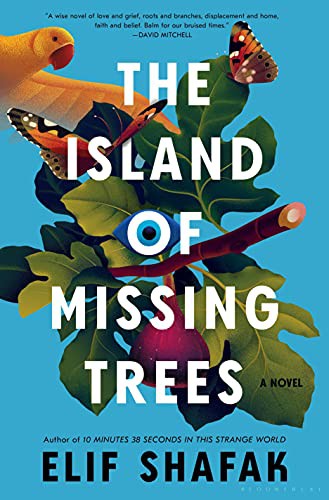
The Island of Missing Trees
A Novel
The novel links a divided family to the divided island of Cyprus. Its principal human story follows Kostas, a Greek Cypriot, and Defne, a Turkish Cypriot, whose youthful relationship develops amid communal hostility and the violence surrounding Cyprus in 1974. A second timeline centers on their London-born daughter, Ada, who inherits the emotional consequences of a past her parents have largely concealed from her. Between these narratives stands a fig tree descended from one that grew through a Nicosia tavern where Kostas and Defne once met. Shafak uses the fig tree not simply as a symbol but as a speaking character and witness. Human history, family memory, migration, plant life and ecological damage are therefore narrated as interconnected rather than separate subjects. The chronology moves between Cyprus and London and between the 1970s and a later family present, gradually disclosing how political violence enters intimate relationships and persists through silence. The novel’s six…
Where to buy or borrow
Are you selling this book? Bookstores, publishers, authors and libraries can be listed here for free. Request a listing
About this book
Shafak uses the fig tree not simply as a symbol but as a speaking character and witness. Human history, family memory, migration, plant life and ecological damage are therefore narrated as interconnected rather than separate subjects. The chronology moves between Cyprus and London and between the 1970s and a later family present, gradually disclosing how political violence enters intimate relationships and persists through silence. The novel’s six-part structure—organized around burying, roots, trunk, branches, ecosystem and unburying—extends the arboreal idea into its form. ([bloomsbury.com](https://www.bloomsbury.com/us/island-of-missing-trees-9781635578591/?utm_source=openai))
Deep Overview
Shafak uses the fig tree not simply as a symbol but as a speaking character and witness. Human history, family memory, migration, plant life and ecological damage are therefore narrated as interconnected rather than separate subjects. The chronology moves between Cyprus and London and between the 1970s and a later family present, gradually disclosing how political violence enters intimate relationships and persists through silence. The novel’s six-part structure—organized around burying, roots, trunk, branches, ecosystem and unburying—extends the arboreal idea into its form. ([bloomsbury.com](https://www.bloomsbury.com/us/island-of-missing-trees-9781635578591/?utm_source=openai))
Key Themes
Roots carry deliberately mixed meanings. They can provide continuity and belonging, but they can also become an exclusionary demand that people identify with only one religion, ethnicity or nation. Transplantation offers a complementary image: Kostas, Defne, Ada and the fig tree all live at varying distances from the places that shaped them. The missing people of Cyprus give the title its human significance, while damaged and uprooted trees expand “missingness” into an ecological concern. ([bloomsbury.com](https://www.bloomsbury.com/media/lhjloxar/the-island-of-missing-trees_rgg-ce-bd.pdf))
Historical and Cultural Context
The novel’s concern with bodies, unidentified graves and families denied certainty reflects an enduring humanitarian issue. The bicommunal Committee on Missing Persons in Cyprus was established in 1981 with United Nations participation. Its mandate concerns 2,002 people—Greek Cypriots and Turkish Cypriots—recorded as missing in connection with the intercommunal fighting of 1963–1964 and the events of 1974. ([cmp-cyprus.org](https://www.cmp-cyprus.org/?utm_source=openai))
Readers should nevertheless approach the novel as imaginative literature rather than as a comprehensive political history. It deliberately brings the conflict into focus through particular families, lovers, witnesses and losses instead of systematically explaining every disputed event or interpretation.
Intended Audience
Readers primarily seeking a military or diplomatic account of Cyprus may find the intimate and symbolic approach insufficient on its own. Those who strongly prefer strict realism should also know that a sentient fig tree narrates significant portions of the novel.
Reading Difficulty
The greatest challenges are emotional and structural rather than lexical. The book addresses bereavement, communal violence, disappearance, prejudice, displacement and family trauma. Ecological observations occasionally pause the human plot, creating a more reflective pace than readers expecting a continuously driven historical romance may anticipate.
Helpful Background Knowledge
Readers may also benefit from recognizing ambiguous loss: grief made especially difficult when a person’s fate or remains are unknown. That idea is central both to the historical missing-persons issue and to the novel’s treatment of families living without definitive answers. ([cmp-cyprus.org](https://www.cmp-cyprus.org/wp-content/uploads/2022/05/Cyprus-FNA-Public-Report-April-2019-EN-1.pdf?utm_source=openai))
Why Read This Book?
It is also a useful book for thinking about inherited history. Ada’s story makes political conflict relevant to a generation born elsewhere, showing how secrecy intended as protection can produce confusion and isolation. For discussion groups, the combination of family ethics, national division, ecology and narrative experimentation supplies several distinct routes into the text. The book was shortlisted for the 2022 Women’s Prize for Fiction. ([womensprize.com](https://womensprize.com/6-books-set-on-distant-shores/?utm_source=openai))
Potential Reader Takeaways
The ecological narrative encourages a less human-centered understanding of witness and survival. Trees, insects, fungi, birds and seeds operate across borders that humans treat as fixed. Renewal does not erase death or injustice, but the novel presents it as a process through which damaged lives and landscapes can form new connections.
Editorial Strengths
The dual setting also gives the book a productive generational range. Cyprus is not treated merely as a past setting, and London is not simply a place of escape. Both become environments in which identity must be negotiated. The combination of romantic, familial, historical and ecological material makes the novel particularly rich for group discussion.
Limitations and Reader Cautions
As an editorial assessment, the fig tree is likely to be the book’s most divisive feature. Some readers may find that its voice opens an imaginative, nonhuman perspective; others may find its explanations of plant life and human behavior overly conspicuous or didactic. The gradual disclosure of family secrets may also feel melodramatic to readers who prefer understated realism.
The narrative includes war, death, missing persons, burial sites, prejudice, grief and the death of a child. Readers sensitive to these subjects may wish to approach it with care.
Important Concepts and Motifs
• Roots and transplantation: competing models of belonging, continuity and adaptation.
• The Green Line: the division running through Cyprus and Nicosia, as well as a symbol of borders imposed on connected lives.
• Missing persons: an unresolved humanitarian legacy that turns uncertainty itself into a form of suffering.
• Intergenerational trauma: the transmission of distress and unresolved history to those born after the originating events.
• Ambiguous loss: mourning without reliable knowledge or physical confirmation.
• Ecosystems and fungal networks: models of mutual dependence that challenge isolated or strictly national ideas of identity.
• Butterflies, birds and seeds: forms of movement that cross political boundaries and suggest transformation or continuity.
• Burying and unburying: acts of protection and survival that also parallel the concealment and recovery of memory. ([bloomsbury.com](https://www.bloomsbury.com/media/lhjloxar/the-island-of-missing-trees_rgg-ce-bd.pdf))
Questions the Novel Explores
Reading Group Guide
A second session could compare the novel’s different forms of witness: personal memory, scientific recovery, family testimony, landscape and the fig tree’s narration. Participants should consider whether these forms complement or challenge one another.
For historical discussion, use a neutral reference on the United Nations buffer zone and the bicommunal Committee on Missing Persons alongside the novel. This can clarify the factual background without treating the fictional characters as representatives of every Cypriot experience. ([unficyp.unmissions.org](https://unficyp.unmissions.org/en/operations-1974?utm_source=openai))
A final discussion might examine the ending through the paired actions of burial and unburial. Ask what is preserved, what is disclosed and whether the novel equates recovery with healing.
Discussion Questions
2. Does the tree function primarily as a character, a witness, a symbol or an ethical challenge to human-centered storytelling?
3. Why do Kostas and Defne withhold so much of their past from Ada? Where does protection end and harm begin?
4. How does Ada belong to Cyprus despite never having visited it?
5. What different meanings do roots acquire across the novel?
6. How are human migration and botanical transplantation compared? Where does the comparison become imperfect?
7. How does the novel portray identities that do not fit neatly into Greek/Turkish, Christian/Muslim or British/Cypriot divisions?
8. What is the relationship between recovering human remains and recovering family stories?
9. Does the non-linear structure reproduce the workings of memory, trauma or ecological time?
10. Which characters are most capable of crossing inherited boundaries, and what enables them to do so?
11. Does the book offer reconciliation, renewal, acceptance or something more uncertain?
12. Which aspects of the Cyprus conflict would you want to investigate after finishing the novel?
Sources and Verification
The current Bloomsbury product page identifies the first US hardcover as a 368-page edition, while a prepublication Bloomsbury catalog listed 352 pages. The current product record has been used, but physical-copy confirmation is advisable if pagination is operationally important. Interpretive comments under strengths, limitations and reader guidance are original editorial assessments rather than claims of critical consensus.
Comments
No published comments yet.
Available editions
Hardcover
1st US edition, hardcover
- Publisher
- Bloomsbury Publishing
- ISBN-13
- 9781635578591
- Publication date
- Pages
- 368