
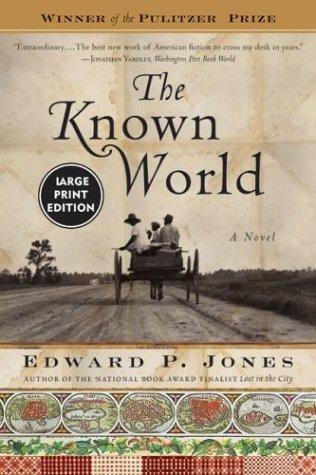
The Known World
Set in fictional Manchester County, Virginia, before the Civil War, The Known World begins with the death of Henry Townsend, a formerly enslaved Black man who has become a landowner and enslaver. His death unsettles the plantation he leaves to his widow, Caldonia, but the novel’s reach extends far beyond that household. Edward P. Jones follows enslaved people, free Black families, white landowners, patrolmen, officials, and others whose lives are connected by ownership, law, kinship, desire, and betrayal. Moving backward and forward through time, the narrative reveals consequences before causes and exposes how slavery reshapes generations. The novel’s central historical complication—Black participation in slaveholding—does not soften its judgment of slavery. Instead, it demonstrates how a system based on human property corrupts freedom itself, placing even legally free people inside a social order that can erase their rights, divide families, and turn aspiration into complicity.
Where to buy or borrow
Are you selling this book? Bookstores, publishers, authors and libraries can be listed here for free. Request a listing
About this book
Deep Overview
After Henry dies, Caldonia Townsend inherits the plantation and its human property. Her grief, uncertainty, and dependence on overseer Moses weaken the estate’s already unstable order. The consequences spread through households and relationships rather than following a single line of action. Enslaved people consider escape, spouses and parents struggle against forced separation, and characters bargain for safety within rules designed to deny their full personhood. Moses’s position is especially revealing. As an enslaved overseer, he possesses delegated authority but remains property himself; his limited power encourages ambitions the system will not allow him to fulfill.
The broader county shows that Henry’s plantation is not an exception sealed off from public life. Sheriff John Skiffington attempts to reconcile his self-image as a principled man with his responsibility for enforcing slave law. Slave patrols, traders, courts, documents, and local officials convert racial domination into routine administration. Augustus Townsend’s experiences demonstrate the fragility of free Black status: legal papers may record liberty, but those papers offer little protection when armed white men can disregard them. Jones repeatedly brings private affection into collision with public ownership. Marriages, parent-child bonds, friendships, and sexual relationships cannot escape a marketplace that gives owners authority over residence, labor, and family continuity.
The novel’s nonlinear structure enlarges this analysis. The narrator frequently discloses what will happen years later or traces an apparently minor life into another generation. These departures prevent the plantation from becoming the boundary of the story. They also show that no character fully knows the world governing them; each person sees only a fragment of the network connecting law, memory, violence, and inheritance. Even maps and records become morally charged because they claim to represent a complete world while omitting the interior lives of the people contained within it.
By giving Black enslavers a central role, Jones does not redistribute blame evenly across racial lines. White authority created, legalized, and protected the institution. The novel instead asks what happens when an oppressive system defines success so thoroughly that some of those once subjected to it seek security through its privileges. Its deepest subject is therefore not an historical anomaly but the reproductive power of institutions: slavery persists through statutes and force, but also through imitation, ambition, silence, and compromised forms of belonging.
Key Themes
**Freedom’s instability:** Legal emancipation does not provide dependable security. Free Black characters remain vulnerable to abduction, fraudulent sale, destroyed documentation, and arbitrary white power.
**Complicity within oppressive systems:** Henry’s transformation from an enslaved child into an enslaver shows how institutions can recruit people they have harmed by making domination appear to be a path toward safety and status.
**Law as organized violence:** Sheriffs, patrols, courts, papers, and commercial transactions give slavery a bureaucratic surface. Jones reveals that ordinary procedure can administer extraordinary injustice.
**Family under property rule:** Parental authority, marriage, inheritance, and romantic attachment are repeatedly distorted by an owner’s power to move or separate people.
**Knowledge and incomplete maps:** Characters misunderstand the larger forces shaping their lives. The title suggests both the limits of individual perception and the danger of mistaking an official representation for a complete human world.
**Memory and historical recovery:** The narration imagines lives that conventional archives might reduce to names, prices, or absences, while refusing to present imaginative reconstruction as simple historical certainty.
Historical Context
The book also belongs to the modern tradition often called the neo-slave or contemporary slave narrative: later imaginative works that revisit slavery from perspectives excluded or constrained in the surviving record. Its publication in 2003 placed it in conversation with American literature about slavery, freedom, racial capitalism, and historical memory. Unlike a conventional plantation saga organized around one lineage, it constructs a densely connected county whose public institutions and intimate relationships enforce the same hierarchy.
Intended Audience
Readers who prefer a single protagonist, chronological plotting, quick resolution, or clearly signposted transitions may find it demanding. The subject matter includes enslavement, family separation, racial terror, sexual coercion, abduction, and death. These elements are not incidental background; they are integral to the novel’s account of a slave society.
Reading Difficulty
The more substantial difficulty is ethical and conceptual. Jones withholds easy reassurance, presents contradictory motives, and often reports devastating events in an understated voice. Readers must distinguish a character’s rationalizations from the novel’s larger exposure of the system. The book is best approached slowly enough to notice recurring links among ownership, documentation, family, and authority.
Helpful Background Knowledge
Readers should keep in mind that Manchester County is fictional. The novel draws on historical realities while using invention to examine lives and connections that formal records often fail to preserve. Familiarity with nonlinear narration is helpful but unnecessary; a character list can make the first reading smoother.
Why Read This Book?
The novel is also formally distinctive. Its narrator can leap beyond a character’s lifetime, disclose a distant outcome, or reveal a connection that no one within the scene understands. Those movements transform what might have been a plantation drama into a study of historical consequence. Readers looking for fiction that joins structural analysis to psychologically complex characterization will find unusually rich material here.
Reader Takeaways
It may also prompt reconsideration of what freedom means when the surrounding society can revoke or ignore it in practice. Henry Townsend’s life complicates any assumption that personal advancement necessarily challenges an unjust order. More broadly, the book encourages skepticism toward maps, ledgers, legal papers, and inherited stories that claim completeness while excluding human experience. Its many future glimpses emphasize that the effects of institutional violence outlast the immediate act and travel across generations.
Strengths
Another strength is the refusal to turn complexity into false equivalence. The book examines Black slaveholding, compromised officials, and conflicts among enslaved people, yet it consistently locates these actions within a white-controlled legal and economic order. Its understated treatment of violence often makes the institution’s normalization more disturbing than overt authorial commentary would. The networked structure also restores imaginative individuality to people whom historical records might register only as property or legal status.
Limitations and Considerations
Because the county and principal characters are fictional, the novel should not be used as a substitute for historical scholarship about Black slaveholding or antebellum Virginia. Its purpose is imaginative and ethical exploration, not statistical representation. The broad narrative authority that makes the book powerful may also raise questions about how fiction fills gaps left by archives. Finally, the novel offers no comforting route around its subject: coercion, family destruction, and racial violence remain pervasive even when described indirectly.
Important Concepts, People, and Places
**Caldonia Townsend:** Henry’s widow and inheritor. Her grief and management of the estate expose how inheritance can transfer both wealth and responsibility for violence.
**Augustus and Mildred Townsend:** Henry’s parents, who labor to secure their family’s freedom. Augustus’s rejection of slaveholding provides a moral counterpoint to his son’s choices, while his vulnerability reveals the limits of legal freedom.
**Moses:** The enslaved overseer on the Townsend plantation. His delegated authority, ambitions, and dependence demonstrate how slavery creates unstable hierarchies among the enslaved without granting genuine power.
**William Robbins:** A wealthy white slaveholder and Henry’s former owner and mentor. He represents the social model Henry imitates and the entanglement of patronage with domination.
**John Skiffington:** The county sheriff. His effort to see himself as decent while enforcing slave law illustrates the impossibility of moral neutrality within an unjust office.
**Fern Elston:** An educated free Black woman connected to the county’s Black slaveholding class. Her story complicates assumptions about refinement, security, gender, and ownership.
**Manchester County, Virginia:** The fictional setting. It functions as a complete social system in miniature, joining plantations to courts, roads, patrols, markets, and households.
**Manumission and freedom papers:** Legal mechanisms by which enslaved people could become or prove themselves free. The novel shows that documentary status remains precarious when authorities refuse to honor it.
**Slave patrols and the domestic slave trade:** Enforcement and commercial structures that maintain racial control, threaten free Black residents, and make family separation an ordinary economic possibility.
**The “known world”:** A title-image associated with maps, bounded knowledge, and claims of mastery. It points to the gap between what a society records and the lives it fails to comprehend.
Questions the Book Explores
Can a person gain status inside an oppressive institution without helping reproduce its violence?
How does ownership alter the owner as well as the person treated as property?
What happens to family obligation when inheritance includes human beings?
Can officials remain personally moral while administering immoral laws?
Why do people imitate the values of systems that once oppressed them?
How do documents, maps, and records illuminate history, and what human truths do they leave out?
What responsibilities accompany survival, ambition, resistance, and compromise under coercive conditions?
How should historical fiction imagine lives that archives record incompletely or not at all?
Reading Group Guide
Next, examine institutions rather than only personalities. Track where patrols, courts, inheritance, trade, and written documents shape events. Ask whether the county’s violence depends primarily on exceptionally cruel people or on ordinary people performing accepted roles.
The narrative structure offers another productive angle. Select one early disclosure of a character’s future and discuss how knowing the outcome changes the emotional or ethical meaning of the present scene. Consider whether the narrator’s broad knowledge corrects the limits of official history or creates a different kind of authority.
Groups may also compare forms of compromised power: Henry as owner, Moses as overseer, Caldonia as inheritor, and Skiffington as sheriff. Notice what each can control, what each cannot, and whom each harms while pursuing order or security.
Finally, return to the title and the book’s images of mapping, paperwork, names, and ledgers. Discuss which worlds are made visible by those records and which remain known only through story.
Discussion Questions
2. How does William Robbins shape Henry’s understanding of freedom, adulthood, and success?
3. Where do Henry’s choices reflect personal responsibility, and where do they reflect the values imposed by his society?
4. How do Augustus and Mildred differ from Henry in their understanding of what emancipation requires?
5. Does Caldonia regard herself chiefly as an inheritor, a caretaker, an owner, or something else? How does that self-understanding affect her conduct?
6. What kinds of authority does Moses possess, and why can none of them make him secure?
7. How does John Skiffington reconcile his conscience with his public duties? Is that reconciliation ever credible?
8. What does the novel suggest about the ability of legal papers to protect a person whose society does not recognize equal rights?
9. How do parent-child relationships change when children, parents, or spouses may be sold or inherited?
10. What is gained by the narrator’s movement into characters’ futures? What, if anything, is lost?
11. How does the fictional Manchester County help Jones examine historical reality differently from a novel tied to a documented county or plantation?
12. What does the title The Known World mean by the end of the novel?
13. How does the book distinguish moral complexity from moral equivalence?
14. Which character most clearly recognizes the system surrounding them, and what are the limits of that knowledge?
15. What responsibilities does historical fiction bear when it imaginatively enters gaps in the archive?
Sources and Verification
Comments
No published comments yet.
Available editions
Hardcover
First edition, hardcover
- Publisher
- Amistad
- ISBN-13
- 9780060557546
- Publication date
- Pages
- 388